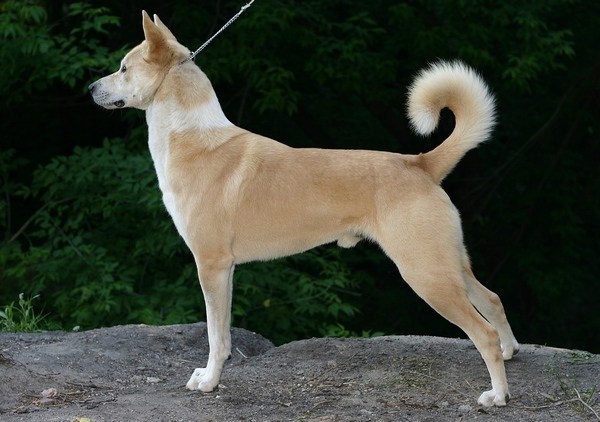
We don’t hold a licensed photograph of this breed yet.
Xoloitzcuintle (Standard)
The Standard is the largest of the Xoloitzcuintle sizes and the one closest to the dogs that Spanish chroniclers described in sixteenth-century Mexico. It stands roughly 46 to 60…
About the Xoloitzcuintle (Standard)
The Standard is the largest of the Xoloitzcuintle sizes and the one closest to the dogs that Spanish chroniclers described in sixteenth-century Mexico. It stands roughly 46 to 60 cm and was the size most often kept around a household as a guard, alert to arrivals without being noisy about them.
A dog of this size should look like a well-made, moderately built hound rather than a lightweight: good length of leg, a clean neck, a level topline and plenty of room in the chest. Skin colour ranges through black, slate, grey, liver, bronze and spotted. Coated dogs from the same litters carry a short, flat coat over the whole body and are equally correct in the breed, though some countries show them separately.
A larger frame makes joints worth attention, so hip and elbow scoring are the sensible requests here, alongside a patella assessment and an eye examination. Ask about the stud's teeth: hairless dogs are typically missing several premolars, which is normal in the variety, but a vet should still have looked at what is there. Ask too about sunburn and about how the dog is kept warm in winter, since a large hairless animal loses heat quickly.
Health & breeding
We check every hip, elbow, eye and DNA result you give us against the Royal Kennel Club’s public records by hand, and we record who checked it and when. The Royal Kennel Club’s public records may not include all the screening a dog has had, so a dog with no Royal Kennel Club record showing is not necessarily untested.
Breed Right’s summary — under The Royal Kennel Club Health Standard
Health tests for the Xoloitzcuintle (Standard)
This panel is Breed Right’s summary of the testing that matters for the breed under The Royal Kennel Club Health Standard. The Health Standard is the Royal Kennel Club’s guidance for breeders, not a registration rule. It describes tests to ask about — it is not a report on any individual dog. The Royal Kennel Club’s public records may not include all the screening a dog has had, so a dog with no Royal Kennel Club record showing is not necessarily untested.
Best Practice — further tests it recommends
Completing these as well as the Good Practice tests is what the Royal Kennel Club calls Best Practice.
| Test | Type | Scheme | What’s involved |
|---|---|---|---|
| Hip score (BVA/KC) | Screening scheme | BVA/KC | Total of both hips, 0–106. Lower is better. |
| Elbow grading (BVA/KC) | Screening scheme | BVA/KC | Grade 0–3. The dog is graded on the worse of the two elbows. |
| Eye testing (BVA/KC/ISDS) | Screening scheme | BVA/KC/ISDS | Result printed on the eye certificate. |
Breed hip median
Breed median 7 (BVA Hip Dysplasia Scheme breed statistics 2025 — 5 years, 11 dogs scored — indicative only, from a small sample). Lower is better. Source · How hip scores work
At stud now
Xoloitzcuintle (Standard) stud dogs
No Xoloitzcuintle (Standard) studs are listed right now
When a Xoloitzcuintle (Standard) on the Royal Kennel Club Breed Register is listed at stud, it will appear here.
Also available
Xoloitzcuintle (Standard) litters
No Xoloitzcuintle (Standard) litters are listed right now
Litters appear here as breeders list them. Check back soon, or browse other breeds.