Dalmatian
The Dalmatian's origins are argued over, but its job is not: for two centuries it ran beside horse-drawn carriages and fire engines as a guard and escort, and it retains both the…
About the Dalmatian
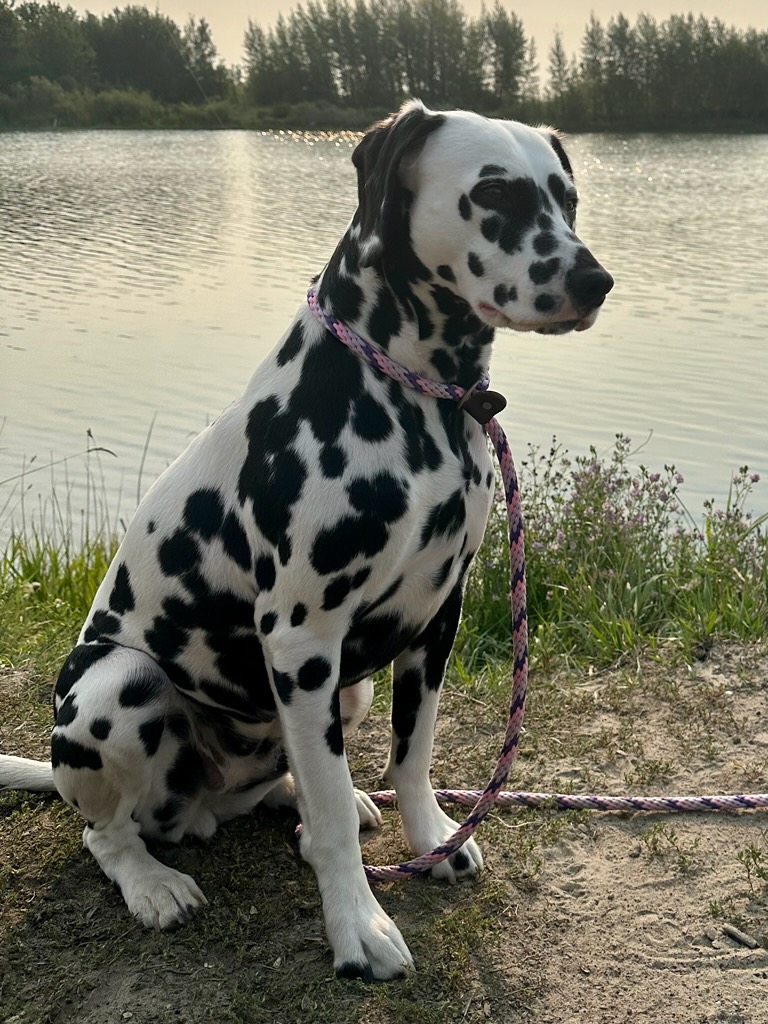
The Dalmatian's origins are argued over, but its job is not: for two centuries it ran beside horse-drawn carriages and fire engines as a guard and escort, and it retains both the stamina and the love of horses. The spotted coat is unique among dog breeds and is the reason most people first notice it.
Dogs stand about 58 to 61 cm, lean and athletic, with a short dense coat that is white with black or liver spots, the puppies being born pure white. The breed is friendly, active and needs a great deal of exercise; a stud with an easy, outgoing temperament matters because shyness has appeared in the breed and is a serious fault.
Two questions dominate Dalmatian screening. Deafness is common in the breed, and a stud should have a BAER hearing test showing hearing in both ears, not one. Hyperuricosuria, which predisposes the breed to urate bladder stones, is carried by almost all Dalmatians; a DNA test exists and a small number of lines carry the normal gene, which a stud owner will know about. Hip scoring and an eye certificate complete the picture.
Health & breeding
We check every hip, elbow, eye and DNA result you give us against the Royal Kennel Club’s public records by hand, and we record who checked it and when. The Royal Kennel Club’s public records may not include all the screening a dog has had, so a dog with no Royal Kennel Club record showing is not necessarily untested.
Breed Right’s summary — under The Royal Kennel Club Health Standard
Health tests for the Dalmatian
This panel is Breed Right’s summary of the testing that matters for the breed under The Royal Kennel Club Health Standard. The Health Standard is the Royal Kennel Club’s guidance for breeders, not a registration rule. It describes tests to ask about — it is not a report on any individual dog. The Royal Kennel Club’s public records may not include all the screening a dog has had, so a dog with no Royal Kennel Club record showing is not necessarily untested.
Best Practice — further tests it recommends
Completing these as well as the Good Practice tests is what the Royal Kennel Club calls Best Practice.
| Test | Type | Scheme | What’s involved |
|---|---|---|---|
| DNA test — DD-PRKG2 (Disproportionate Dwarfism) | DNA test | Laboratory | The result printed on the laboratory certificate. |
| DNA test — HUU (Hyperuricosuria) | DNA test | Laboratory | The result printed on the laboratory certificate. |
| Hip score (BVA/KC) | Screening scheme | BVA/KC | Total of both hips, 0–106. Lower is better. |
| Elbow grading (BVA/KC) | Screening scheme | BVA/KC | Grade 0–3. The dog is graded on the worse of the two elbows. |
| Hearing test — BAER (RKC BAER Scheme) | Screening scheme | RKC | Per ear: hearing or deaf, as certified. |
Breed hip median
Breed median 10 (BVA Hip Dysplasia Scheme breed statistics 2025 — 5 years, 203 dogs scored). Lower is better. Source · How hip scores work
At stud now
Dalmatian stud dogs
No Dalmatian studs are listed right now
When a Dalmatian on the Royal Kennel Club Breed Register is listed at stud, it will appear here.
Also available
Dalmatian litters
No Dalmatian litters are listed right now
Litters appear here as breeders list them. Check back soon, or browse other breeds.