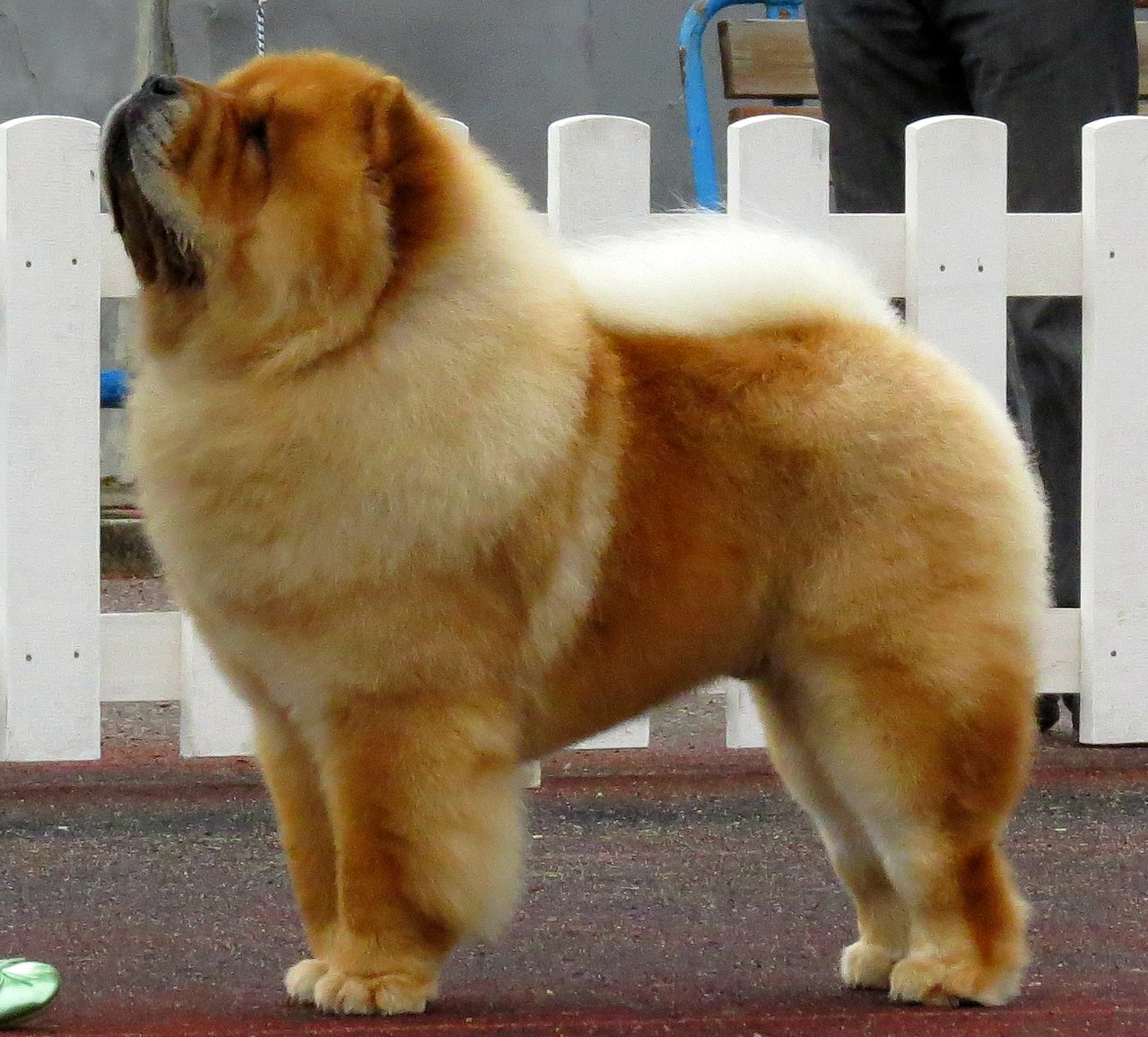
Chow Chow
The Chow Chow is one of the oldest recognisable breeds in China, where it worked as a hunting dog and a guard and was used, unsentimentally, for meat and fur, and it reached…
About the Chow Chow
The Chow Chow is one of the oldest recognisable breeds in China, where it worked as a hunting dog and a guard and was used, unsentimentally, for meat and fur, and it reached Britain with the tea clippers in the eighteenth century. Its blue-black tongue and stilted, straight-hocked hind action are found in no other breed.
There are two coat types, rough and smooth, both over a dense standing-off undercoat, in red, black, blue, fawn, cream or white, and dogs stand 48 to 56 cm. The Chow is undemonstrative and forms a strong attachment to one or two people; a stud must be handleable and tolerant of a vet's examination. Excess coat and heavy wrinkling around the eye are the faults the breed is being asked to move away from.
The eye is the first place to look. Entropion, where the lid rolls inward against the cornea, is common in these dogs and often needs surgery, so a stud whose eyes are open, dry and plainly visible is a much better prospect than one with a deep-set, half-hidden eye. Hip and elbow scoring matters in a heavy, straight-stifled animal. Ask how the dog copes with heat and exercise, and about skin and thyroid problems in the family.
Health & breeding
We check every hip, elbow, eye and DNA result you give us against the Royal Kennel Club’s public records by hand, and we record who checked it and when. The Royal Kennel Club’s public records may not include all the screening a dog has had, so a dog with no Royal Kennel Club record showing is not necessarily untested.
Breed Right’s summary — under The Royal Kennel Club Health Standard
Health tests for the Chow Chow
This panel is Breed Right’s summary of the testing that matters for the breed under The Royal Kennel Club Health Standard. The Health Standard is the Royal Kennel Club’s guidance for breeders, not a registration rule. It describes tests to ask about — it is not a report on any individual dog. The Royal Kennel Club’s public records may not include all the screening a dog has had, so a dog with no Royal Kennel Club record showing is not necessarily untested.
Good Practice — the Royal Kennel Club’s minimum before breeding
The tests the Royal Kennel Club says breeders should, at a minimum, complete before breeding.
| Test | Type | Scheme | What’s involved |
|---|---|---|---|
| Hip score (BVA/KC) | Screening scheme | BVA/KC | Total of both hips, 0–106. Lower is better. |
| Elbow grading (BVA/KC) | Screening scheme | BVA/KC | Grade 0–3. The dog is graded on the worse of the two elbows. |
| Eye testing (BVA/KC/ISDS) | Screening scheme | BVA/KC/ISDS | Result printed on the eye certificate. |
Breed club schemes listed in the Health Standard
Run by the breed club, not the Royal Kennel Club, which does not record their results. The Standard lists them as schemes to be aware of.
| Test | Type | Scheme | What’s involved |
|---|---|---|---|
| Breed club health scheme (named in the result) | Other | Breed club | Name the scheme and the outcome. |
Breed hip median
Breed median 10 (BVA Hip Dysplasia Scheme breed statistics 2025 — 5 years, 59 dogs scored). Lower is better. Source · How hip scores work
At stud now
Chow Chow stud dogs
No Chow Chow studs are listed right now
When a Chow Chow on the Royal Kennel Club Breed Register is listed at stud, it will appear here.
Also available
Chow Chow litters
No Chow Chow litters are listed right now
Litters appear here as breeders list them. Check back soon, or browse other breeds.