Shar Pei
The Shar Pei is a southern Chinese farm dog, used for herding, guarding and at times for fighting, and its name refers to the sandpaper feel of its coat rather than to its…
About the Shar Pei
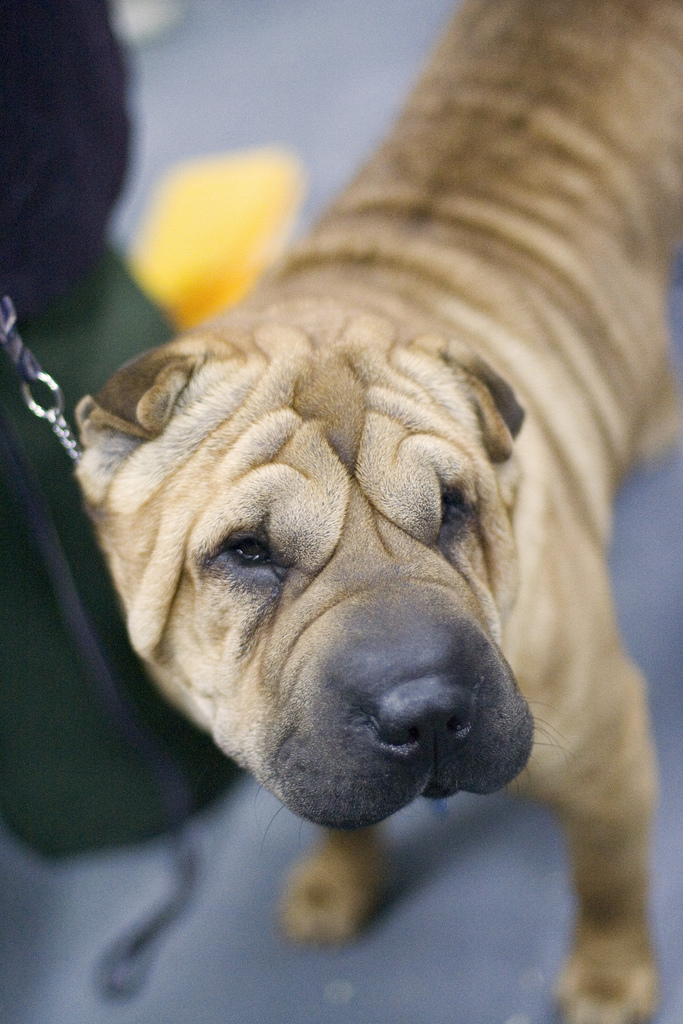
The Shar Pei is a southern Chinese farm dog, used for herding, guarding and at times for fighting, and its name refers to the sandpaper feel of its coat rather than to its wrinkles. It came close to extinction in the 1970s and was rebuilt from a very small number of dogs, which lies behind several of the problems it carries today.
Dogs stand 46 to 51 cm, squarely built, with a broad muzzle, a blue-black tongue and a harsh, straight coat that stands away from the body, in either the very short horse coat or the slightly longer brush coat. Wrinkling should be moderate in an adult and largely confined to head, neck and withers; heavy folds over the body and around the eyes are what the Royal Kennel Club's Breed Watch flags, and a stud with a clean, open face is a far better prospect.
Eyes and skin lead any enquiry. Entropion is common and many puppies need their lids tacked, so ask whether the stud needed surgery as a puppy and what its lids look like now. The breed also carries a familial fever and inflammatory syndrome that can lead to amyloid damage to the kidneys; a DNA test exists which estimates risk rather than giving a clear answer, and an owner who has used it and understands its limits is being careful. Ask about ear infections, since the canals are narrow, and about how the dog copes with heat.
Health & breeding
We check every hip, elbow, eye and DNA result you give us against the Royal Kennel Club’s public records by hand, and we record who checked it and when. The Royal Kennel Club’s public records may not include all the screening a dog has had, so a dog with no Royal Kennel Club record showing is not necessarily untested.
Breed Right’s summary — under The Royal Kennel Club Health Standard
Health tests for the Shar Pei
This panel is Breed Right’s summary of the testing that matters for the breed under The Royal Kennel Club Health Standard. The Health Standard is the Royal Kennel Club’s guidance for breeders, not a registration rule. It describes tests to ask about — it is not a report on any individual dog. The Royal Kennel Club’s public records may not include all the screening a dog has had, so a dog with no Royal Kennel Club record showing is not necessarily untested.
Good Practice — the Royal Kennel Club’s minimum before breeding
The tests the Royal Kennel Club says breeders should, at a minimum, complete before breeding.
| Test | Type | Scheme | What’s involved |
|---|---|---|---|
| Eye testing (BVA/KC/ISDS) | Screening scheme | BVA/KC/ISDS | Result printed on the eye certificate. |
Best Practice — further tests it recommends
Completing these as well as the Good Practice tests is what the Royal Kennel Club calls Best Practice.
| Test | Type | Scheme | What’s involved |
|---|---|---|---|
| DNA test — POAG/PLL (Primary Open Angle Glaucoma / Primary Lens Luxation, Shar Pei) | DNA test | Laboratory | The result printed on the laboratory certificate. |
| Hip score (BVA/KC) | Screening scheme | BVA/KC | Total of both hips, 0–106. Lower is better. |
| Elbow grading (BVA/KC) | Screening scheme | BVA/KC | Grade 0–3. The dog is graded on the worse of the two elbows. |
Breed hip median
Breed median 10 (BVA Hip Dysplasia Scheme breed statistics 2025 — 15 years, 10 dogs scored — indicative only, from a small sample). Lower is better. Source · How hip scores work
At stud now
Shar Pei stud dogs
No Shar Pei studs are listed right now
When a Shar Pei on the Royal Kennel Club Breed Register is listed at stud, it will appear here.
Also available
Shar Pei litters
No Shar Pei litters are listed right now
Litters appear here as breeders list them. Check back soon, or browse other breeds.