Tibetan Terrier
The Tibetan Terrier was never a terrier and never went to ground. It was the companion and general-purpose farm dog of the Tibetan plateau, kept by monasteries and by herdsmen…
About the Tibetan Terrier
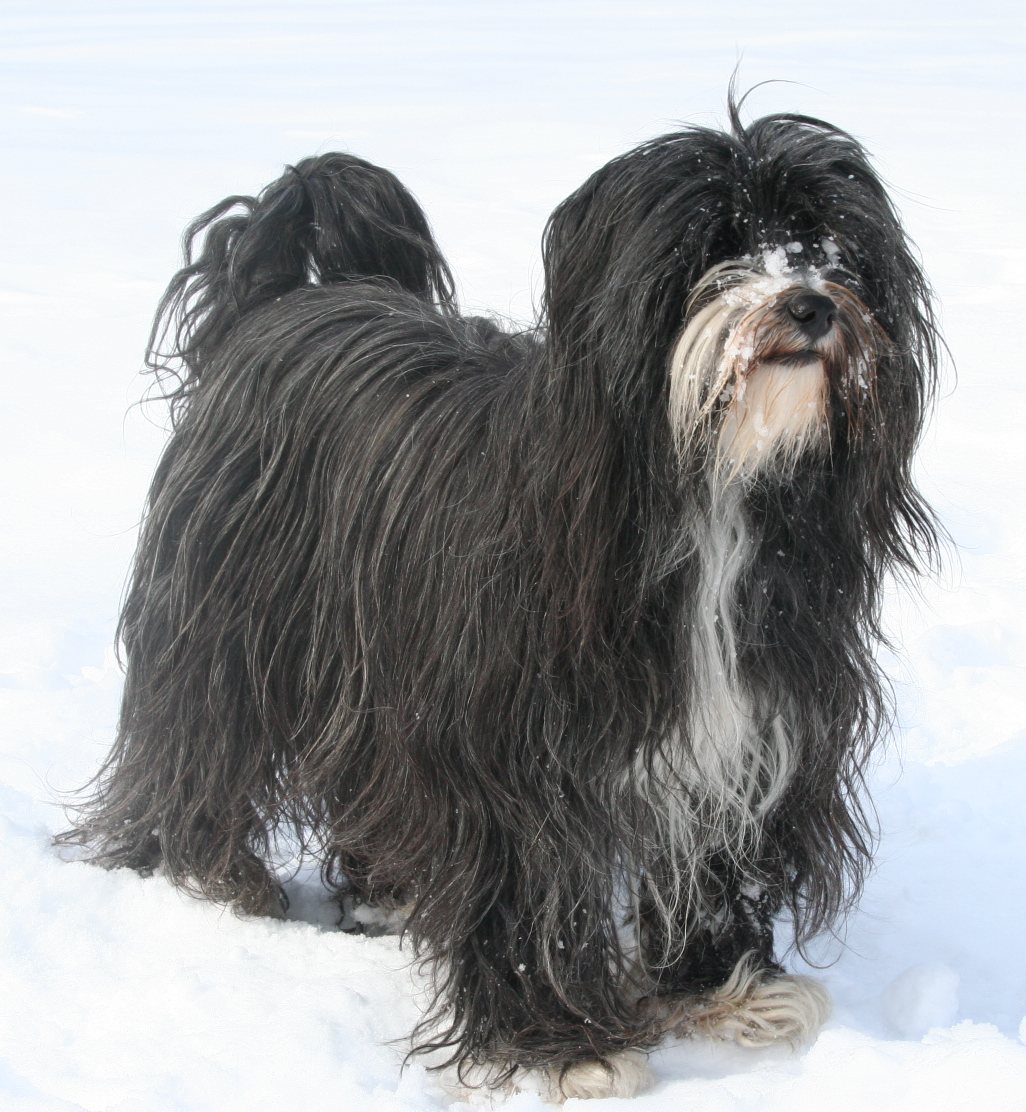
The Tibetan Terrier was never a terrier and never went to ground. It was the companion and general-purpose farm dog of the Tibetan plateau, kept by monasteries and by herdsmen, and its large, flat, well-furnished feet work like snowshoes on soft ground. European fanciers attached the terrier name on the basis of size alone.
Dogs stand 36 to 41 cm, square in outline, beneath a long, fine, profuse double coat that may be straight or wavy and comes in almost any colour or combination. The coat falls over the eyes as it does in the breed's homeland and does not obstruct the dog. A stud should be square, sound and heavy in bone for its size, and the feet should be genuinely large and flat rather than neat and cat-like.
This breed carries a well-populated DNA panel and an owner should be able to produce several results: primary lens luxation, neuronal ceroid lipofuscinosis, and the retinal tests used here for progressive retinal atrophy. Hip scoring and an annual eye examination sit alongside them. Ask about the dog's hearing as it ages and about hip soundness in the wider family, and ask what the breed club currently recommends, as the panel has grown over time.
Health & breeding
We check every hip, elbow, eye and DNA result you give us against the Royal Kennel Club’s public records by hand, and we record who checked it and when. The Royal Kennel Club’s public records may not include all the screening a dog has had, so a dog with no Royal Kennel Club record showing is not necessarily untested.
Breed Right’s summary — under The Royal Kennel Club Health Standard
Health tests for the Tibetan Terrier
This panel is Breed Right’s summary of the testing that matters for the breed under The Royal Kennel Club Health Standard. The Health Standard is the Royal Kennel Club’s guidance for breeders, not a registration rule. It describes tests to ask about — it is not a report on any individual dog. The Royal Kennel Club’s public records may not include all the screening a dog has had, so a dog with no Royal Kennel Club record showing is not necessarily untested.
Good Practice — the Royal Kennel Club’s minimum before breeding
The tests the Royal Kennel Club says breeders should, at a minimum, complete before breeding.
| Test | Type | Scheme | What’s involved |
|---|---|---|---|
| DNA test — DP-LHX3 (Pituitary Dwarfism) | DNA test | Laboratory | The result printed on the laboratory certificate. |
| DNA test — NCL12 (Neuronal Ceroid Lipofuscinosis 12) | DNA test | Laboratory | The result printed on the laboratory certificate. |
| DNA test — PLL (Primary Lens Luxation) | DNA test | Laboratory | The result printed on the laboratory certificate. |
| DNA test — rcd4-PRA (Progressive Retinal Atrophy, rod-cone dysplasia 4) | DNA test | Laboratory | The result printed on the laboratory certificate. |
| Hip score (BVA/KC) | Screening scheme | BVA/KC | Total of both hips, 0–106. Lower is better. |
Best Practice — further tests it recommends
Completing these as well as the Good Practice tests is what the Royal Kennel Club calls Best Practice.
| Test | Type | Scheme | What’s involved |
|---|---|---|---|
| DNA test — PRA3 (Progressive Retinal Atrophy 3) | DNA test | Laboratory | The result printed on the laboratory certificate. |
| Eye testing (BVA/KC/ISDS) | Screening scheme | BVA/KC/ISDS | Result printed on the eye certificate. |
Breed hip median
Breed median 10 (BVA Hip Dysplasia Scheme breed statistics 2025 — 5 years, 398 dogs scored). Lower is better. Source · How hip scores work
At stud now
Tibetan Terrier stud dogs
No Tibetan Terrier studs are listed right now
When a Tibetan Terrier on the Royal Kennel Club Breed Register is listed at stud, it will appear here.
Also available
Tibetan Terrier litters
No Tibetan Terrier litters are listed right now
Litters appear here as breeders list them. Check back soon, or browse other breeds.