Schipperke
The Schipperke was the guard and ratter of the Flemish barges and workshops, a little black dog with a foxy head and an enormous ruff, and its name is usually read as little…
About the Schipperke
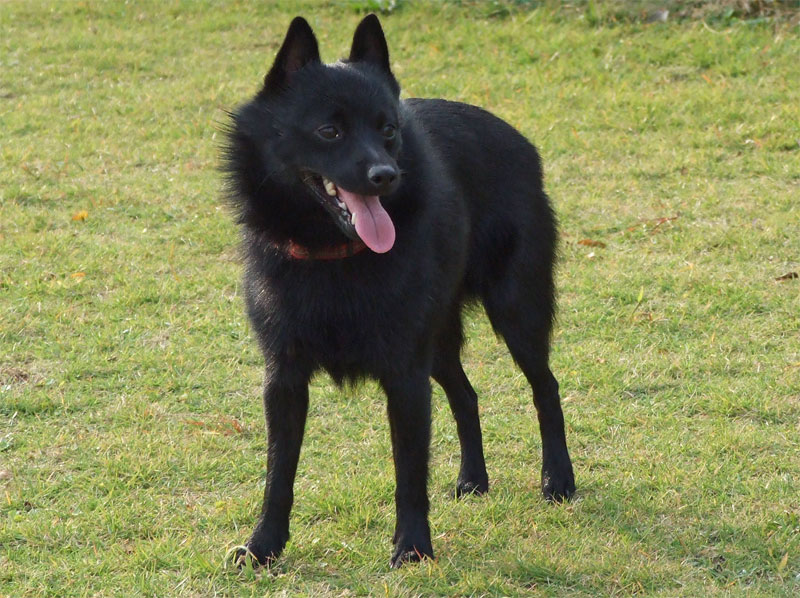
The Schipperke was the guard and ratter of the Flemish barges and workshops, a little black dog with a foxy head and an enormous ruff, and its name is usually read as little skipper, though some accounts prefer little shepherd. It was among the first breeds anywhere to have an organised club of its own in Belgium.
Dogs stand about 26 to 33 cm and weigh 3 to 9 kg depending on the line, always solid black, with a harsh, abundant coat that stands off in a distinct ruff, cape and culottes. The tail may be naturally short or of normal length. This is an intensely curious breed, quick to bark and often very long-lived, and a stud should be bold and inquisitive rather than timid, and hard-conditioned rather than fat.
The DNA test for mucopolysaccharidosis type IIIB is specific to this breed and no Schipperke should be used at stud without a result, since affected dogs decline neurologically in early adulthood. A patella assessment and an eye examination are the routine additions, and Legg-Calve-Perthes disease is worth asking about. Thyroid function and any history of seizures in the family are fair questions, as is the age and cause of death of the grandparents.
Health & breeding
We check every hip, elbow, eye and DNA result you give us against the Royal Kennel Club’s public records by hand, and we record who checked it and when. The Royal Kennel Club’s public records may not include all the screening a dog has had, so a dog with no Royal Kennel Club record showing is not necessarily untested.
Breed Right’s summary — under The Royal Kennel Club Health Standard
Health tests for the Schipperke
This panel is Breed Right’s summary of the testing that matters for the breed under The Royal Kennel Club Health Standard. The Health Standard is the Royal Kennel Club’s guidance for breeders, not a registration rule. It describes tests to ask about — it is not a report on any individual dog. The Royal Kennel Club’s public records may not include all the screening a dog has had, so a dog with no Royal Kennel Club record showing is not necessarily untested.
Best Practice — further tests it recommends
Completing these as well as the Good Practice tests is what the Royal Kennel Club calls Best Practice.
| Test | Type | Scheme | What’s involved |
|---|---|---|---|
| DNA test — MPS IIIB (Mucopolysaccharidosis IIIB) | DNA test | Laboratory | The result printed on the laboratory certificate. |
| DNA test — T-box (natural bobtail) | DNA test | Laboratory | Bobtail carrier status — not a disease test. |
At stud now
Schipperke stud dogs
No Schipperke studs are listed right now
When a Schipperke on the Royal Kennel Club Breed Register is listed at stud, it will appear here.
Also available
Schipperke litters
No Schipperke litters are listed right now
Litters appear here as breeders list them. Check back soon, or browse other breeds.