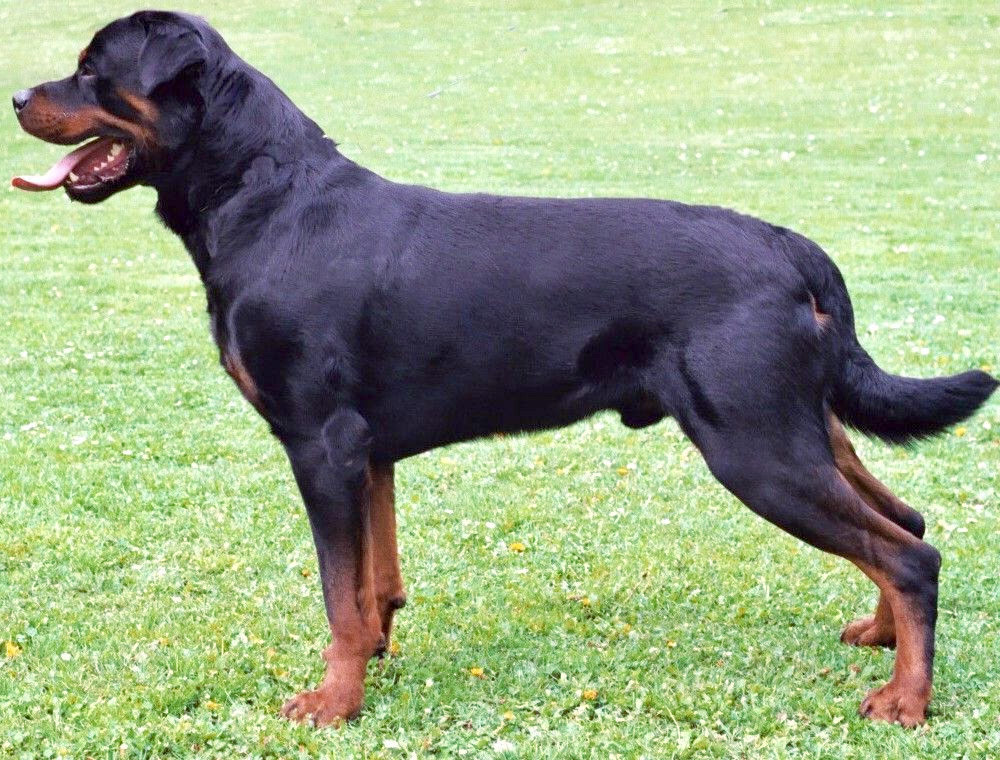
Rottweiler
The Rottweiler takes its name from the German town of Rottweil, where it drove cattle to market and guarded the butcher's takings on the way home, a tail of coin purse tied round…
About the Rottweiler
The Rottweiler takes its name from the German town of Rottweil, where it drove cattle to market and guarded the butcher's takings on the way home, a tail of coin purse tied round its neck. It is one of the oldest working breeds and was among the first used in police service.
Dogs stand about 63 to 69 cm, powerfully built and black with clearly defined tan markings. The standard asks for a dog that is good-natured, self-assured and fearless, and that is the whole argument for choosing a stud on temperament above anything else in this breed: a Rottweiler's size means a poor temperament is not a small problem. Look for a dog that is calm and unbothered in a busy place.
Ask a Rottweiler stud owner for hip and elbow scores under the BVA/KC schemes, and for a cardiac examination, since subaortic stenosis occurs in the breed. A current eye certificate is worth having, and a DNA result for juvenile laryngeal paralysis and polyneuropathy, which has an established test. Bloat and osteosarcoma both appear in the breed and deserve a question about the line.
Health & breeding
We check every hip, elbow, eye and DNA result you give us against the Royal Kennel Club’s public records by hand, and we record who checked it and when. The Royal Kennel Club’s public records may not include all the screening a dog has had, so a dog with no Royal Kennel Club record showing is not necessarily untested.
Breed Right’s summary — under The Royal Kennel Club Health Standard
Health tests for the Rottweiler
This panel is Breed Right’s summary of the testing that matters for the breed under The Royal Kennel Club Health Standard. The Health Standard is the Royal Kennel Club’s guidance for breeders, not a registration rule. It describes tests to ask about — it is not a report on any individual dog. The Royal Kennel Club’s public records may not include all the screening a dog has had, so a dog with no Royal Kennel Club record showing is not necessarily untested.
Good Practice — the Royal Kennel Club’s minimum before breeding
The tests the Royal Kennel Club says breeders should, at a minimum, complete before breeding.
| Test | Type | Scheme | What’s involved |
|---|---|---|---|
| DNA test — JLPP (Juvenile Laryngeal Paralysis and Polyneuropathy) | DNA test | Laboratory | The result printed on the laboratory certificate. |
| Hip score (BVA/KC) | Screening scheme | BVA/KC | Total of both hips, 0–106. Lower is better. |
| Elbow grading (BVA/KC) | Screening scheme | BVA/KC | Grade 0–3. The dog is graded on the worse of the two elbows. |
Best Practice — further tests it recommends
Completing these as well as the Good Practice tests is what the Royal Kennel Club calls Best Practice.
| Test | Type | Scheme | What’s involved |
|---|---|---|---|
| DNA test — LEMP-2 (Leukoencephalomyelopathy, Rottweiler) | DNA test | Laboratory | The result printed on the laboratory certificate. |
| Eye testing (BVA/KC/ISDS) | Screening scheme | BVA/KC/ISDS | Result printed on the eye certificate. |
Breed hip median
Breed median 8 (BVA Hip Dysplasia Scheme breed statistics 2025 — 5 years, 854 dogs scored). Lower is better. Source · How hip scores work
At stud now
Rottweiler stud dogs
No Rottweiler studs are listed right now
When a Rottweiler on the Royal Kennel Club Breed Register is listed at stud, it will appear here.
Also available
Rottweiler litters
No Rottweiler litters are listed right now
Litters appear here as breeders list them. Check back soon, or browse other breeds.