St Bernard
The St Bernard is named for the hospice on the Great St Bernard Pass in the Swiss Alps, where the monks kept dogs to find travellers lost in snow, and the breed's reputation for…
About the St Bernard
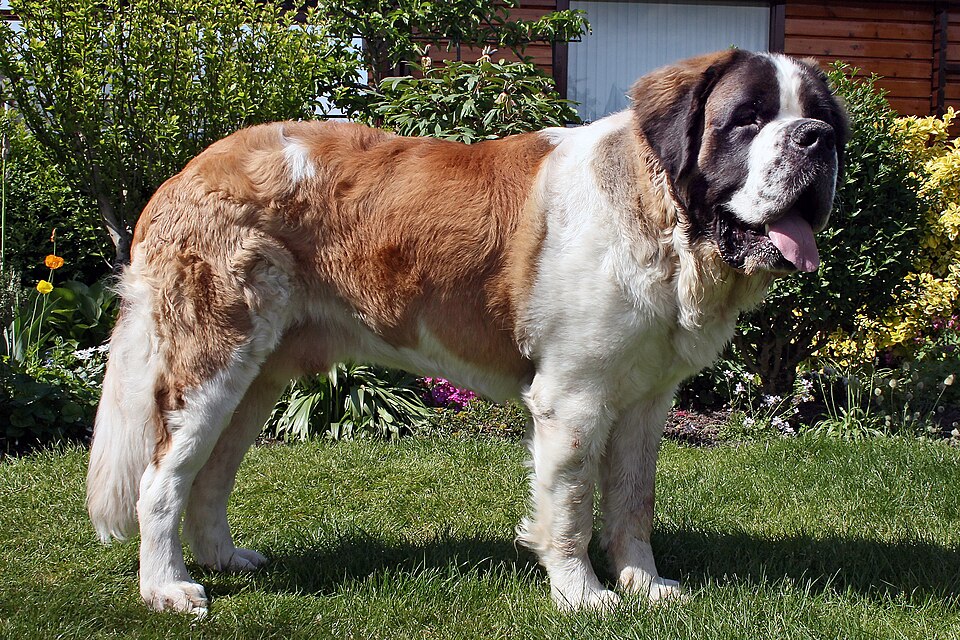
The St Bernard is named for the hospice on the Great St Bernard Pass in the Swiss Alps, where the monks kept dogs to find travellers lost in snow, and the breed's reputation for rescue is genuine even if the brandy barrel is a Victorian invention. It exists in rough-coated and smooth-coated forms, registered together.
Dogs are enormous, with no upper height limit in the standard and weights commonly over 70 kg, in white with red or brindle patches. The breed should be benevolent and steady; nervousness or sharpness in a dog this size is unacceptable, so temperament comes first in choosing a stud. Growth in puppies must be slow and controlled, and adults are prone to overheating.
Ask a St Bernard stud owner for hip and elbow scores and a current eye certificate, since entropion and ectropion occur in a breed with heavy facial skin. A cardiac examination is worth having, as dilated cardiomyopathy appears in giant breeds. Bloat, osteosarcoma and a short lifespan are the honest realities of the breed, and a stud owner who will discuss the ages and causes of death in the line is giving you the most useful information available.
Health & breeding
We check every hip, elbow, eye and DNA result you give us against the Royal Kennel Club’s public records by hand, and we record who checked it and when. The Royal Kennel Club’s public records may not include all the screening a dog has had, so a dog with no Royal Kennel Club record showing is not necessarily untested.
Breed Right’s summary — under The Royal Kennel Club Health Standard
Health tests for the St Bernard
This panel is Breed Right’s summary of the testing that matters for the breed under The Royal Kennel Club Health Standard. The Health Standard is the Royal Kennel Club’s guidance for breeders, not a registration rule. It describes tests to ask about — it is not a report on any individual dog. The Royal Kennel Club’s public records may not include all the screening a dog has had, so a dog with no Royal Kennel Club record showing is not necessarily untested.
Good Practice — the Royal Kennel Club’s minimum before breeding
The tests the Royal Kennel Club says breeders should, at a minimum, complete before breeding.
| Test | Type | Scheme | What’s involved |
|---|---|---|---|
| Hip score (BVA/KC) | Screening scheme | BVA/KC | Total of both hips, 0–106. Lower is better. |
| Elbow grading (BVA/KC) | Screening scheme | BVA/KC | Grade 0–3. The dog is graded on the worse of the two elbows. |
| Eye testing (BVA/KC/ISDS) | Screening scheme | BVA/KC/ISDS | Result printed on the eye certificate. |
Breed hip median
Breed median 14 (BVA Hip Dysplasia Scheme breed statistics 2025 — 5 years, 81 dogs scored). Lower is better. Source · How hip scores work
At stud now
St Bernard stud dogs
No St Bernard studs are listed right now
When a St Bernard on the Royal Kennel Club Breed Register is listed at stud, it will appear here.
Also available
St Bernard litters
No St Bernard litters are listed right now
Litters appear here as breeders list them. Check back soon, or browse other breeds.