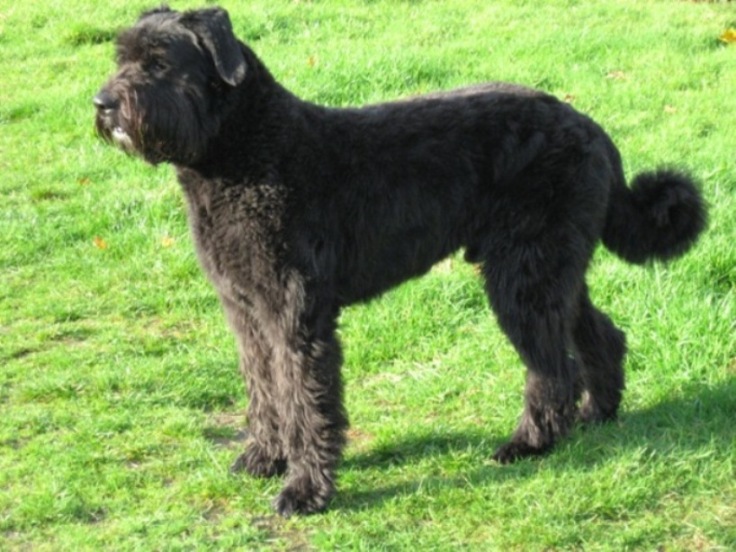
Bouvier des Flandres
The Bouvier des Flandres was the cattle drover and general farm dog of Flanders, put to churning butter and pulling carts as well as moving stock, and it went on to serve as a…
About the Bouvier des Flandres
The Bouvier des Flandres was the cattle drover and general farm dog of Flanders, put to churning butter and pulling carts as well as moving stock, and it went on to serve as a messenger and ambulance dog in the First World War, which very nearly wiped it out in its home region.
Dogs stand 62 to 68 cm and are impressively substantial, with a harsh, dry, tousled double coat in fawn through grey and brindle to black, and the beard and moustache that give the breed its stern expression. The coat needs regular stripping and sheds less than most. A Bouvier is calm, deliberate and protective; a stud should be unflappable and straightforward for a stranger to handle.
Glaucoma and goniodysgenesis are documented in the breed, so ask for an eye examination that includes gonioscopy rather than a routine check alone. Hereditary laryngeal paralysis has been reported in Bouviers and deserves a direct question, particularly if the stud has ever sounded hoarse or noisy on exertion. Ask for hip and elbow scores, about heart screening for subaortic stenosis, and about bloat in the line.
Health & breeding
We check every hip, elbow, eye and DNA result you give us against the Royal Kennel Club’s public records by hand, and we record who checked it and when. The Royal Kennel Club’s public records may not include all the screening a dog has had, so a dog with no Royal Kennel Club record showing is not necessarily untested.
Breed Right’s summary — under The Royal Kennel Club Health Standard
Health tests for the Bouvier des Flandres
This panel is Breed Right’s summary of the testing that matters for the breed under The Royal Kennel Club Health Standard. The Health Standard is the Royal Kennel Club’s guidance for breeders, not a registration rule. It describes tests to ask about — it is not a report on any individual dog. The Royal Kennel Club’s public records may not include all the screening a dog has had, so a dog with no Royal Kennel Club record showing is not necessarily untested.
Best Practice — further tests it recommends
Completing these as well as the Good Practice tests is what the Royal Kennel Club calls Best Practice.
| Test | Type | Scheme | What’s involved |
|---|---|---|---|
| Hip score (BVA/KC) | Screening scheme | BVA/KC | Total of both hips, 0–106. Lower is better. |
| Elbow grading (BVA/KC) | Screening scheme | BVA/KC | Grade 0–3. The dog is graded on the worse of the two elbows. |
| Eye testing (BVA/KC/ISDS) | Screening scheme | BVA/KC/ISDS | Result printed on the eye certificate. |
Breed hip median
Breed median 11 (BVA Hip Dysplasia Scheme breed statistics 2025 — 5 years, 8 dogs scored — indicative only, from a small sample). Lower is better. Source · How hip scores work
At stud now
Bouvier des Flandres stud dogs
No Bouvier des Flandres studs are listed right now
When a Bouvier des Flandres on the Royal Kennel Club Breed Register is listed at stud, it will appear here.
Also available
Bouvier des Flandres litters
No Bouvier des Flandres litters are listed right now
Litters appear here as breeders list them. Check back soon, or browse other breeds.