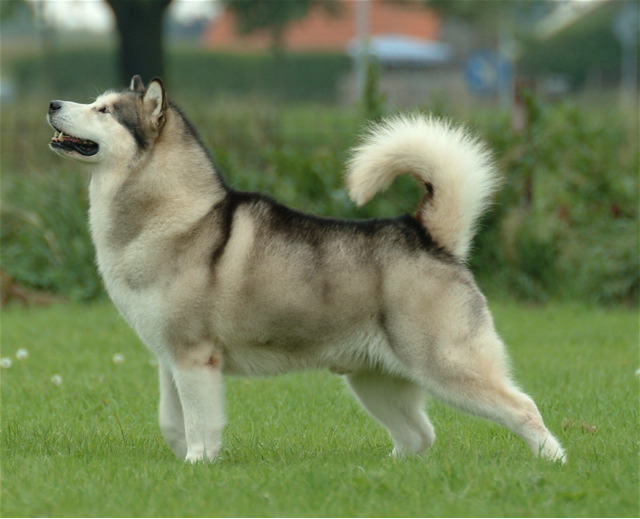
Alaskan Malamute
The Alaskan Malamute is the heavy freighting dog of the Arctic, developed by the Mahlemut people of north-western Alaska to haul substantial loads over distance rather than to…
About the Alaskan Malamute
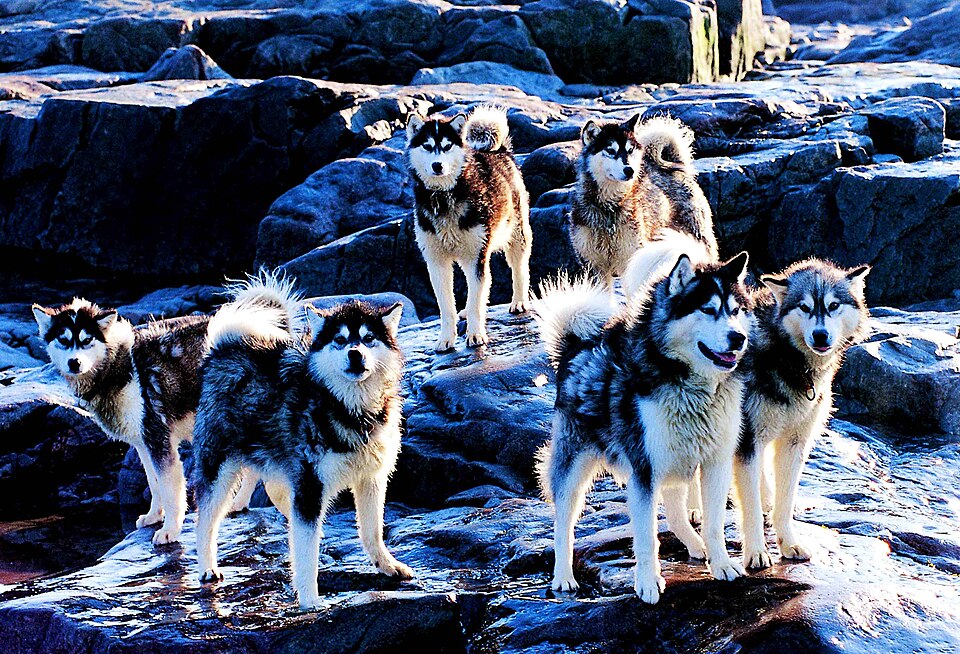
The Alaskan Malamute is the heavy freighting dog of the Arctic, developed by the Mahlemut people of north-western Alaska to haul substantial loads over distance rather than to race, and it is built accordingly: bigger, slower and far stronger than a racing sled dog.
Dogs stand about 64 cm and weigh 38 kg or more, with a thick coarse double coat in grey, sable, red or black over a white underbody and face markings; solid white is the only permitted single colour. Malamutes are affable with people, often difficult with other dogs of the same sex, and dig and howl for their own entertainment. A stud should be sound, hard-muscled and good-tempered in company.
Two DNA tests are specific to this breed and a stud owner should have both: Alaskan Malamute polyneuropathy, and cone degeneration, which is sometimes called day blindness. Ask for hip scores under the BVA/KC scheme and a current eye certificate covering hereditary cataract. Chondrodysplasia, the breed's inherited dwarfism, is worth raising, as is hypothyroidism, and so is how the dog manages a warm British summer.
Health & breeding
We check every hip, elbow, eye and DNA result you give us against the Royal Kennel Club’s public records by hand, and we record who checked it and when. The Royal Kennel Club’s public records may not include all the screening a dog has had, so a dog with no Royal Kennel Club record showing is not necessarily untested.
Breed Right’s summary — under The Royal Kennel Club Health Standard
Health tests for the Alaskan Malamute
This panel is Breed Right’s summary of the testing that matters for the breed under The Royal Kennel Club Health Standard. The Health Standard is the Royal Kennel Club’s guidance for breeders, not a registration rule. It describes tests to ask about — it is not a report on any individual dog. The Royal Kennel Club’s public records may not include all the screening a dog has had, so a dog with no Royal Kennel Club record showing is not necessarily untested.
Good Practice — the Royal Kennel Club’s minimum before breeding
The tests the Royal Kennel Club says breeders should, at a minimum, complete before breeding.
| Test | Type | Scheme | What’s involved |
|---|---|---|---|
| DNA test — AMPN (Alaskan Malamute Polyneuropathy) | DNA test | Laboratory | The result printed on the laboratory certificate. |
Best Practice — further tests it recommends
Completing these as well as the Good Practice tests is what the Royal Kennel Club calls Best Practice.
| Test | Type | Scheme | What’s involved |
|---|---|---|---|
| DNA test — CD (Cone Degeneration) | DNA test | Laboratory | The result printed on the laboratory certificate. |
| Hip score (BVA/KC) | Screening scheme | BVA/KC | Total of both hips, 0–106. Lower is better. |
| Elbow grading (BVA/KC) | Screening scheme | BVA/KC | Grade 0–3. The dog is graded on the worse of the two elbows. |
| Eye testing (BVA/KC/ISDS) | Screening scheme | BVA/KC/ISDS | Result printed on the eye certificate. |
Breed hip median
Breed median 9 (BVA Hip Dysplasia Scheme breed statistics 2025 — 5 years, 108 dogs scored). Lower is better. Source · How hip scores work
At stud now
Alaskan Malamute stud dogs
No Alaskan Malamute studs are listed right now
When an Alaskan Malamute on the Royal Kennel Club Breed Register is listed at stud, it will appear here.
Also available
Alaskan Malamute litters
No Alaskan Malamute litters are listed right now
Litters appear here as breeders list them. Check back soon, or browse other breeds.