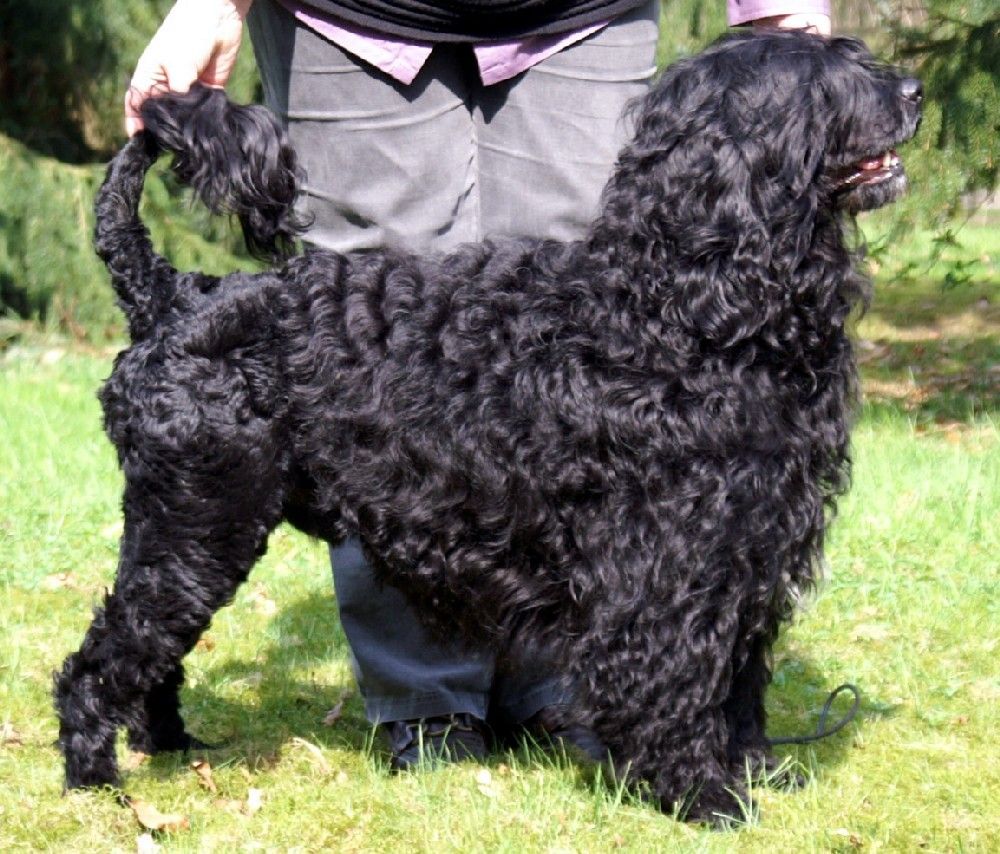
Portuguese Water Dog
The Portuguese Water Dog worked the Algarve fishing boats, driving fish towards the nets, retrieving gear that went overboard and carrying messages between vessels, and it swims…
About the Portuguese Water Dog
The Portuguese Water Dog worked the Algarve fishing boats, driving fish towards the nets, retrieving gear that went overboard and carrying messages between vessels, and it swims with a webbed foot under a coat that stays wet without chilling. Fewer than a hundred were left by the 1960s before Portuguese and American breeders rebuilt the breed.
Dogs stand 50 to 57 cm, in a curly coat or a longer wavy one, in black, brown or white, with or without white markings; the traditional lion clip has a working origin, keeping the shoulders warm while freeing the hindquarters to swim. The coat sheds little but grows continuously and needs clipping. A stud should be athletic, keen on water and level-headed, since the breed is intense and turns mouthy without work.
This breed has an unusually specific DNA panel and a serious stud owner will have used it: GM1 storage disease, juvenile dilated cardiomyopathy, prcd progressive retinal atrophy, and the improper coat marker. Hip scores and a current eye certificate should accompany that panel. Addison's disease occurs in the breed and cannot be tested for, so ask whether it has appeared in the pedigree, and ask what age relatives reached.
Health & breeding
We check every hip, elbow, eye and DNA result you give us against the Royal Kennel Club’s public records by hand, and we record who checked it and when. The Royal Kennel Club’s public records may not include all the screening a dog has had, so a dog with no Royal Kennel Club record showing is not necessarily untested.
Breed Right’s summary — under The Royal Kennel Club Health Standard
Health tests for the Portuguese Water Dog
This panel is Breed Right’s summary of the testing that matters for the breed under The Royal Kennel Club Health Standard. The Health Standard is the Royal Kennel Club’s guidance for breeders, not a registration rule. It describes tests to ask about — it is not a report on any individual dog. The Royal Kennel Club’s public records may not include all the screening a dog has had, so a dog with no Royal Kennel Club record showing is not necessarily untested.
Good Practice — the Royal Kennel Club’s minimum before breeding
The tests the Royal Kennel Club says breeders should, at a minimum, complete before breeding.
| Test | Type | Scheme | What’s involved |
|---|---|---|---|
| DNA test — prcd-PRA (Progressive Retinal Atrophy) | DNA test | Laboratory | The result printed on the laboratory certificate. |
Best Practice — further tests it recommends
Completing these as well as the Good Practice tests is what the Royal Kennel Club calls Best Practice.
| Test | Type | Scheme | What’s involved |
|---|---|---|---|
| DNA test — EOPRA (Early-Onset Progressive Retinal Atrophy) | DNA test | Laboratory | The result printed on the laboratory certificate. |
| DNA test — GM1 (GM1 Gangliosidosis) | DNA test | Laboratory | The result printed on the laboratory certificate. |
| Hip score (BVA/KC) | Screening scheme | BVA/KC | Total of both hips, 0–106. Lower is better. |
| Elbow grading (BVA/KC) | Screening scheme | BVA/KC | Grade 0–3. The dog is graded on the worse of the two elbows. |
Breed hip median
Breed median 10 (BVA Hip Dysplasia Scheme breed statistics 2025 — 5 years, 77 dogs scored). Lower is better. Source · How hip scores work
At stud now
Portuguese Water Dog stud dogs
No Portuguese Water Dog studs are listed right now
When a Portuguese Water Dog on the Royal Kennel Club Breed Register is listed at stud, it will appear here.
Also available
Portuguese Water Dog litters
No Portuguese Water Dog litters are listed right now
Litters appear here as breeders list them. Check back soon, or browse other breeds.