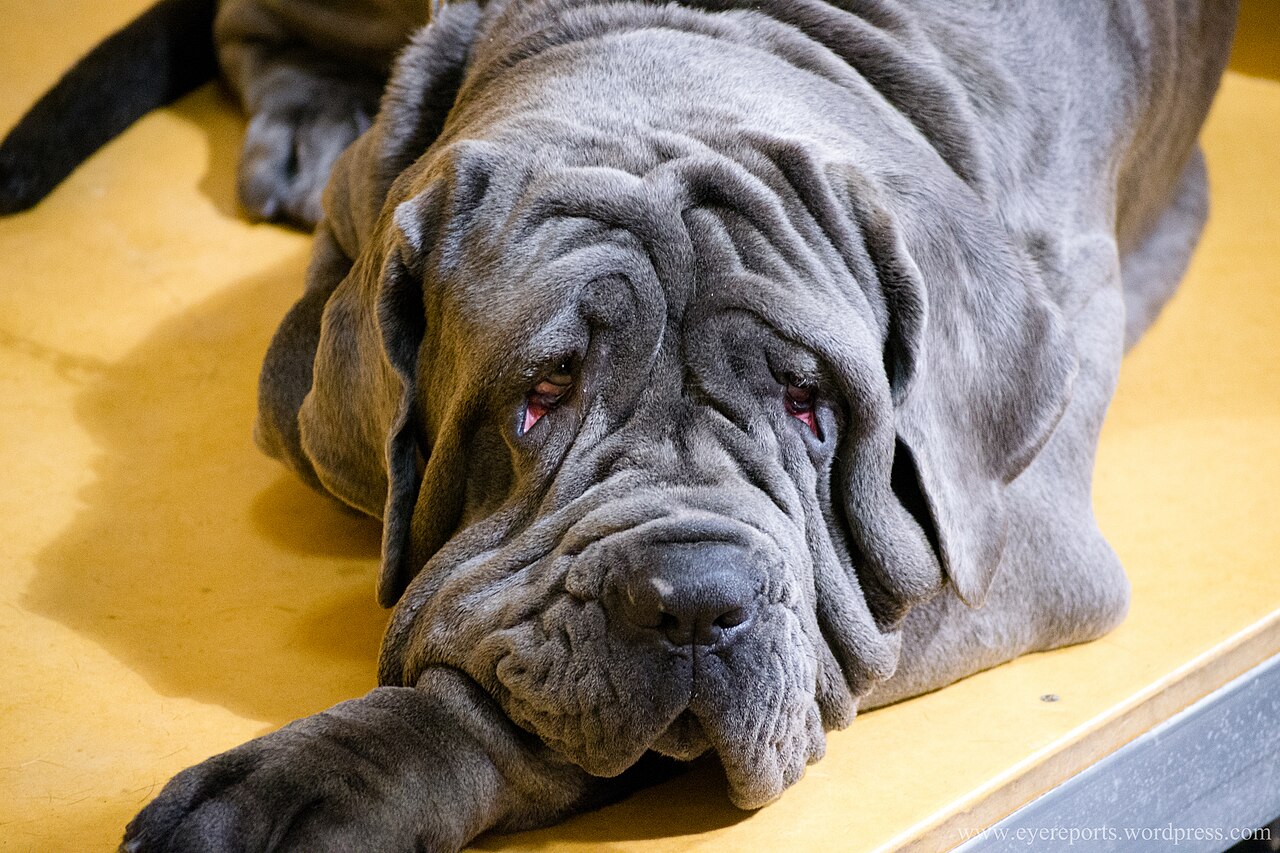
Neapolitan Mastiff
The Neapolitan Mastiff is the guarding mastiff of southern Italy, rebuilt after the Second World War around Naples from surviving farm and yard dogs, and it is defined in the…
About the Neapolitan Mastiff
The Neapolitan Mastiff is the guarding mastiff of southern Italy, rebuilt after the Second World War around Naples from surviving farm and yard dogs, and it is defined in the standard by loose skin, heavy wrinkle and a rolling, bear-like gait. It guards by presence and is not a demonstrative breed.
Dogs stand 65 to 75 cm and weigh 60 to 70 kg, in grey, blue, black or mahogany, sometimes brindled. The exaggerations are the health story here: Breed Watch draws attention to excessive skin folds, heavy haw and eyelid problems, and a stud should be chosen for a clean eye, a muzzle that lets it breathe properly, and skin that is not weeping or infected in the folds.
Ask for hip and elbow scores and for a veterinary eye examination, since entropion, ectropion and prolapsed nictitans gland all follow a loose eyelid. Ask how the stud copes in warm weather and after exercise, which is the practical test of its breathing. Bloat is a risk, and the breed is not long-lived, so ask what age relatives reached. A stud with less exaggeration than the ring tends to reward is the better choice for producing sound puppies.
Health & breeding
We check every hip, elbow, eye and DNA result you give us against the Royal Kennel Club’s public records by hand, and we record who checked it and when. The Royal Kennel Club’s public records may not include all the screening a dog has had, so a dog with no Royal Kennel Club record showing is not necessarily untested.
Breed Right’s summary — under The Royal Kennel Club Health Standard
Health tests for the Neapolitan Mastiff
This panel is Breed Right’s summary of the testing that matters for the breed under The Royal Kennel Club Health Standard. The Health Standard is the Royal Kennel Club’s guidance for breeders, not a registration rule. It describes tests to ask about — it is not a report on any individual dog. The Royal Kennel Club’s public records may not include all the screening a dog has had, so a dog with no Royal Kennel Club record showing is not necessarily untested.
Good Practice — the Royal Kennel Club’s minimum before breeding
The tests the Royal Kennel Club says breeders should, at a minimum, complete before breeding.
| Test | Type | Scheme | What’s involved |
|---|---|---|---|
| Hip score (BVA/KC) | Screening scheme | BVA/KC | Total of both hips, 0–106. Lower is better. |
| Elbow grading (BVA/KC) | Screening scheme | BVA/KC | Grade 0–3. The dog is graded on the worse of the two elbows. |
Best Practice — further tests it recommends
Completing these as well as the Good Practice tests is what the Royal Kennel Club calls Best Practice.
| Test | Type | Scheme | What’s involved |
|---|---|---|---|
| Eye testing (BVA/KC/ISDS) | Screening scheme | BVA/KC/ISDS | Result printed on the eye certificate. |
Breed hip median
Breed median 5 (BVA Hip Dysplasia Scheme breed statistics 2025 — 5 years, 12 dogs scored — indicative only, from a small sample). Lower is better. Source · How hip scores work
At stud now
Neapolitan Mastiff stud dogs
No Neapolitan Mastiff studs are listed right now
When a Neapolitan Mastiff on the Royal Kennel Club Breed Register is listed at stud, it will appear here.
Also available
Neapolitan Mastiff litters
No Neapolitan Mastiff litters are listed right now
Litters appear here as breeders list them. Check back soon, or browse other breeds.