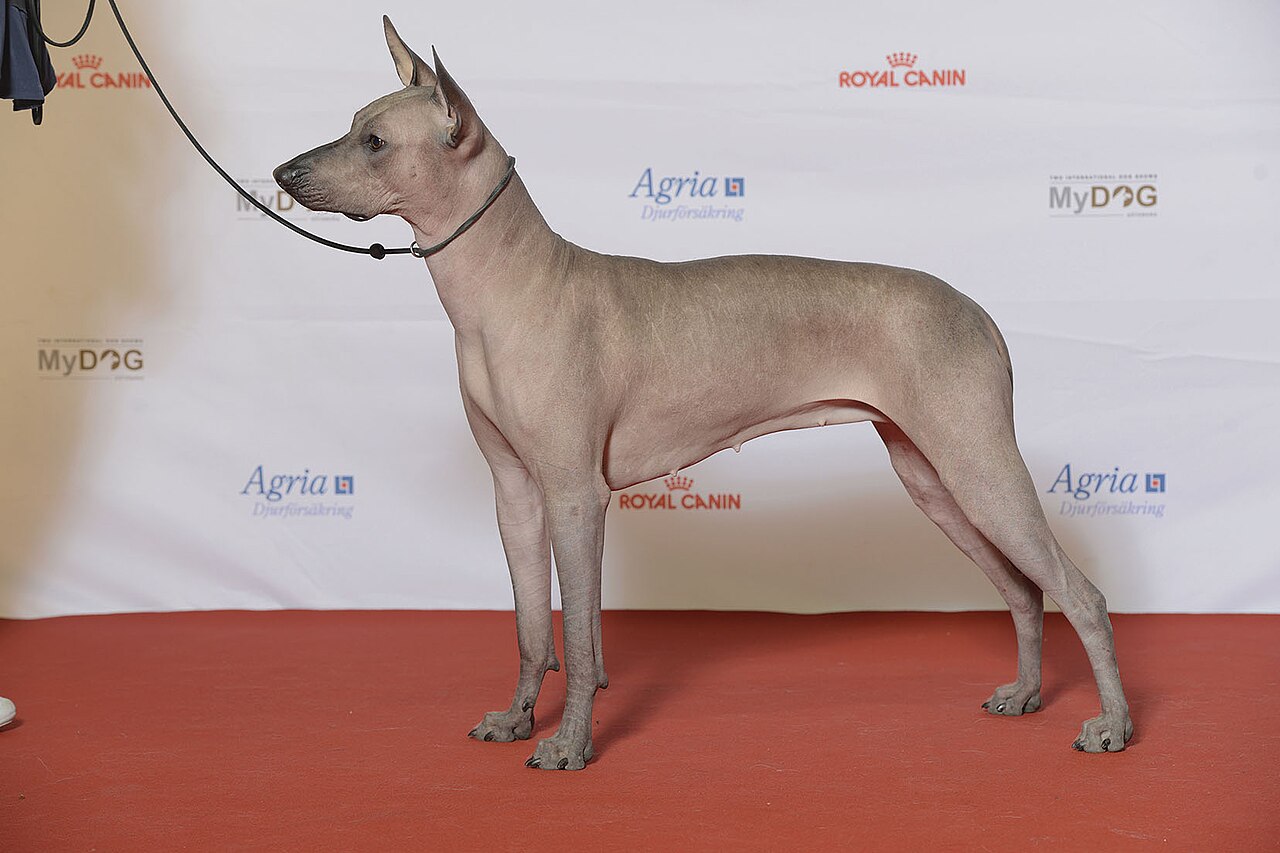
Mexican Hairless
The Mexican Hairless is the name under which British registration has long listed the hairless dog of Mexico, known in its homeland by the Nahuatl name Xoloitzcuintle…
About the Mexican Hairless
The Mexican Hairless is the name under which British registration has long listed the hairless dog of Mexico, known in its homeland by the Nahuatl name Xoloitzcuintle. Archaeological finds place the type in Mesoamerica for well over two thousand years, where it was kept as a companion, as a bed-warmer against pain, and in Aztec belief as a guide to the underworld.
The breed comes in three sizes and in two coat varieties, hairless and coated, and coated puppies appear naturally in the same litters. Skin on a hairless dog is smooth, warm and tough, in dark slate, black, grey, red or bronze, and a patch of coarse hair on the head and at the tail tip is normal. Hairless dogs typically have incomplete dentition, which the standard accepts because one gene governs both coat and teeth, and it is not something to breed against.
Skin care replaces coat care here: ask what the stud's skin is like in summer, whether it burns, and whether it suffers with blackheads or acne, which are the usual complaints. A patella assessment, hip scoring and an eye examination are the sensible scheme requests. Ask how the owner plans matings, because the gene responsible for hairlessness is not viable in a double dose, and thoughtful breeders manage that rather than ignore it.
Health & breeding
We check every hip, elbow, eye and DNA result you give us against the Royal Kennel Club’s public records by hand, and we record who checked it and when. The Royal Kennel Club’s public records may not include all the screening a dog has had, so a dog with no Royal Kennel Club record showing is not necessarily untested.
Breed Right’s summary — under The Royal Kennel Club Health Standard
Health tests for the Mexican Hairless
This panel is Breed Right’s summary of the testing that matters for the breed under The Royal Kennel Club Health Standard. The Health Standard is the Royal Kennel Club’s guidance for breeders, not a registration rule. It describes tests to ask about — it is not a report on any individual dog. The Royal Kennel Club’s public records may not include all the screening a dog has had, so a dog with no Royal Kennel Club record showing is not necessarily untested.
Best Practice — further tests it recommends
Completing these as well as the Good Practice tests is what the Royal Kennel Club calls Best Practice.
| Test | Type | Scheme | What’s involved |
|---|---|---|---|
| Hip score (BVA/KC) | Screening scheme | BVA/KC | Total of both hips, 0–106. Lower is better. |
| Elbow grading (BVA/KC) | Screening scheme | BVA/KC | Grade 0–3. The dog is graded on the worse of the two elbows. |
| Eye testing (BVA/KC/ISDS) | Screening scheme | BVA/KC/ISDS | Result printed on the eye certificate. |
At stud now
Mexican Hairless stud dogs
No Mexican Hairless studs are listed right now
When a Mexican Hairless on the Royal Kennel Club Breed Register is listed at stud, it will appear here.
Also available
Mexican Hairless litters
No Mexican Hairless litters are listed right now
Litters appear here as breeders list them. Check back soon, or browse other breeds.