Hovawart
The Hovawart takes its name from the medieval German Hofwart, the guard of the yard, and the modern breed was reconstructed in the 1920s from farm dogs found in the Black Forest…
About the Hovawart
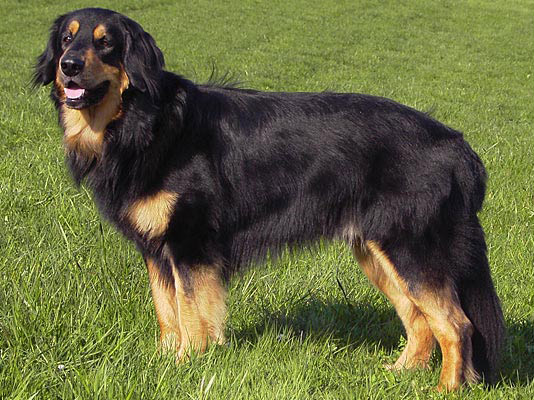
The Hovawart takes its name from the medieval German Hofwart, the guard of the yard, and the modern breed was reconstructed in the 1920s from farm dogs found in the Black Forest and the Harz mountains rather than descending unbroken from the old type. It works today as a guard and search dog with a reputation for level judgement.
Dogs stand 63 to 70 cm, with a long, slightly wavy coat in one of three colours: black, blond, and black and gold. The breed matures slowly, often taking three years to finish, and is watchful without being trigger-happy. A stud should show the breed's characteristic discrimination, greeting a visitor calmly and taking its cue from its handler, because a Hovawart that reacts first is not what the breed is for.
Ask for hip and elbow scores under the BVA/KC schemes and for a current eye certificate. Ask which DNA tests the breed club currently recommends, since the panels offered for the breed have changed. Hypothyroidism is worth a question, as is bloat in a deep-chested dog of this size. Ask how the stud's existing puppies have turned out, because a guarding breed lives or dies on the temperament it passes on.
Health & breeding
We check every hip, elbow, eye and DNA result you give us against the Royal Kennel Club’s public records by hand, and we record who checked it and when. The Royal Kennel Club’s public records may not include all the screening a dog has had, so a dog with no Royal Kennel Club record showing is not necessarily untested.
Breed Right’s summary — under The Royal Kennel Club Health Standard
Health tests for the Hovawart
This panel is Breed Right’s summary of the testing that matters for the breed under The Royal Kennel Club Health Standard. The Health Standard is the Royal Kennel Club’s guidance for breeders, not a registration rule. It describes tests to ask about — it is not a report on any individual dog. The Royal Kennel Club’s public records may not include all the screening a dog has had, so a dog with no Royal Kennel Club record showing is not necessarily untested.
Best Practice — further tests it recommends
Completing these as well as the Good Practice tests is what the Royal Kennel Club calls Best Practice.
| Test | Type | Scheme | What’s involved |
|---|---|---|---|
| Hip score (BVA/KC) | Screening scheme | BVA/KC | Total of both hips, 0–106. Lower is better. |
Breed club schemes listed in the Health Standard
Run by the breed club, not the Royal Kennel Club, which does not record their results. The Standard lists them as schemes to be aware of.
| Test | Type | Scheme | What’s involved |
|---|---|---|---|
| Thyroid testing (breed club scheme) | Other | Breed club | Panel result within the club’s time limit. |
Breed hip median
Breed median 7 (BVA Hip Dysplasia Scheme breed statistics 2025 — 5 years, 40 dogs scored — indicative only, from a small sample). Lower is better. Source · How hip scores work
At stud now
Hovawart stud dogs
No Hovawart studs are listed right now
When a Hovawart on the Royal Kennel Club Breed Register is listed at stud, it will appear here.
Also available
Hovawart litters
No Hovawart litters are listed right now
Litters appear here as breeders list them. Check back soon, or browse other breeds.