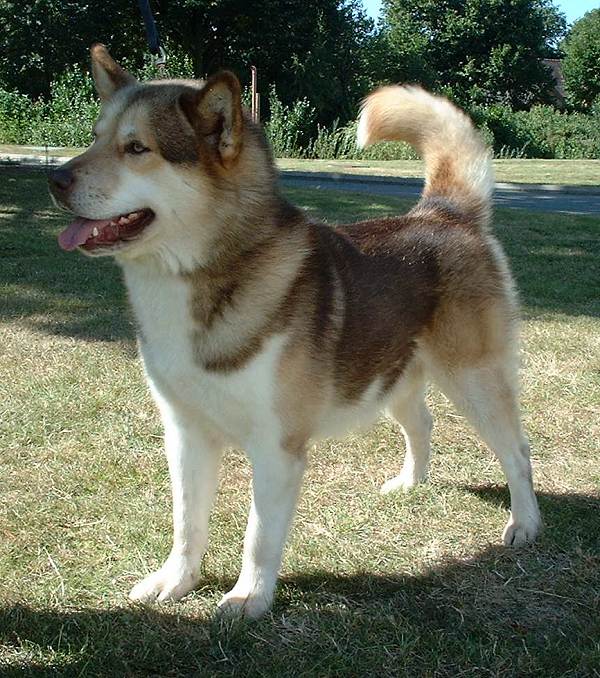
Greenland Dog
The Greenland Dog is one of the oldest sledge breeds, carried into the Arctic by the Thule people and used for hunting and hauling in Greenland ever since; it pulled for Nansen…
About the Greenland Dog
The Greenland Dog is one of the oldest sledge breeds, carried into the Arctic by the Thule people and used for hunting and hauling in Greenland ever since; it pulled for Nansen, Amundsen and Scott, and it remains in working use north of the Arctic Circle. Greenland enforces strict rules to keep its northern population unmixed.
Dogs stand from about 60 cm, heavily boned and thickly coated, in any colour except albino, with a short dense undercoat beneath a coarse outer coat and a bushy tail carried over the back. The breed lives naturally in a team, works out its own hierarchy and needs experienced handling with serious containment. A stud should be fit, hard-muscled and sound in the feet, which take the punishment.
There is little breed-specific DNA testing to ask for here, so the questions are practical ones: hip scores under the BVA/KC scheme, a current eye certificate, and honest answers about joints and feet in the line. Because the British population is small and closely related, ask what the coefficient of inbreeding for the mating would be. Ask about the ages relatives reached and about how the stud behaves among other dogs.
Health & breeding
We check every hip, elbow, eye and DNA result you give us against the Royal Kennel Club’s public records by hand, and we record who checked it and when. The Royal Kennel Club’s public records may not include all the screening a dog has had, so a dog with no Royal Kennel Club record showing is not necessarily untested.
Breed Right’s summary — under The Royal Kennel Club Health Standard
Health tests for the Greenland Dog
This panel is Breed Right’s summary of the testing that matters for the breed under The Royal Kennel Club Health Standard. The Health Standard is the Royal Kennel Club’s guidance for breeders, not a registration rule. It describes tests to ask about — it is not a report on any individual dog. The Royal Kennel Club’s public records may not include all the screening a dog has had, so a dog with no Royal Kennel Club record showing is not necessarily untested.
Best Practice — further tests it recommends
Completing these as well as the Good Practice tests is what the Royal Kennel Club calls Best Practice.
| Test | Type | Scheme | What’s involved |
|---|---|---|---|
| Hip score (BVA/KC) | Screening scheme | BVA/KC | Total of both hips, 0–106. Lower is better. |
Breed hip median
Breed median 8 (BVA Hip Dysplasia Scheme breed statistics 2025 — 5 years, 6 dogs scored — indicative only, from a small sample). Lower is better. Source · How hip scores work
At stud now
Greenland Dog stud dogs
No Greenland Dog studs are listed right now
When a Greenland Dog on the Royal Kennel Club Breed Register is listed at stud, it will appear here.
Also available
Greenland Dog litters
No Greenland Dog litters are listed right now
Litters appear here as breeders list them. Check back soon, or browse other breeds.