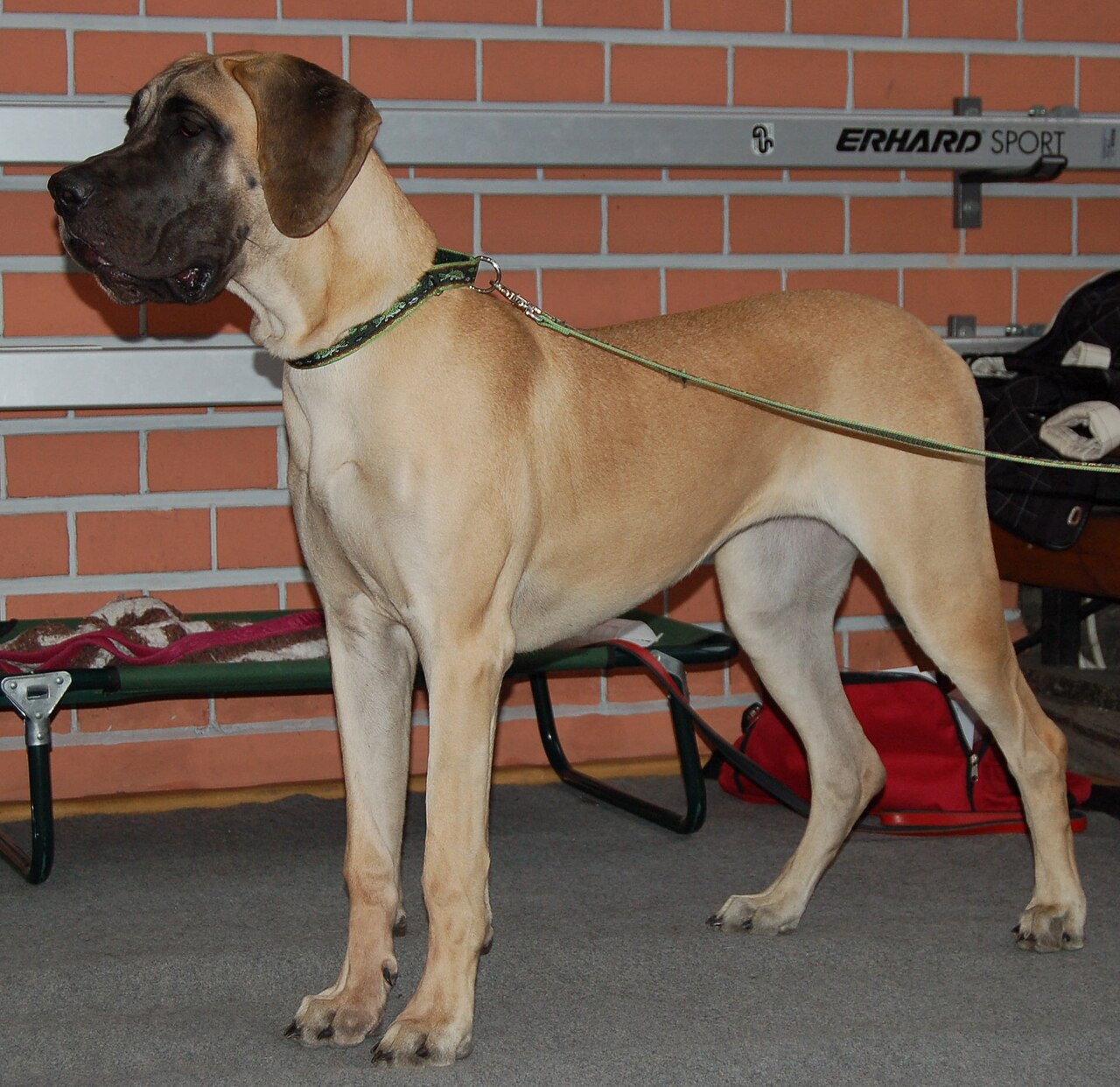
Great Dane
The Great Dane is a German breed despite its name, developed from boarhounds into the tallest of the working dogs, and the standard calls it the Apollo of dogs. Its size is the…
About the Great Dane
The Great Dane is a German breed despite its name, developed from boarhounds into the tallest of the working dogs, and the standard calls it the Apollo of dogs. Its size is the first thing anyone notices and the first thing anyone breeding it must think about.
Dogs stand a minimum of 76 cm and often far more, in fawn, brindle, black, blue, harlequin or mantle. Harlequin breeding carries the same rule as merle: two harlequins should not be mated. The temperament should be kindly and dependable; a Dane of poor temperament is a danger by weight alone, so a stud that is calm, confident and gentle is the only sensible choice. Growth must be managed carefully in puppies.
The breed's great risk is bloat and gastric torsion, which is a genuine emergency and disproportionately affects deep-chested giants; ask a stud owner about it in the line and about whether relatives have had preventive gastropexy. Ask for a cardiac examination, since dilated cardiomyopathy occurs, for hip scores, and for a current eye certificate. Lifespan is short, often only seven or eight years, and longevity in the pedigree is worth asking about.
Health & breeding
We check every hip, elbow, eye and DNA result you give us against the Royal Kennel Club’s public records by hand, and we record who checked it and when. The Royal Kennel Club’s public records may not include all the screening a dog has had, so a dog with no Royal Kennel Club record showing is not necessarily untested.
Breed Right’s summary — under The Royal Kennel Club Health Standard
Health tests for the Great Dane
This panel is Breed Right’s summary of the testing that matters for the breed under The Royal Kennel Club Health Standard. The Health Standard is the Royal Kennel Club’s guidance for breeders, not a registration rule. It describes tests to ask about — it is not a report on any individual dog. The Royal Kennel Club’s public records may not include all the screening a dog has had, so a dog with no Royal Kennel Club record showing is not necessarily untested.
Best Practice — further tests it recommends
Completing these as well as the Good Practice tests is what the Royal Kennel Club calls Best Practice.
| Test | Type | Scheme | What’s involved |
|---|---|---|---|
| DNA test — IMGD (Inherited Myopathy of Great Danes) | DNA test | Laboratory | The result printed on the laboratory certificate. |
| Hip score (BVA/KC) | Screening scheme | BVA/KC | Total of both hips, 0–106. Lower is better. |
| Elbow grading (BVA/KC) | Screening scheme | BVA/KC | Grade 0–3. The dog is graded on the worse of the two elbows. |
| Eye testing (BVA/KC/ISDS) | Screening scheme | BVA/KC/ISDS | Result printed on the eye certificate. |
Breed club schemes listed in the Health Standard
Run by the breed club, not the Royal Kennel Club, which does not record their results. The Standard lists them as schemes to be aware of.
| Test | Type | Scheme | What’s involved |
|---|---|---|---|
| Heart testing (breed club scheme) | Other | Breed club | The club scheme’s own result, e.g. murmur grade. |
Breed hip median
Breed median 9 (BVA Hip Dysplasia Scheme breed statistics 2025 — 5 years, 172 dogs scored). Lower is better. Source · How hip scores work
At stud now
Great Dane stud dogs
No Great Dane studs are listed right now
When a Great Dane on the Royal Kennel Club Breed Register is listed at stud, it will appear here.
Also available
Great Dane litters
No Great Dane litters are listed right now
Litters appear here as breeders list them. Check back soon, or browse other breeds.