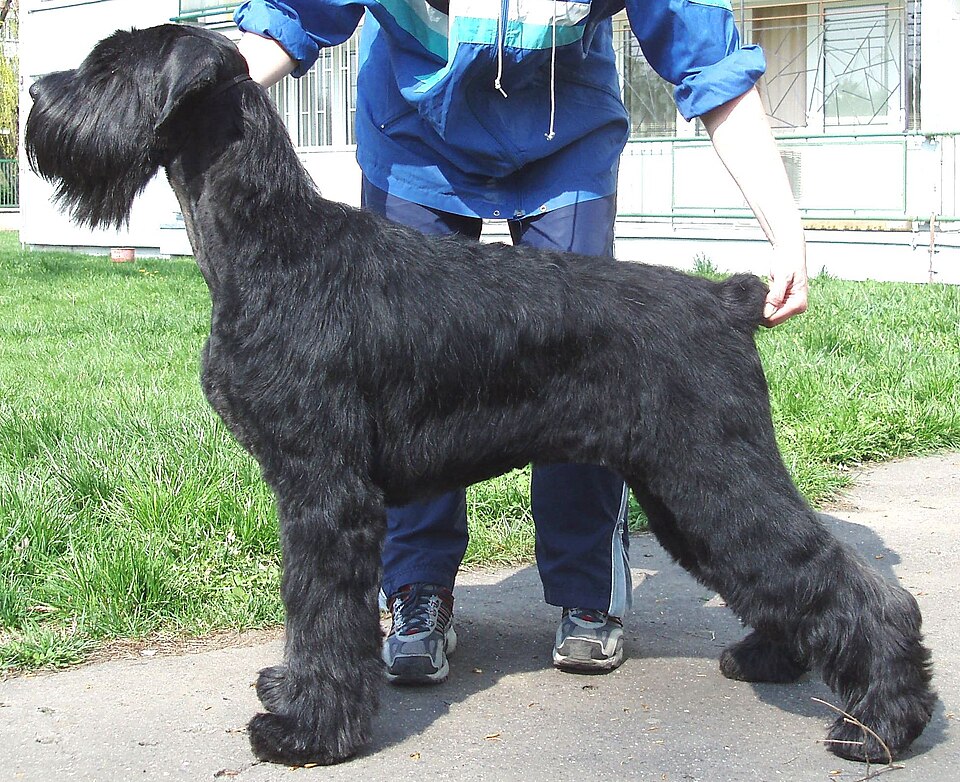
Giant Schnauzer
The Giant Schnauzer was bred in Bavaria to drive cattle and later to guard breweries and stockyards, and it became a police and military dog in Germany. It is the largest of the…
About the Giant Schnauzer
The Giant Schnauzer was bred in Bavaria to drive cattle and later to guard breweries and stockyards, and it became a police and military dog in Germany. It is the largest of the three Schnauzer breeds, each of which is registered separately, and it is very much a working animal rather than a scaled-up companion.
Dogs stand about 65 to 70 cm, with a harsh wiry coat in solid black or pepper and salt, and the breed's characteristic beard and eyebrows. The coat needs hand-stripping or regular clipping. This is a demanding, high-drive breed that is unsuited to an inexperienced owner, and a stud should be confident and controllable, with the trainability the breed is known for.
Ask a Giant Schnauzer stud owner for hip and elbow scores and a current eye certificate. The DNA test for hypothyroidism-related conditions is not established, but tests exist for degenerative myelopathy and for the breed's form of gangliosidosis; ask which the stud has had. Ask about autoimmune disease, particularly hypothyroidism, and about toe cancer, which appears in black Schnauzers more than most breeds.
Health & breeding
We check every hip, elbow, eye and DNA result you give us against the Royal Kennel Club’s public records by hand, and we record who checked it and when. The Royal Kennel Club’s public records may not include all the screening a dog has had, so a dog with no Royal Kennel Club record showing is not necessarily untested.
Breed Right’s summary — under The Royal Kennel Club Health Standard
Health tests for the Giant Schnauzer
This panel is Breed Right’s summary of the testing that matters for the breed under The Royal Kennel Club Health Standard. The Health Standard is the Royal Kennel Club’s guidance for breeders, not a registration rule. It describes tests to ask about — it is not a report on any individual dog. The Royal Kennel Club’s public records may not include all the screening a dog has had, so a dog with no Royal Kennel Club record showing is not necessarily untested.
Good Practice — the Royal Kennel Club’s minimum before breeding
The tests the Royal Kennel Club says breeders should, at a minimum, complete before breeding.
| Test | Type | Scheme | What’s involved |
|---|---|---|---|
| DNA test — prcd-PRA (Progressive Retinal Atrophy) | DNA test | Laboratory | The result printed on the laboratory certificate. |
| Hip score (BVA/KC) | Screening scheme | BVA/KC | Total of both hips, 0–106. Lower is better. |
| Elbow grading (BVA/KC) | Screening scheme | BVA/KC | Grade 0–3. The dog is graded on the worse of the two elbows. |
Best Practice — further tests it recommends
Completing these as well as the Good Practice tests is what the Royal Kennel Club calls Best Practice.
| Test | Type | Scheme | What’s involved |
|---|---|---|---|
| DNA test — DCM (Dilated Cardiomyopathy, Schnauzer) | DNA test | Laboratory | The result printed on the laboratory certificate. |
| DNA test — HUU (Hyperuricosuria) | DNA test | Laboratory | The result printed on the laboratory certificate. |
| DNA test — PRA5 (Progressive Retinal Atrophy 5) | DNA test | Laboratory | The result printed on the laboratory certificate. |
| Eye testing (BVA/KC/ISDS) | Screening scheme | BVA/KC/ISDS | Result printed on the eye certificate. |
| Litter eye screening (BVA/KC/ISDS) | Screening scheme | BVA/KC/ISDS | The litter screening result on the certificate. |
Breed hip median
Breed median 10 (BVA Hip Dysplasia Scheme breed statistics 2025 — 5 years, 54 dogs scored). Lower is better. Source · How hip scores work
At stud now
Giant Schnauzer stud dogs
No Giant Schnauzer studs are listed right now
When a Giant Schnauzer on the Royal Kennel Club Breed Register is listed at stud, it will appear here.
Also available
Giant Schnauzer litters
No Giant Schnauzer litters are listed right now
Litters appear here as breeders list them. Check back soon, or browse other breeds.