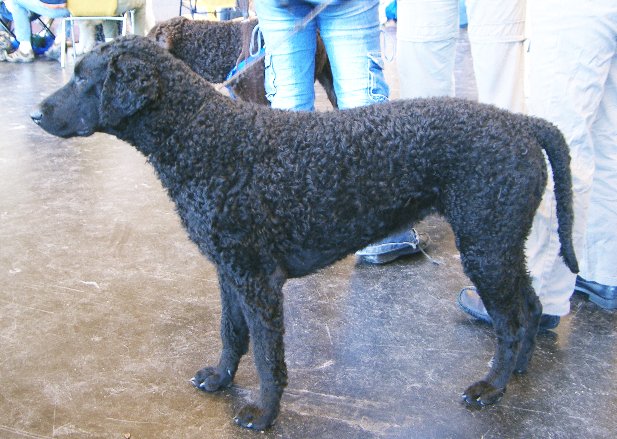
Curly Coated Retriever
The Curly Coated Retriever is the oldest of Britain's retrieving breeds and was the wildfowler's dog long before the Labrador arrived. Its crisp mass of small, tight curls covers…
About the Curly Coated Retriever
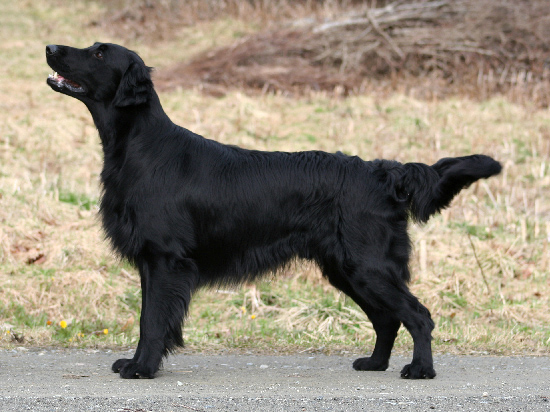
The Curly Coated Retriever is the oldest of Britain's retrieving breeds and was the wildfowler's dog long before the Labrador arrived. Its crisp mass of small, tight curls covers body and legs, sheds water, and asks for no trimming at all beyond being left alone.
Standing 63.5 to 69 cm, this is the tallest of the retrievers, black or liver only, with a smooth face and a slightly wedge-shaped head. The breed is aloof with strangers and devoted at home, which is not the retriever character most people expect; a stud should be level and confident rather than gushing, and a nervy dog is best passed over. Curl quality varies, so look closely at any patchy or open coat.
A DNA test exists for glycogen storage disease type IIIa, a fatal metabolic condition here, and it belongs at the top of the list. Hip and elbow scores and an annual eye examination follow, with distichiasis and retinal dysplasia in mind. Ask about coat loss, since follicular dysplasia occurs, and about bloat and cancer among the dog's relatives, neither of which any certificate can cover.
Health & breeding
We check every hip, elbow, eye and DNA result you give us against the Royal Kennel Club’s public records by hand, and we record who checked it and when. The Royal Kennel Club’s public records may not include all the screening a dog has had, so a dog with no Royal Kennel Club record showing is not necessarily untested.
Breed Right’s summary — under The Royal Kennel Club Health Standard
Health tests for the Curly Coated Retriever
This panel is Breed Right’s summary of the testing that matters for the breed under The Royal Kennel Club Health Standard. The Health Standard is the Royal Kennel Club’s guidance for breeders, not a registration rule. It describes tests to ask about — it is not a report on any individual dog. The Royal Kennel Club’s public records may not include all the screening a dog has had, so a dog with no Royal Kennel Club record showing is not necessarily untested.
Good Practice — the Royal Kennel Club’s minimum before breeding
The tests the Royal Kennel Club says breeders should, at a minimum, complete before breeding.
| Test | Type | Scheme | What’s involved |
|---|---|---|---|
| Hip score (BVA/KC) | Screening scheme | BVA/KC | Total of both hips, 0–106. Lower is better. |
| Elbow grading (BVA/KC) | Screening scheme | BVA/KC | Grade 0–3. The dog is graded on the worse of the two elbows. |
Best Practice — further tests it recommends
Completing these as well as the Good Practice tests is what the Royal Kennel Club calls Best Practice.
| Test | Type | Scheme | What’s involved |
|---|---|---|---|
| DNA test — EIC (Exercise Induced Collapse) | DNA test | Laboratory | The result printed on the laboratory certificate. |
Breed hip median
Breed median 10 (BVA Hip Dysplasia Scheme breed statistics 2025 — 5 years, 86 dogs scored). Lower is better. Source · How hip scores work
At stud now
Curly Coated Retriever stud dogs
No Curly Coated Retriever studs are listed right now
When a Curly Coated Retriever on the Royal Kennel Club Breed Register is listed at stud, it will appear here.
Also available
Curly Coated Retriever litters
No Curly Coated Retriever litters are listed right now
Litters appear here as breeders list them. Check back soon, or browse other breeds.