Labrador Retriever
The Labrador Retriever was shaped in nineteenth-century Britain from water dogs brought back from Newfoundland, and bred to fetch shot game from cold water and heavy cover without…
About the Labrador Retriever
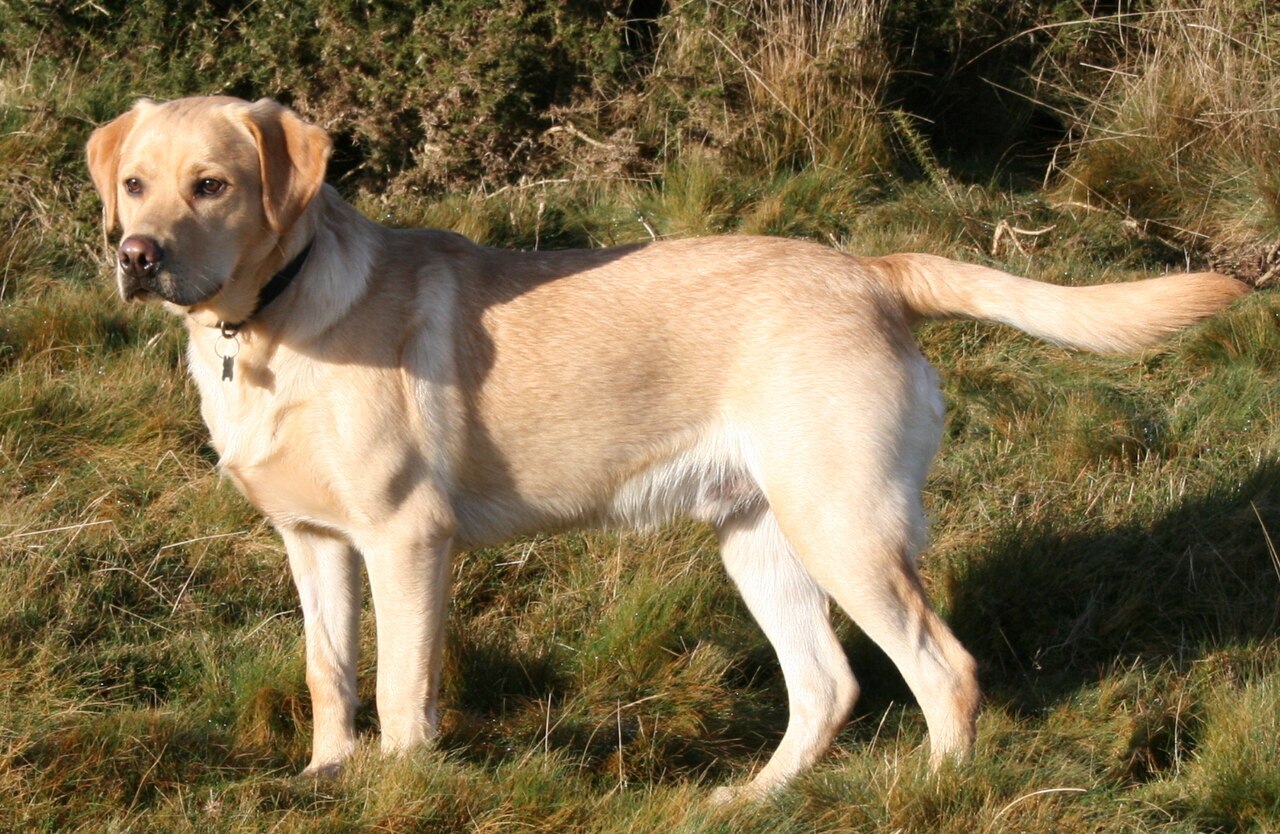
The Labrador Retriever was shaped in nineteenth-century Britain from water dogs brought back from Newfoundland, and bred to fetch shot game from cold water and heavy cover without fuss. It has been the most registered breed in the United Kingdom for decades, and the reason is temperament: a good Labrador is steady, biddable and pleased to see everyone.
Two types have grown apart over the years. The show type is heavier in bone and head; the working type is leaner and faster, with more drive. Both are the same breed on the same register, but a litter from one will not look like a litter from the other, so say which line you are looking for when you make a stud enquiry. Dogs stand around 56 to 57 cm at the shoulder, with a short, dense, weather-resisting coat in black, yellow or chocolate.
For a Labrador stud, the screening worth asking about is hips and elbows under the BVA/KC schemes, a current eye certificate, and the DNA tests widely used in the breed: prcd-PRA, exercise-induced collapse and centronuclear myopathy. A stud owner who can show these without being asked twice is the one you want.
Health & breeding
We check every hip, elbow, eye and DNA result you give us against the Royal Kennel Club’s public records by hand, and we record who checked it and when. The Royal Kennel Club’s public records may not include all the screening a dog has had, so a dog with no Royal Kennel Club record showing is not necessarily untested.
Breed Right’s summary — under The Royal Kennel Club Health Standard
Health tests for the Labrador Retriever
This panel is Breed Right’s summary of the testing that matters for the breed under The Royal Kennel Club Health Standard. The Health Standard is the Royal Kennel Club’s guidance for breeders, not a registration rule. It describes tests to ask about — it is not a report on any individual dog. The Royal Kennel Club’s public records may not include all the screening a dog has had, so a dog with no Royal Kennel Club record showing is not necessarily untested.
Good Practice — the Royal Kennel Club’s minimum before breeding
The tests the Royal Kennel Club says breeders should, at a minimum, complete before breeding.
| Test | Type | Scheme | What’s involved |
|---|---|---|---|
| DNA test — CNM (Centronuclear Myopathy) | DNA test | Laboratory | The result printed on the laboratory certificate. |
| DNA test — EIC (Exercise Induced Collapse) | DNA test | Laboratory | The result printed on the laboratory certificate. |
| DNA test — MCD (Macular Corneal Dystrophy) | DNA test | Laboratory | The result printed on the laboratory certificate. |
| DNA test — prcd-PRA (Progressive Retinal Atrophy) | DNA test | Laboratory | The result printed on the laboratory certificate. |
| DNA test — SD2 (Skeletal Dysplasia 2) | DNA test | Laboratory | The result printed on the laboratory certificate. |
| DNA test — STGD (Stargardt Disease) | DNA test | Laboratory | The result printed on the laboratory certificate. |
| Hip score (BVA/KC) | Screening scheme | BVA/KC | Total of both hips, 0–106. Lower is better. |
| Elbow grading (BVA/KC) | Screening scheme | BVA/KC | Grade 0–3. The dog is graded on the worse of the two elbows. |
| Eye testing (BVA/KC/ISDS) | Screening scheme | BVA/KC/ISDS | Result printed on the eye certificate. |
Best Practice — further tests it recommends
Completing these as well as the Good Practice tests is what the Royal Kennel Club calls Best Practice.
| Test | Type | Scheme | What’s involved |
|---|---|---|---|
| DNA test — HNPK (Hereditary Nasal Parakeratosis) | DNA test | Laboratory | The result printed on the laboratory certificate. |
Breed hip median
Breed median 8 (BVA Hip Dysplasia Scheme breed statistics 2025 — 5 years, 17,727 dogs scored). Lower is better. Source · How hip scores work
At stud now
Labrador Retriever stud dogs
No Labrador Retriever studs are listed right now
When a Labrador Retriever on the Royal Kennel Club Breed Register is listed at stud, it will appear here.
Also available
Labrador Retriever litters
No Labrador Retriever litters are listed right now
Litters appear here as breeders list them. Check back soon, or browse other breeds.