English Setter
The English Setter is the oldest of the three setter breeds and was shaped in the nineteenth century by two men with opposite aims: Edward Laverack bred for the show ring, and…
About the English Setter
The English Setter is the oldest of the three setter breeds and was shaped in the nineteenth century by two men with opposite aims: Edward Laverack bred for the show ring, and Purcell Llewellin for the field. Both strains survive today, and on a moor the breed quarters wide before dropping to a beautiful low set.
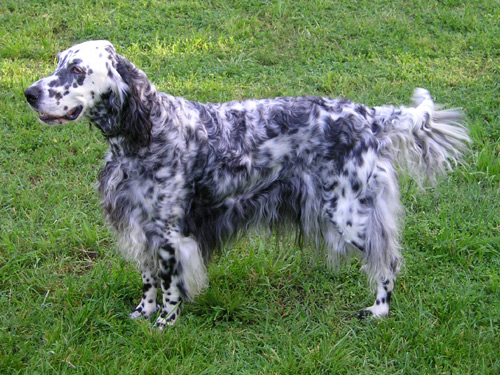
Its flecked coat gives the breed a vocabulary of its own, and a dog is described as blue, orange, lemon or liver belton according to the colour ticked into the white, with tricolours as well. Height runs to about 65 to 68 cm, with fine feathering and a silky, slightly wavy jacket. Field-bred dogs are plainer and lighter, so ask which type a stud is before anything else, because the two produce very different litters.
Congenital deafness occurs in this breed, and a BAER test on the stud is a fair thing to ask for, since it is the only way to know whether a dog hears on both sides. Hip scores and an annual eye certificate belong on the list. Ask about thyroid function, because hypothyroidism is reported, and ask what DNA testing the breed club currently advises, as the panel used for setters has grown over the last decade.
Health & breeding
We check every hip, elbow, eye and DNA result you give us against the Royal Kennel Club’s public records by hand, and we record who checked it and when. The Royal Kennel Club’s public records may not include all the screening a dog has had, so a dog with no Royal Kennel Club record showing is not necessarily untested.
Breed Right’s summary — under The Royal Kennel Club Health Standard
Health tests for the English Setter
This panel is Breed Right’s summary of the testing that matters for the breed under The Royal Kennel Club Health Standard. The Health Standard is the Royal Kennel Club’s guidance for breeders, not a registration rule. It describes tests to ask about — it is not a report on any individual dog. The Royal Kennel Club’s public records may not include all the screening a dog has had, so a dog with no Royal Kennel Club record showing is not necessarily untested.
Good Practice — the Royal Kennel Club’s minimum before breeding
The tests the Royal Kennel Club says breeders should, at a minimum, complete before breeding.
| Test | Type | Scheme | What’s involved |
|---|---|---|---|
| Hip score (BVA/KC) | Screening scheme | BVA/KC | Total of both hips, 0–106. Lower is better. |
Best Practice — further tests it recommends
Completing these as well as the Good Practice tests is what the Royal Kennel Club calls Best Practice.
| Test | Type | Scheme | What’s involved |
|---|---|---|---|
| DNA test — NCL8 (Neuronal Ceroid Lipofuscinosis 8) | DNA test | Laboratory | The result printed on the laboratory certificate. |
| DNA test — rcd4-PRA (Progressive Retinal Atrophy, rod-cone dysplasia 4) | DNA test | Laboratory | The result printed on the laboratory certificate. |
| Elbow grading (BVA/KC) | Screening scheme | BVA/KC | Grade 0–3. The dog is graded on the worse of the two elbows. |
| Hearing test — BAER (RKC BAER Scheme) | Screening scheme | RKC | Per ear: hearing or deaf, as certified. |
Breed hip median
Breed median 11 (BVA Hip Dysplasia Scheme breed statistics 2025 — 5 years, 260 dogs scored). Lower is better. Source · How hip scores work
At stud now
English Setter stud dogs
No English Setter studs are listed right now
When an English Setter on the Royal Kennel Club Breed Register is listed at stud, it will appear here.
Also available
English Setter litters
No English Setter litters are listed right now
Litters appear here as breeders list them. Check back soon, or browse other breeds.