Sussex Spaniel
The Sussex Spaniel was bred on the Weald in the late eighteenth century for shooting in dense, tangled cover, where a dog had to work slowly, push game out on foot and tell the…
About the Sussex Spaniel
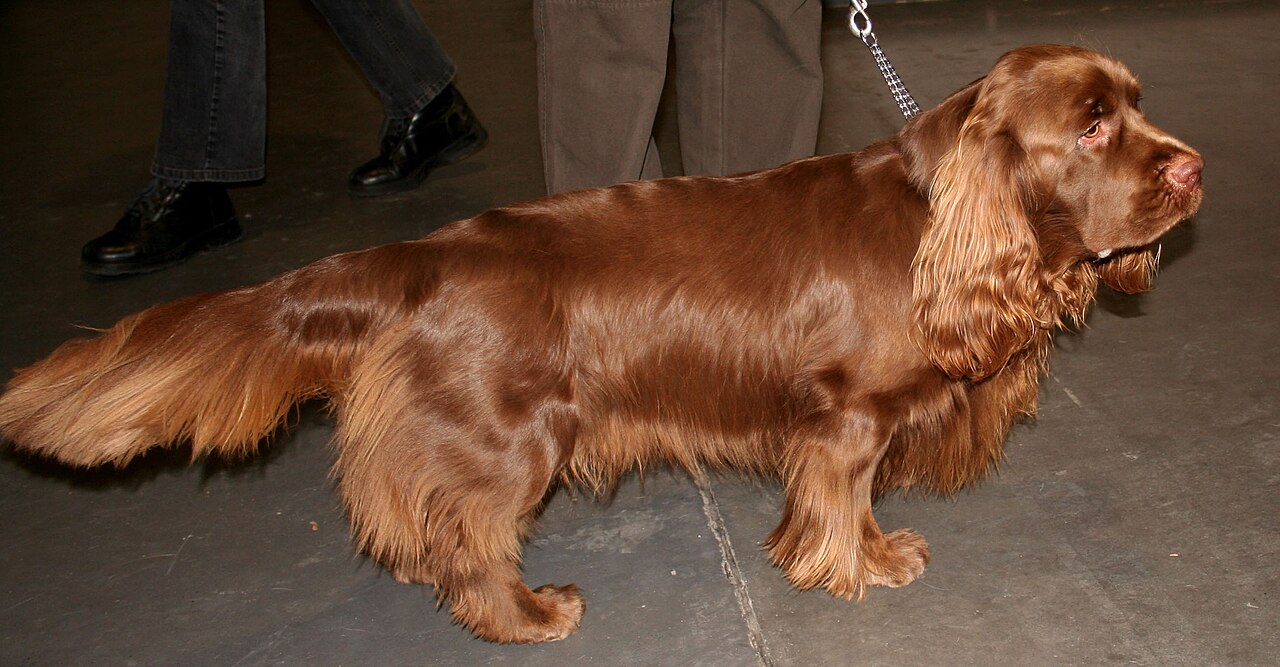
The Sussex Spaniel was bred on the Weald in the late eighteenth century for shooting in dense, tangled cover, where a dog had to work slowly, push game out on foot and tell the guns where it had got to. Its habit of giving tongue on a line is unique among British spaniels, and it is now one of the rarest native breeds in the country.
The coat is a rich golden liver with golden tips, and no other colour is correct, over a long, low, heavy body of about 38 to 41 cm at the shoulder and some 23 kg in weight. The head frowns and the expression is sombre despite a cheerful nature. A Sussex stud should still be able to work: fit, free-moving, with a tight eye and no surplus weight, since this shape punishes excess badly.
A DNA test for pyruvate dehydrogenase phosphatase deficiency is used in the breed and a stud owner should be able to show it. Hip scoring matters, because the breed mean has historically been high, and an eye examination should study the lids as much as anything else. Heart murmurs occur, so a cardiac check is worth asking about, and with so few puppies registered each year the pedigree conversation is as important as the certificates.
Health & breeding
We check every hip, elbow, eye and DNA result you give us against the Royal Kennel Club’s public records by hand, and we record who checked it and when. The Royal Kennel Club’s public records may not include all the screening a dog has had, so a dog with no Royal Kennel Club record showing is not necessarily untested.
Breed Right’s summary — under The Royal Kennel Club Health Standard
Health tests for the Sussex Spaniel
This panel is Breed Right’s summary of the testing that matters for the breed under The Royal Kennel Club Health Standard. The Health Standard is the Royal Kennel Club’s guidance for breeders, not a registration rule. It describes tests to ask about — it is not a report on any individual dog. The Royal Kennel Club’s public records may not include all the screening a dog has had, so a dog with no Royal Kennel Club record showing is not necessarily untested.
Best Practice — further tests it recommends
Completing these as well as the Good Practice tests is what the Royal Kennel Club calls Best Practice.
| Test | Type | Scheme | What’s involved |
|---|---|---|---|
| Hip score (BVA/KC) | Screening scheme | BVA/KC | Total of both hips, 0–106. Lower is better. |
| Eye testing (BVA/KC/ISDS) | Screening scheme | BVA/KC/ISDS | Result printed on the eye certificate. |
Breed hip median
Breed median 25 (BVA Hip Dysplasia Scheme breed statistics 2025 — 5 years, 33 dogs scored — indicative only, from a small sample). Lower is better. Source · How hip scores work
At stud now
Sussex Spaniel stud dogs
No Sussex Spaniel studs are listed right now
When a Sussex Spaniel on the Royal Kennel Club Breed Register is listed at stud, it will appear here.
Also available
Sussex Spaniel litters
No Sussex Spaniel litters are listed right now
Litters appear here as breeders list them. Check back soon, or browse other breeds.