American Cocker Spaniel
The American Cocker Spaniel parted company with its English ancestor in the show rings of the United States, where breeders selected for a smaller dog with a domed skull, a short…
About the American Cocker Spaniel
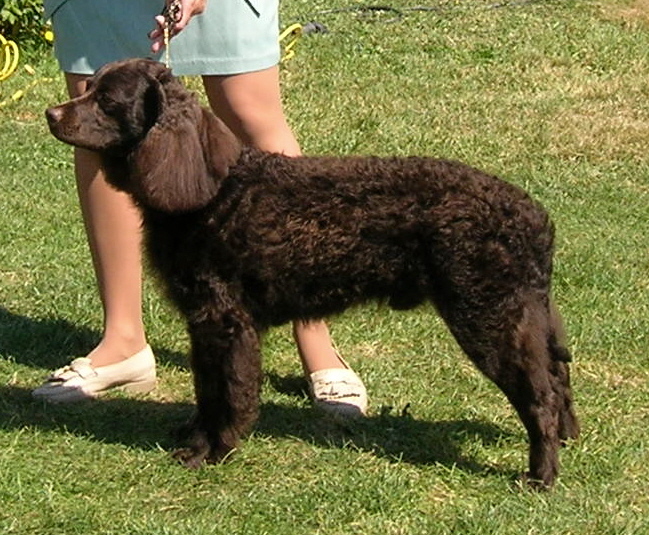
The American Cocker Spaniel parted company with its English ancestor in the show rings of the United States, where breeders selected for a smaller dog with a domed skull, a short muzzle and a coat that pours to the floor. It came from the same woodcock-flushing stock, but a century of divergence has left two clearly separate breeds on two separate registers.
Dogs stand around 37 to 39 cm and are noticeably more compact than an English Cocker, carrying heavy feathering on the legs and body in black, any solid colour, or parti-colour. That coat is the largest single commitment in the breed, and a stud kept in full show trim tells you nothing about what an ordinary household will face. Look for a moderate stop, a clean eye and an ear that sits free of infection.
The DNA test for prcd-PRA has been used in this breed for many years and a stud owner should be able to produce the certificate without hunting for it. Alongside it, ask for an annual eye examination, since cataract and glaucoma both occur, and for hip scores. Ear health deserves a direct question, because the low-hung, heavily furnished ear is this breed's most frequent trip to the vet, and so does any family history of autoimmune disease.
Health & breeding
We check every hip, elbow, eye and DNA result you give us against the Royal Kennel Club’s public records by hand, and we record who checked it and when. The Royal Kennel Club’s public records may not include all the screening a dog has had, so a dog with no Royal Kennel Club record showing is not necessarily untested.
Breed Right’s summary — under The Royal Kennel Club Health Standard
Health tests for the American Cocker Spaniel
This panel is Breed Right’s summary of the testing that matters for the breed under The Royal Kennel Club Health Standard. The Health Standard is the Royal Kennel Club’s guidance for breeders, not a registration rule. It describes tests to ask about — it is not a report on any individual dog. The Royal Kennel Club’s public records may not include all the screening a dog has had, so a dog with no Royal Kennel Club record showing is not necessarily untested.
Good Practice — the Royal Kennel Club’s minimum before breeding
The tests the Royal Kennel Club says breeders should, at a minimum, complete before breeding.
| Test | Type | Scheme | What’s involved |
|---|---|---|---|
| Eye testing (BVA/KC/ISDS) | Screening scheme | BVA/KC/ISDS | Result printed on the eye certificate. |
| Gonioscopy (BVA/KC/ISDS) | Screening scheme | BVA/KC/ISDS | Grade 1–3 on the certificate; 1 is normal or mild. |
Best Practice — further tests it recommends
Completing these as well as the Good Practice tests is what the Royal Kennel Club calls Best Practice.
| Test | Type | Scheme | What’s involved |
|---|---|---|---|
| DNA test — prcd-PRA (Progressive Retinal Atrophy) | DNA test | Laboratory | The result printed on the laboratory certificate. |
| Hip score (BVA/KC) | Screening scheme | BVA/KC | Total of both hips, 0–106. Lower is better. |
Breed hip median
Breed median 10 (BVA Hip Dysplasia Scheme breed statistics 2025 — 5 years, 12 dogs scored — indicative only, from a small sample). Lower is better. Source · How hip scores work
At stud now
American Cocker Spaniel stud dogs
No American Cocker Spaniel studs are listed right now
When an American Cocker Spaniel on the Royal Kennel Club Breed Register is listed at stud, it will appear here.
Also available
American Cocker Spaniel litters
No American Cocker Spaniel litters are listed right now
Litters appear here as breeders list them. Check back soon, or browse other breeds.