Welsh Springer Spaniel
The Welsh Springer Spaniel is older than its English cousin and has kept closer to its roots: a compact, red-and-white flushing spaniel from the Welsh valleys, bred to work all…
About the Welsh Springer Spaniel
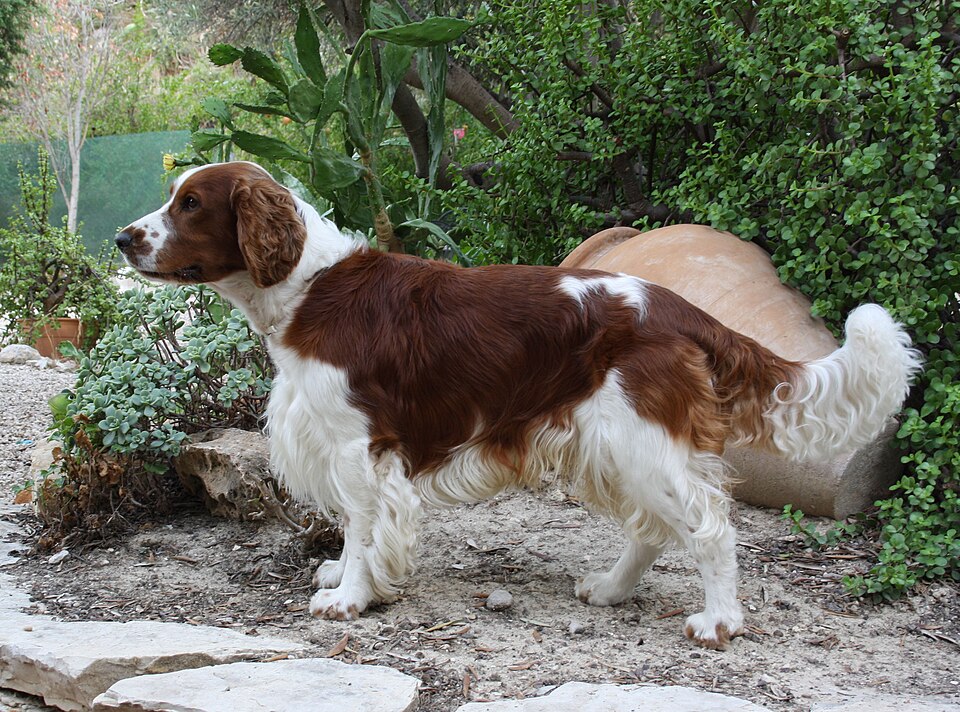
The Welsh Springer Spaniel is older than its English cousin and has kept closer to its roots: a compact, red-and-white flushing spaniel from the Welsh valleys, bred to work all day on rough ground and come home wanting more. It is the only colour the breed comes in, and a Welsh Springer of any other colour is not a Welsh Springer.
The breed is smaller than the English Springer, dogs standing about 48 cm, and has never divided into show and working strains in the same way, so most Welsh Springers can still do the job they were bred for. Temperament is affectionate at home and a little aloof with strangers; a stud that is confident and easy in company is the one to look for, because softness can tip into timidity if it is not bred against.
Ask about hip scores and a current eye certificate with gonioscopy, since glaucoma is the breed's most watched eye condition. Epilepsy occurs in the breed and a straight answer about family history is worth asking for. This is a breed with a small gene pool, so a stud owner who can talk about the pedigree and the coefficient of inbreeding of a proposed mating is doing you a service.
Health & breeding
We check every hip, elbow, eye and DNA result you give us against the Royal Kennel Club’s public records by hand, and we record who checked it and when. The Royal Kennel Club’s public records may not include all the screening a dog has had, so a dog with no Royal Kennel Club record showing is not necessarily untested.
Breed Right’s summary — under The Royal Kennel Club Health Standard
Health tests for the Welsh Springer Spaniel
This panel is Breed Right’s summary of the testing that matters for the breed under The Royal Kennel Club Health Standard. The Health Standard is the Royal Kennel Club’s guidance for breeders, not a registration rule. It describes tests to ask about — it is not a report on any individual dog. The Royal Kennel Club’s public records may not include all the screening a dog has had, so a dog with no Royal Kennel Club record showing is not necessarily untested.
Good Practice — the Royal Kennel Club’s minimum before breeding
The tests the Royal Kennel Club says breeders should, at a minimum, complete before breeding.
| Test | Type | Scheme | What’s involved |
|---|---|---|---|
| Eye testing (BVA/KC/ISDS) | Screening scheme | BVA/KC/ISDS | Result printed on the eye certificate. |
| Gonioscopy (BVA/KC/ISDS) | Screening scheme | BVA/KC/ISDS | Grade 1–3 on the certificate; 1 is normal or mild. |
Best Practice — further tests it recommends
Completing these as well as the Good Practice tests is what the Royal Kennel Club calls Best Practice.
| Test | Type | Scheme | What’s involved |
|---|---|---|---|
| Hip score (BVA/KC) | Screening scheme | BVA/KC | Total of both hips, 0–106. Lower is better. |
Breed hip median
Breed median 11 (BVA Hip Dysplasia Scheme breed statistics 2025 — 5 years, 239 dogs scored). Lower is better. Source · How hip scores work
At stud now
Welsh Springer Spaniel stud dogs
No Welsh Springer Spaniel studs are listed right now
When a Welsh Springer Spaniel on the Royal Kennel Club Breed Register is listed at stud, it will appear here.
Also available
Welsh Springer Spaniel litters
No Welsh Springer Spaniel litters are listed right now
Litters appear here as breeders list them. Check back soon, or browse other breeds.