Soft Coated Wheaten Terrier
The Soft Coated Wheaten Terrier is the old Irish farm dog, kept for a century or more before anybody registered it, and expected to guard the yard, drive cattle, kill vermin and…
About the Soft Coated Wheaten Terrier
The Soft Coated Wheaten Terrier is the old Irish farm dog, kept for a century or more before anybody registered it, and expected to guard the yard, drive cattle, kill vermin and be trusted around the family. Ireland recognised it only in 1937, on St Patrick's Day.
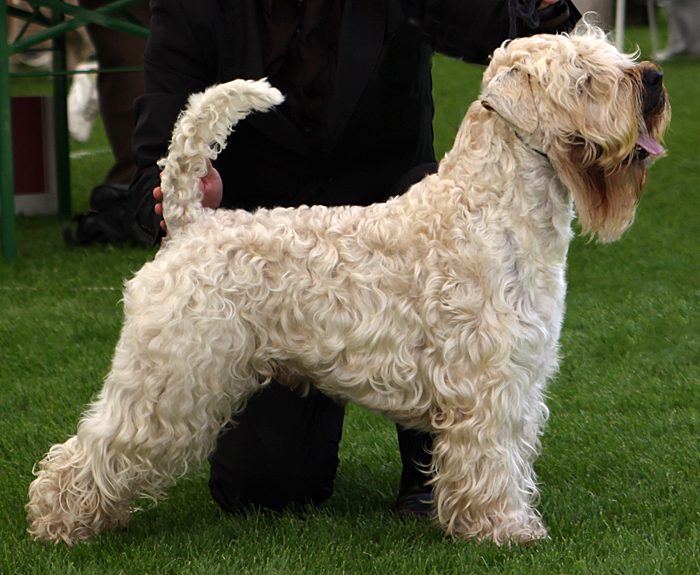
Its coat is both the name and the defining feature: soft, silky, gently waving and a warm wheaten colour, quite unlike the harsh jacket of most terriers, and puppies are born dark and clear as they mature. Dogs stand 46 to 49 cm. The breed is famously effusive, and a stud should be confident and outgoing without being uncontrollable, since the bounce that charms in a puppy is harder work in a grown dog.
Protein-losing nephropathy and protein-losing enteropathy dominate health work in this breed, and careful breeders monitor them with blood albumin levels and a urine protein-to-creatinine ratio, repeated each year. Ask for those results by date, not simply in principle. DNA testing for the variants associated with the kidney form is available and worth asking about. Add hip scoring and an eye examination, and ask about kidney disease in the wider family.
Health & breeding
We check every hip, elbow, eye and DNA result you give us against the Royal Kennel Club’s public records by hand, and we record who checked it and when. The Royal Kennel Club’s public records may not include all the screening a dog has had, so a dog with no Royal Kennel Club record showing is not necessarily untested.
Breed Right’s summary — under The Royal Kennel Club Health Standard
Health tests for the Soft Coated Wheaten Terrier
This panel is Breed Right’s summary of the testing that matters for the breed under The Royal Kennel Club Health Standard. The Health Standard is the Royal Kennel Club’s guidance for breeders, not a registration rule. It describes tests to ask about — it is not a report on any individual dog. The Royal Kennel Club’s public records may not include all the screening a dog has had, so a dog with no Royal Kennel Club record showing is not necessarily untested.
Best Practice — further tests it recommends
Completing these as well as the Good Practice tests is what the Royal Kennel Club calls Best Practice.
| Test | Type | Scheme | What’s involved |
|---|---|---|---|
| Hip score (BVA/KC) | Screening scheme | BVA/KC | Total of both hips, 0–106. Lower is better. |
| Eye testing (BVA/KC/ISDS) | Screening scheme | BVA/KC/ISDS | Result printed on the eye certificate. |
Breed club schemes listed in the Health Standard
Run by the breed club, not the Royal Kennel Club, which does not record their results. The Standard lists them as schemes to be aware of.
| Test | Type | Scheme | What’s involved |
|---|---|---|---|
| Kidney testing (breed club scheme) | Other | Breed club | e.g. urine protein:creatinine ratio. |
Breed hip median
Breed median 10 (BVA Hip Dysplasia Scheme breed statistics 2025 — 5 years, 88 dogs scored). Lower is better. Source · How hip scores work
At stud now
Soft Coated Wheaten Terrier stud dogs
No Soft Coated Wheaten Terrier studs are listed right now
When a Soft Coated Wheaten Terrier on the Royal Kennel Club Breed Register is listed at stud, it will appear here.
Also available
Soft Coated Wheaten Terrier litters
No Soft Coated Wheaten Terrier litters are listed right now
Litters appear here as breeders list them. Check back soon, or browse other breeds.