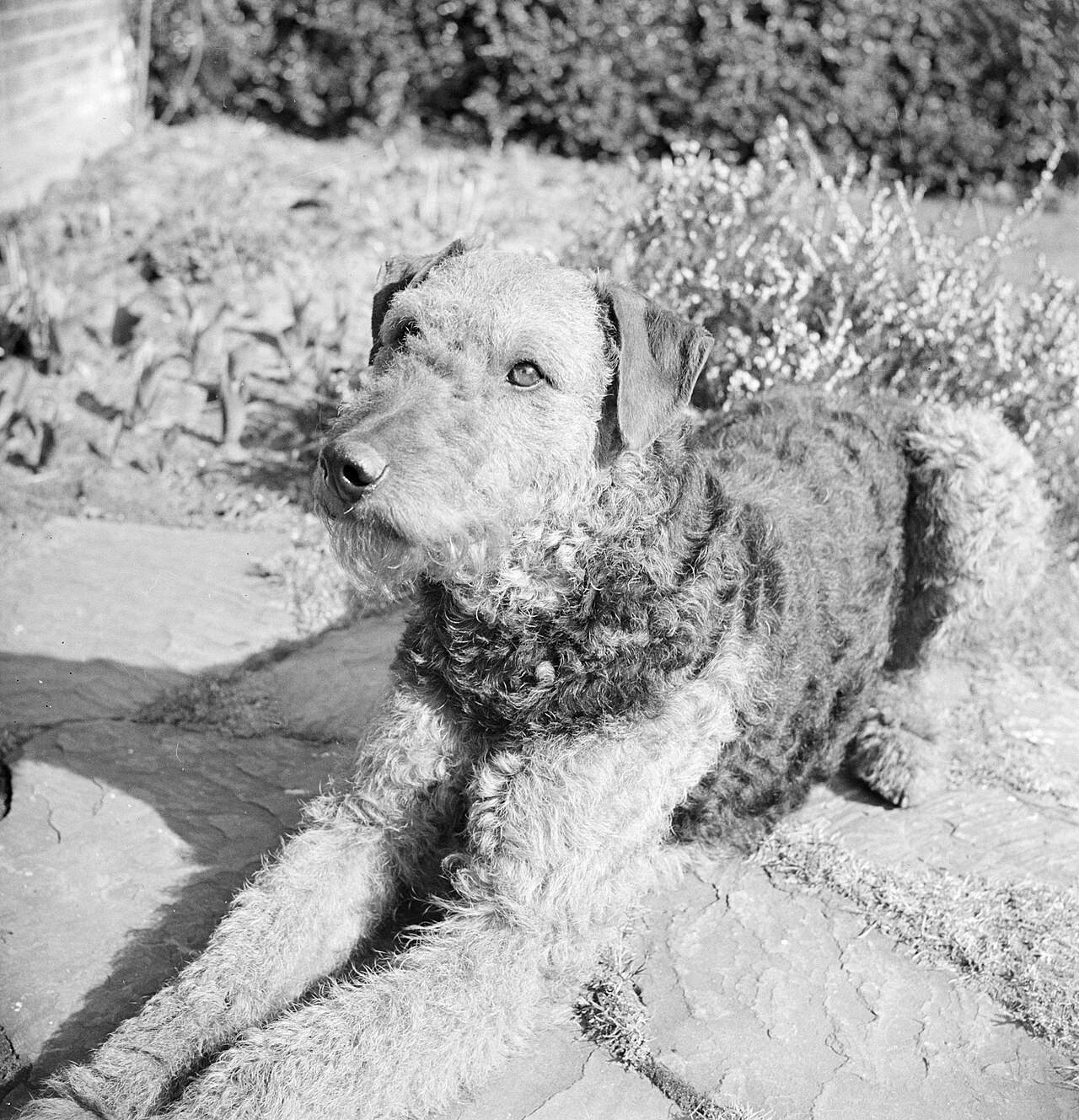
Airedale Terrier
The Airedale Terrier was bred in the valley of the Yorkshire Aire by mill workers who crossed their working terriers with the Otterhound, producing a dog big enough to tackle…
About the Airedale Terrier
The Airedale Terrier was bred in the valley of the Yorkshire Aire by mill workers who crossed their working terriers with the Otterhound, producing a dog big enough to tackle otter and water rat and clever enough to do almost anything else asked of it. Airedales carried messages under fire in the First World War and were working with British police forces before the German Shepherd was.
At 58 to 61 cm this is the tallest terrier by a clear margin, with a hard, wiry, close jacket in tan with a black or grizzle saddle, kept in condition by hand-stripping. The head is long and flat with a small, dark, keen eye. Temperament should come first in a stud of this size: bold and friendly, never sharp, because a big terrier with a short fuse is a serious problem in a household.
Hip and elbow scoring and an annual eye examination are sensible in a terrier this large. Ask about thyroid function, since hypothyroidism turns up in the breed, and about skin, because allergic disease is common and shows itself late under a wire jacket. There is no long DNA panel, so the useful questions concern the family: bloat, cancer, and how long the parents and grandparents lived.
Health & breeding
We check every hip, elbow, eye and DNA result you give us against the Royal Kennel Club’s public records by hand, and we record who checked it and when. The Royal Kennel Club’s public records may not include all the screening a dog has had, so a dog with no Royal Kennel Club record showing is not necessarily untested.
Breed Right’s summary — under The Royal Kennel Club Health Standard
Health tests for the Airedale Terrier
This panel is Breed Right’s summary of the testing that matters for the breed under The Royal Kennel Club Health Standard. The Health Standard is the Royal Kennel Club’s guidance for breeders, not a registration rule. It describes tests to ask about — it is not a report on any individual dog. The Royal Kennel Club’s public records may not include all the screening a dog has had, so a dog with no Royal Kennel Club record showing is not necessarily untested.
Best Practice — further tests it recommends
Completing these as well as the Good Practice tests is what the Royal Kennel Club calls Best Practice.
| Test | Type | Scheme | What’s involved |
|---|---|---|---|
| Hip score (BVA/KC) | Screening scheme | BVA/KC | Total of both hips, 0–106. Lower is better. |
| Elbow grading (BVA/KC) | Screening scheme | BVA/KC | Grade 0–3. The dog is graded on the worse of the two elbows. |
Breed hip median
Breed median 11 (BVA Hip Dysplasia Scheme breed statistics 2025 — 5 years, 235 dogs scored). Lower is better. Source · How hip scores work
At stud now
Airedale Terrier stud dogs
No Airedale Terrier studs are listed right now
When an Airedale Terrier on the Royal Kennel Club Breed Register is listed at stud, it will appear here.
Also available
Airedale Terrier litters
No Airedale Terrier litters are listed right now
Litters appear here as breeders list them. Check back soon, or browse other breeds.