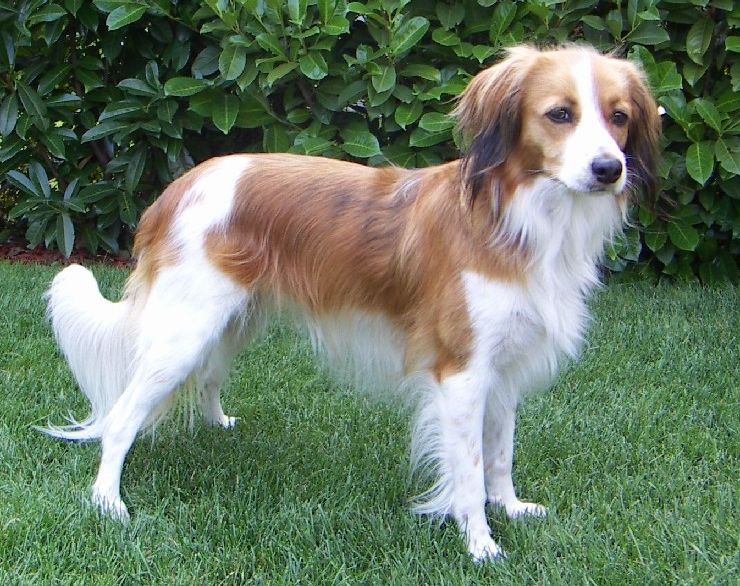
Kooikerhondje
The Kooikerhondje worked the eendenkooi, the Dutch duck decoy, where the flag of its white-tipped tail lured curious ducks along a netted channel into a trap. The breed was almost…
About the Kooikerhondje
The Kooikerhondje worked the eendenkooi, the Dutch duck decoy, where the flag of its white-tipped tail lured curious ducks along a netted channel into a trap. The breed was almost lost by the Second World War and was rebuilt from a handful of dogs by Baroness van Hardenbroek van Ammerstol.
This is a small, tidy dog of around 40 cm at the shoulder, white with clear orange-red patches, and the black-tipped ear feathering that the breed calls earrings is a hallmark of good type. Temperament is soft and observant rather than bold; a stud should be confident and steady, because a nervous Kooiker is a difficult dog to live with and the trait travels down a pedigree.
The breed has two DNA tests that matter and a stud owner should hold both: von Willebrand's disease type III, a serious bleeding disorder, and hereditary necrotising myelopathy, which strikes young dogs. Patella examination and an eye certificate are the standard additions, and hip scoring is worth requesting. Ask about the inbreeding coefficient as well, given how few dogs the modern breed descends from.
Health & breeding
We check every hip, elbow, eye and DNA result you give us against the Royal Kennel Club’s public records by hand, and we record who checked it and when. The Royal Kennel Club’s public records may not include all the screening a dog has had, so a dog with no Royal Kennel Club record showing is not necessarily untested.
Breed Right’s summary — under The Royal Kennel Club Health Standard
Health tests for the Kooikerhondje
This panel is Breed Right’s summary of the testing that matters for the breed under The Royal Kennel Club Health Standard. The Health Standard is the Royal Kennel Club’s guidance for breeders, not a registration rule. It describes tests to ask about — it is not a report on any individual dog. The Royal Kennel Club’s public records may not include all the screening a dog has had, so a dog with no Royal Kennel Club record showing is not necessarily untested.
Best Practice — further tests it recommends
Completing these as well as the Good Practice tests is what the Royal Kennel Club calls Best Practice.
| Test | Type | Scheme | What’s involved |
|---|---|---|---|
| DNA test — ENM (Hereditary Necrotising Myelopathy) | DNA test | Laboratory | The result printed on the laboratory certificate. |
| DNA test — vWD3 (von Willebrand Disease type 3) | DNA test | Laboratory | The result printed on the laboratory certificate. |
Breed hip median
Too few dogs of this breed have been scored (BVA Hip Dysplasia Scheme breed statistics 2025 — 15 years: 2 dogs) to give a meaningful breed median. Source · How hip scores work
At stud now
Kooikerhondje stud dogs
No Kooikerhondje studs are listed right now
When a Kooikerhondje on the Royal Kennel Club Breed Register is listed at stud, it will appear here.
Also available
Kooikerhondje litters
No Kooikerhondje litters are listed right now
Litters appear here as breeders list them. Check back soon, or browse other breeds.