Keeshond
The Keeshond is the Dutch barge dog, named after Cornelis de Gijselaar, whose own dog became the emblem of the eighteenth-century Patriot party, and it lived on the canal boats…
About the Keeshond
The Keeshond is the Dutch barge dog, named after Cornelis de Gijselaar, whose own dog became the emblem of the eighteenth-century Patriot party, and it lived on the canal boats and farms of Holland as a watchman rather than a hunter. It never had to catch anything, and that shows in a breed which is friendly to everybody.
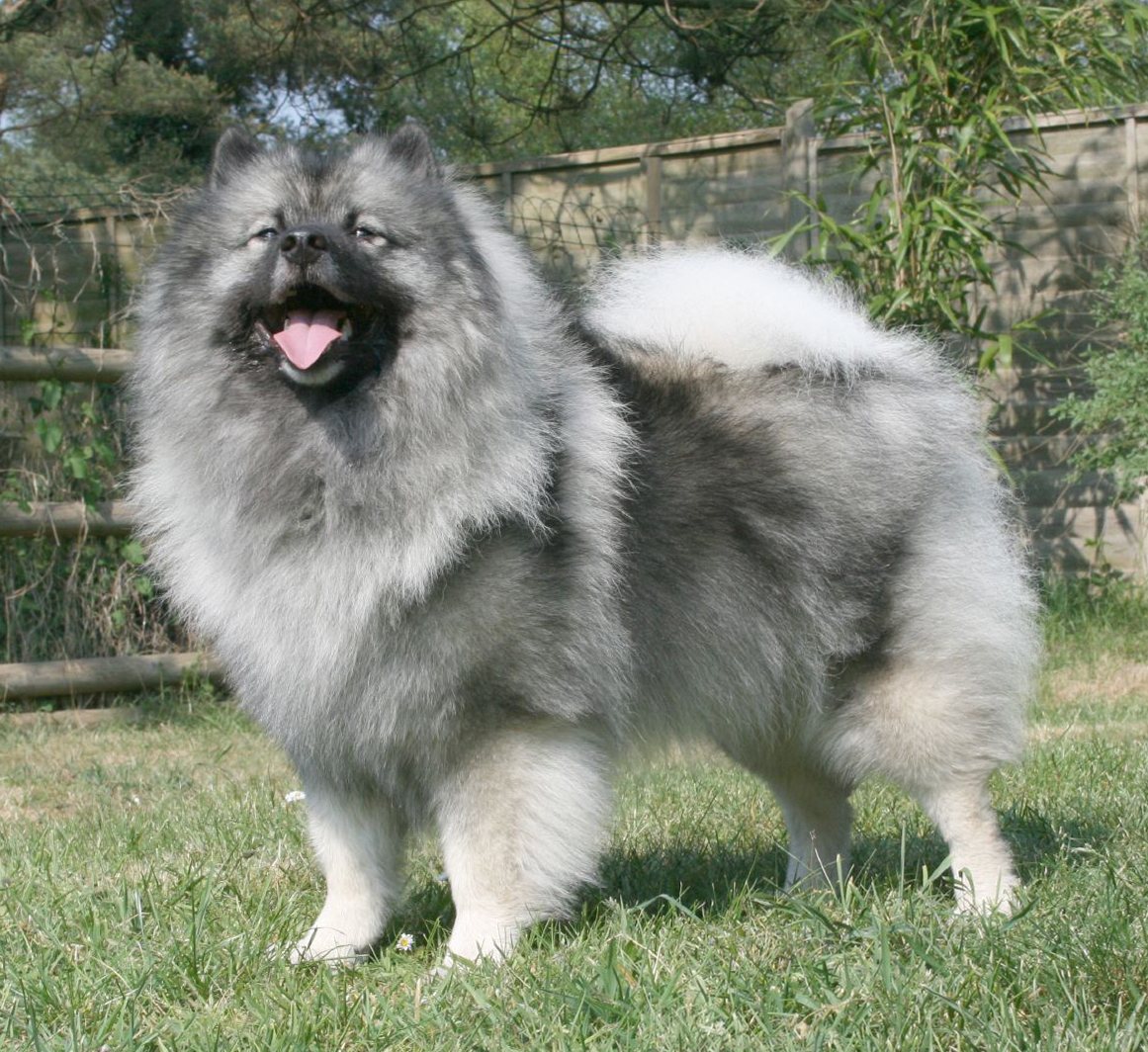
The wolf-grey coat is the signature, with a pale grey to cream undercoat, black-tipped guard hairs, a dense mane, and the distinctive spectacles, a line of shading running from the outer corner of each eye towards the ear. Dogs stand about 46 cm and carry the tail tightly curled on the back with a black tip. A stud should show clear markings and a sound, sociable nature, and it should not be shrill.
The DNA test for primary hyperparathyroidism is specific to this breed and a stud owner should be able to show the result, since the disease raises blood calcium and is easily missed in its early stages. A patella assessment, hip scoring and an annual eye examination are the additions. Epilepsy occurs and no test exists, so ask directly about seizures in the family, and ask whether the dog has ever lost coat and failed to regrow it.
Health & breeding
We check every hip, elbow, eye and DNA result you give us against the Royal Kennel Club’s public records by hand, and we record who checked it and when. The Royal Kennel Club’s public records may not include all the screening a dog has had, so a dog with no Royal Kennel Club record showing is not necessarily untested.
Breed Right’s summary — under The Royal Kennel Club Health Standard
Health tests for the Keeshond
This panel is Breed Right’s summary of the testing that matters for the breed under The Royal Kennel Club Health Standard. The Health Standard is the Royal Kennel Club’s guidance for breeders, not a registration rule. It describes tests to ask about — it is not a report on any individual dog. The Royal Kennel Club’s public records may not include all the screening a dog has had, so a dog with no Royal Kennel Club record showing is not necessarily untested.
Good Practice — the Royal Kennel Club’s minimum before breeding
The tests the Royal Kennel Club says breeders should, at a minimum, complete before breeding.
| Test | Type | Scheme | What’s involved |
|---|---|---|---|
| Hip score (BVA/KC) | Screening scheme | BVA/KC | Total of both hips, 0–106. Lower is better. |
| Elbow grading (BVA/KC) | Screening scheme | BVA/KC | Grade 0–3. The dog is graded on the worse of the two elbows. |
Best Practice — further tests it recommends
Completing these as well as the Good Practice tests is what the Royal Kennel Club calls Best Practice.
| Test | Type | Scheme | What’s involved |
|---|---|---|---|
| DNA test — PHPT (Primary Hyperparathyroidism) | DNA test | Laboratory | The result printed on the laboratory certificate. |
| Eye testing (BVA/KC/ISDS) | Screening scheme | BVA/KC/ISDS | Result printed on the eye certificate. |
Breed hip median
Breed median 10 (BVA Hip Dysplasia Scheme breed statistics 2025 — 5 years, 61 dogs scored). Lower is better. Source · How hip scores work
At stud now
Keeshond stud dogs
No Keeshond studs are listed right now
When a Keeshond on the Royal Kennel Club Breed Register is listed at stud, it will appear here.
Also available
Keeshond litters
No Keeshond litters are listed right now
Litters appear here as breeders list them. Check back soon, or browse other breeds.