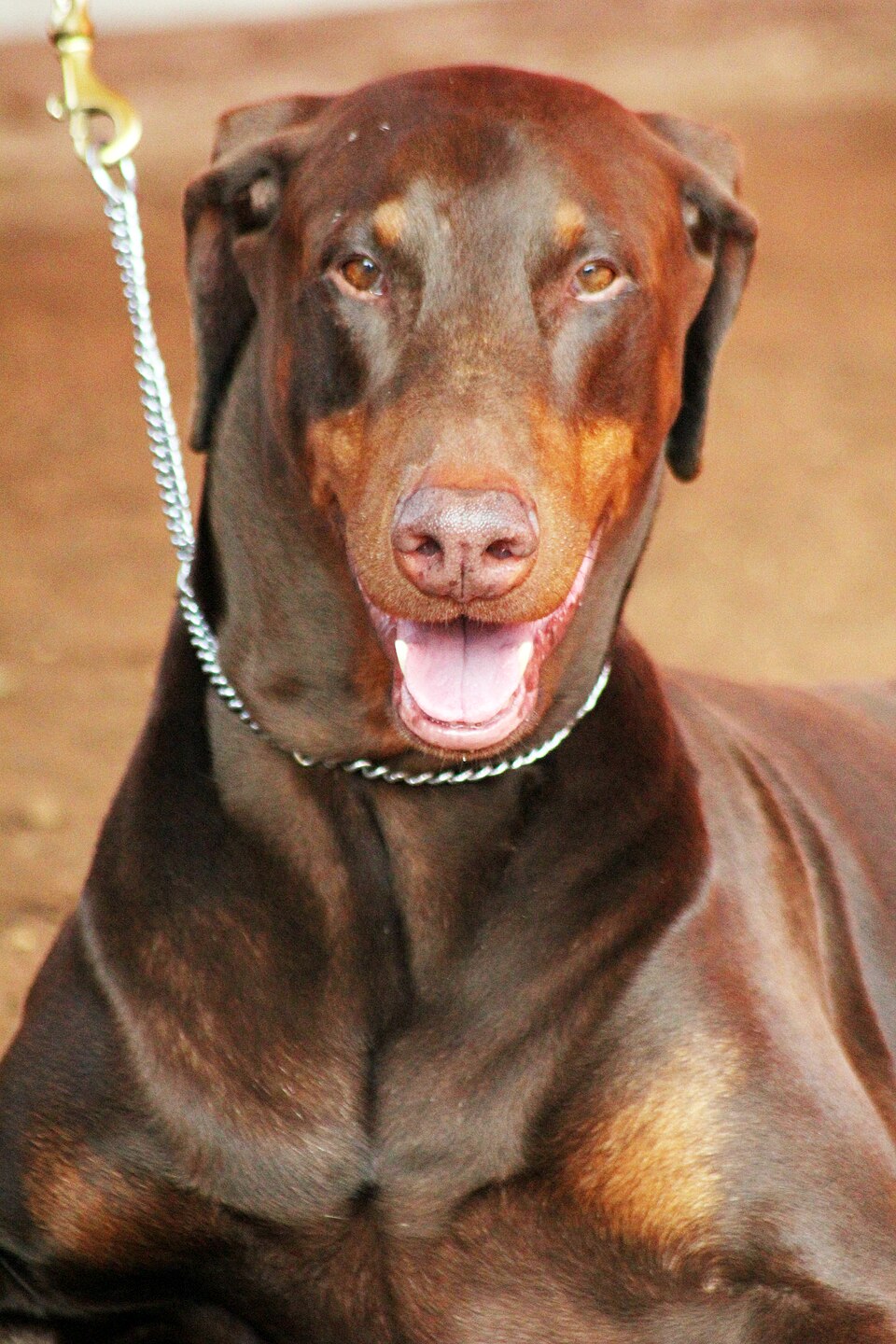
Dobermann
The Dobermann was created in the 1880s by Louis Dobermann, a German tax collector who wanted a protection dog to accompany him on his rounds, and it was assembled quickly from…
About the Dobermann
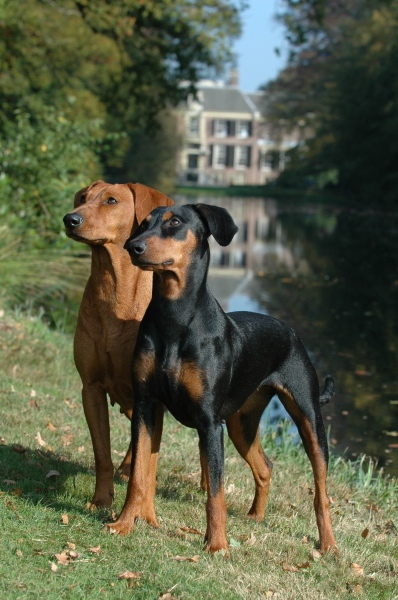
The Dobermann was created in the 1880s by Louis Dobermann, a German tax collector who wanted a protection dog to accompany him on his rounds, and it was assembled quickly from several breeds into one of the most recognisable outlines in dogdom. It is a working guard first and a companion second, though it is affectionate with its own family.
Dogs stand about 69 cm, lean and athletic, with a short hard coat in black, brown, blue or fawn, each with rust markings. Ears are no longer cropped and tails no longer docked in Britain. The breed standard asks for a bold, adaptable temperament, and a stud that is confident and stable rather than sharp is what a responsible breeding needs.
Two health questions matter more than the rest. Dilated cardiomyopathy affects a large proportion of Dobermanns; ask for annual cardiac screening by echocardiography with Holter monitoring, not a stethoscope check alone, and for the DNA results for the DCM1 and DCM2 markers. Von Willebrand's disease type I has a well-established DNA test. Add hip scores, a current eye certificate, and a question about cervical spondylomyelopathy, the wobbler syndrome.
Health & breeding
We check every hip, elbow, eye and DNA result you give us against the Royal Kennel Club’s public records by hand, and we record who checked it and when. The Royal Kennel Club’s public records may not include all the screening a dog has had, so a dog with no Royal Kennel Club record showing is not necessarily untested.
Breed Right’s summary — under The Royal Kennel Club Health Standard
Health tests for the Dobermann
This panel is Breed Right’s summary of the testing that matters for the breed under The Royal Kennel Club Health Standard. The Health Standard is the Royal Kennel Club’s guidance for breeders, not a registration rule. It describes tests to ask about — it is not a report on any individual dog. The Royal Kennel Club’s public records may not include all the screening a dog has had, so a dog with no Royal Kennel Club record showing is not necessarily untested.
Good Practice — the Royal Kennel Club’s minimum before breeding
The tests the Royal Kennel Club says breeders should, at a minimum, complete before breeding.
| Test | Type | Scheme | What’s involved |
|---|---|---|---|
| DNA test — vWD1 (von Willebrand Disease type 1) | DNA test | Laboratory | The result printed on the laboratory certificate. |
Best Practice — further tests it recommends
Completing these as well as the Good Practice tests is what the Royal Kennel Club calls Best Practice.
| Test | Type | Scheme | What’s involved |
|---|---|---|---|
| DNA test — DINGS2 (Dobermann early-onset deafness and vestibular disease) | DNA test | Laboratory | The result printed on the laboratory certificate. |
| Hip score (BVA/KC) | Screening scheme | BVA/KC | Total of both hips, 0–106. Lower is better. |
| Eye testing (BVA/KC/ISDS) | Screening scheme | BVA/KC/ISDS | Result printed on the eye certificate. |
Breed hip median
Breed median 10 (BVA Hip Dysplasia Scheme breed statistics 2025 — 5 years, 359 dogs scored). Lower is better. Source · How hip scores work
At stud now
Dobermann stud dogs
No Dobermann studs are listed right now
When a Dobermann on the Royal Kennel Club Breed Register is listed at stud, it will appear here.
Also available
Dobermann litters
No Dobermann litters are listed right now
Litters appear here as breeders list them. Check back soon, or browse other breeds.