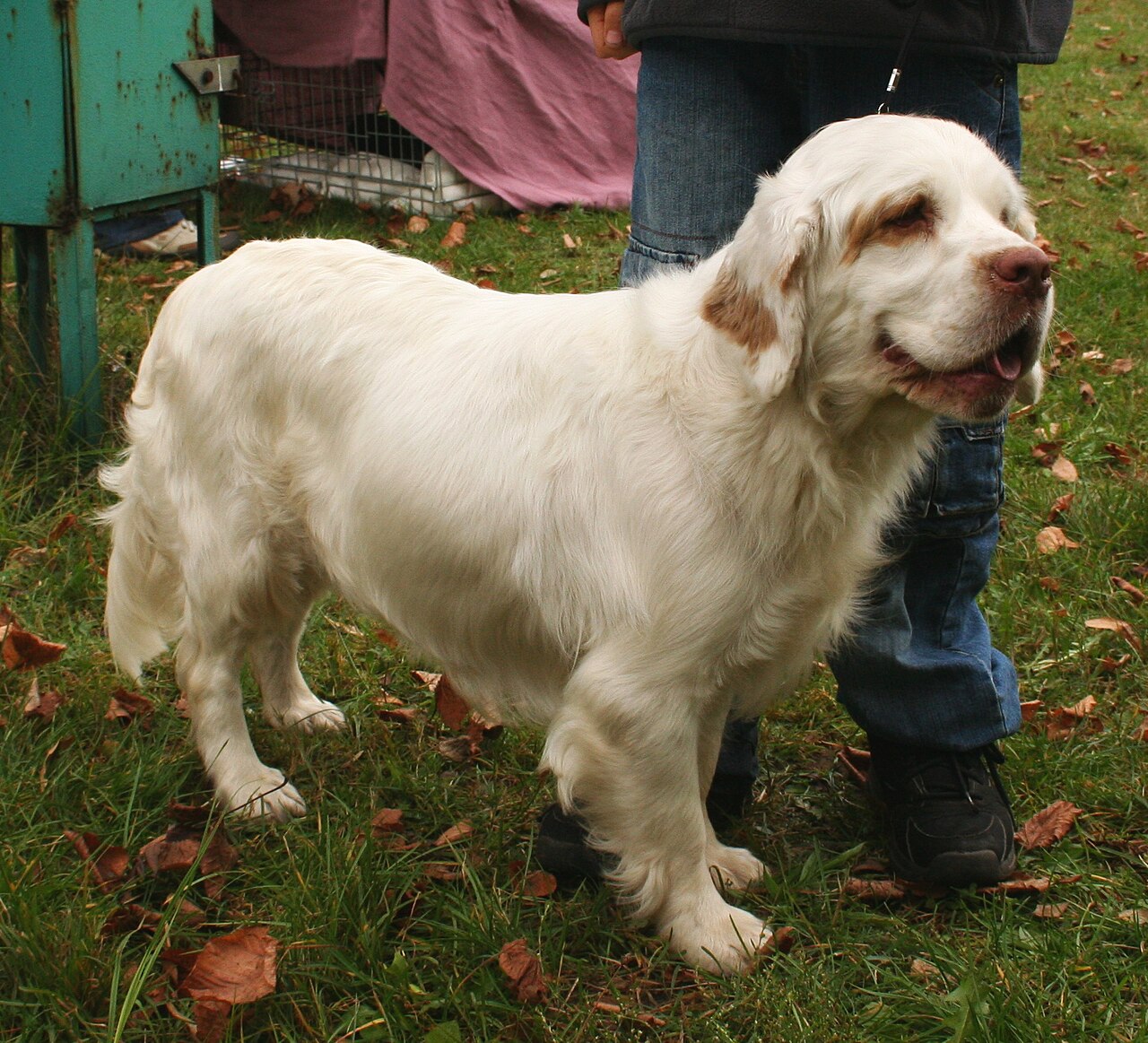
Clumber Spaniel
The Clumber Spaniel is the heaviest of the spaniels, named for Clumber Park in Nottinghamshire, where the Duke of Newcastle's kennel established the type in the eighteenth…
About the Clumber Spaniel
The Clumber Spaniel is the heaviest of the spaniels, named for Clumber Park in Nottinghamshire, where the Duke of Newcastle's kennel established the type in the eighteenth century. It was bred to push game out of dense cover in front of a small party of walking guns, working slowly and silently rather than fast and wide.
Dogs weigh around 29.5 to 34.5 kg on short legs and a long body, plain white with lemon or orange markings, chiefly about the head. The standard has been steered away from exaggeration in recent years, and a stud that moves freely, carries no surplus weight and shows a clean, tight eye rim is exactly the direction the breed clubs are pulling in.
There is a DNA test for pyruvate dehydrogenase phosphatase deficiency, which causes exercise intolerance in this breed, and a stud owner should have the result to hand. Hip scoring matters a great deal, since the breed's mean score sits among the higher figures on the BVA/KC scheme, so ask for the number and how it compares with the current breed mean. An eye examination should cover the lids as well as the retina, and with a vulnerable native breed the inbreeding coefficient deserves a question too.
Health & breeding
We check every hip, elbow, eye and DNA result you give us against the Royal Kennel Club’s public records by hand, and we record who checked it and when. The Royal Kennel Club’s public records may not include all the screening a dog has had, so a dog with no Royal Kennel Club record showing is not necessarily untested.
Breed Right’s summary — under The Royal Kennel Club Health Standard
Health tests for the Clumber Spaniel
This panel is Breed Right’s summary of the testing that matters for the breed under The Royal Kennel Club Health Standard. The Health Standard is the Royal Kennel Club’s guidance for breeders, not a registration rule. It describes tests to ask about — it is not a report on any individual dog. The Royal Kennel Club’s public records may not include all the screening a dog has had, so a dog with no Royal Kennel Club record showing is not necessarily untested.
Good Practice — the Royal Kennel Club’s minimum before breeding
The tests the Royal Kennel Club says breeders should, at a minimum, complete before breeding.
| Test | Type | Scheme | What’s involved |
|---|---|---|---|
| DNA test — EIC (Exercise Induced Collapse) | DNA test | Laboratory | The result printed on the laboratory certificate. |
| Hip score (BVA/KC) | Screening scheme | BVA/KC | Total of both hips, 0–106. Lower is better. |
| Elbow grading (BVA/KC) | Screening scheme | BVA/KC | Grade 0–3. The dog is graded on the worse of the two elbows. |
| Eye testing (BVA/KC/ISDS) | Screening scheme | BVA/KC/ISDS | Result printed on the eye certificate. |
Best Practice — further tests it recommends
Completing these as well as the Good Practice tests is what the Royal Kennel Club calls Best Practice.
| Test | Type | Scheme | What’s involved |
|---|---|---|---|
| DNA test — PDP1 (Pyruvate Dehydrogenase Deficiency) | DNA test | Laboratory | The result printed on the laboratory certificate. |
Breed hip median
Breed median 10 (BVA Hip Dysplasia Scheme breed statistics 2025 — 5 years, 259 dogs scored). Lower is better. Source · How hip scores work
At stud now
Clumber Spaniel stud dogs
No Clumber Spaniel studs are listed right now
When a Clumber Spaniel on the Royal Kennel Club Breed Register is listed at stud, it will appear here.
Also available
Clumber Spaniel litters
No Clumber Spaniel litters are listed right now
Litters appear here as breeders list them. Check back soon, or browse other breeds.