Chesapeake Bay Retriever
The Chesapeake Bay Retriever traces to two puppies saved from a shipwreck off Maryland in 1807 and was developed by market gunners who needed a dog capable of dozens of retrieves…
About the Chesapeake Bay Retriever
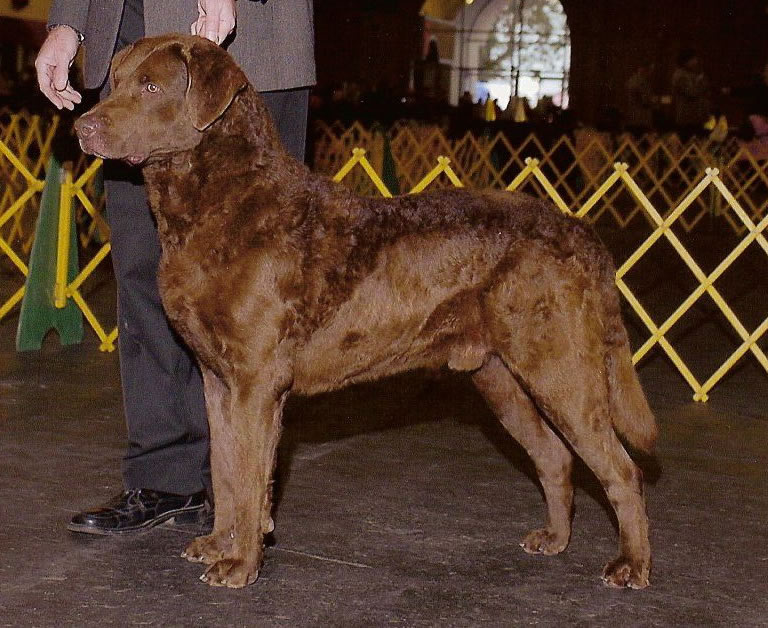
The Chesapeake Bay Retriever traces to two puppies saved from a shipwreck off Maryland in 1807 and was developed by market gunners who needed a dog capable of dozens of retrieves from freezing tidal water in a single day. It is the hardest of the retrievers in every sense, and it was never bred to be biddable the way a Labrador is.
The jacket is oily, harsh and wavy, no more than about four centimetres long, in shades of dead grass, sedge and brown that vanish against a marsh. Dogs stand 58 to 66 cm and are powerfully built, with amber eyes. There is a guarding streak and real independence here; a stud must be confident and sound with people, because a Chesapeake that is sharp will hand that on.
The DNA tests to ask for are prcd-PRA, exercise-induced collapse and degenerative myelopathy, all three in established use in the breed. Add hip and elbow scores and an annual eye examination. Ask about the dog's own working fitness too, since a heavy, unfit Chesapeake is not what this breed was built for, and ask how its relatives have aged.
Health & breeding
We check every hip, elbow, eye and DNA result you give us against the Royal Kennel Club’s public records by hand, and we record who checked it and when. The Royal Kennel Club’s public records may not include all the screening a dog has had, so a dog with no Royal Kennel Club record showing is not necessarily untested.
Breed Right’s summary — under The Royal Kennel Club Health Standard
Health tests for the Chesapeake Bay Retriever
This panel is Breed Right’s summary of the testing that matters for the breed under The Royal Kennel Club Health Standard. The Health Standard is the Royal Kennel Club’s guidance for breeders, not a registration rule. It describes tests to ask about — it is not a report on any individual dog. The Royal Kennel Club’s public records may not include all the screening a dog has had, so a dog with no Royal Kennel Club record showing is not necessarily untested.
Good Practice — the Royal Kennel Club’s minimum before breeding
The tests the Royal Kennel Club says breeders should, at a minimum, complete before breeding.
| Test | Type | Scheme | What’s involved |
|---|---|---|---|
| DNA test — DM (Degenerative Myelopathy, SOD1 risk test) | DNA test | Laboratory | SOD1 risk test: clear, carrier or at risk (affected). |
| Hip score (BVA/KC) | Screening scheme | BVA/KC | Total of both hips, 0–106. Lower is better. |
| Elbow grading (BVA/KC) | Screening scheme | BVA/KC | Grade 0–3. The dog is graded on the worse of the two elbows. |
Best Practice — further tests it recommends
Completing these as well as the Good Practice tests is what the Royal Kennel Club calls Best Practice.
| Test | Type | Scheme | What’s involved |
|---|---|---|---|
| DNA test — prcd-PRA (Progressive Retinal Atrophy) | DNA test | Laboratory | The result printed on the laboratory certificate. |
| Eye testing (BVA/KC/ISDS) | Screening scheme | BVA/KC/ISDS | Result printed on the eye certificate. |
Breed hip median
Breed median 8 (BVA Hip Dysplasia Scheme breed statistics 2025 — 5 years, 52 dogs scored). Lower is better. Source · How hip scores work
At stud now
Chesapeake Bay Retriever stud dogs
No Chesapeake Bay Retriever studs are listed right now
When a Chesapeake Bay Retriever on the Royal Kennel Club Breed Register is listed at stud, it will appear here.
Also available
Chesapeake Bay Retriever litters
No Chesapeake Bay Retriever litters are listed right now
Litters appear here as breeders list them. Check back soon, or browse other breeds.