Miniature Pinscher
Despite the resemblance, the Miniature Pinscher is not a shrunken Dobermann. It is the older breed of the two, developed in Germany from the German Pinscher with terrier and…
About the Miniature Pinscher
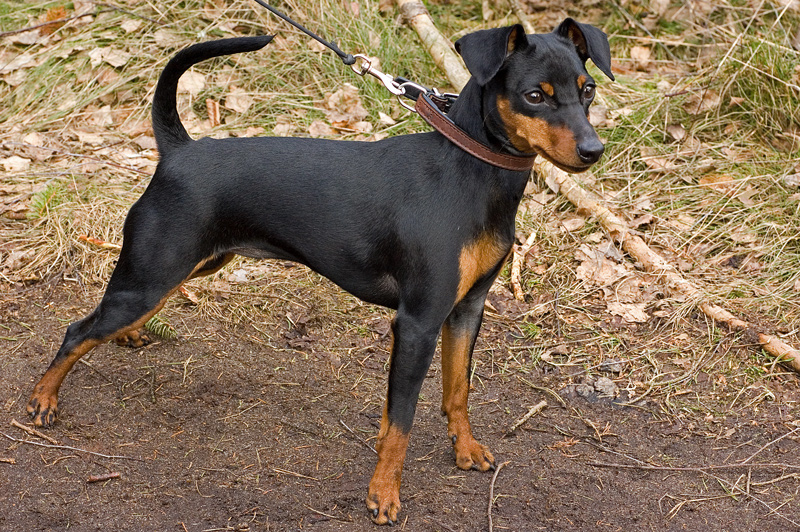
Despite the resemblance, the Miniature Pinscher is not a shrunken Dobermann. It is the older breed of the two, developed in Germany from the German Pinscher with terrier and dachshund influence to kill rats in stables and homes, and Germans call it the Zwergpinscher, the dwarf pinscher.
Standing about 25 to 30 cm, it is square, hard-muscled and smooth-coated in black and tan, chocolate and tan or solid red, with a short, dense coat that needs almost nothing doing to it. The gait is the breed's signature: a high-stepping hackney action with the front foot lifted and flexed at each stride. A stud should be well muscled and confident, and should carry that distinctive movement naturally rather than as an exaggeration.
Ask for a patella examination and a current eye certificate, as progressive retinal atrophy and cataract occur in the breed. Legg-Calvé-Perthes disease affects the hip joint of young dogs of this size and is worth raising directly. Ask the owner which DNA tests the breed clubs currently recommend, as the panel for this breed has changed over time. Thyroid function, dental health and any history of epilepsy in close relatives all deserve a question.
Health & breeding
We check every hip, elbow, eye and DNA result you give us against the Royal Kennel Club’s public records by hand, and we record who checked it and when. The Royal Kennel Club’s public records may not include all the screening a dog has had, so a dog with no Royal Kennel Club record showing is not necessarily untested.
Breed Right’s summary — under The Royal Kennel Club Health Standard
Health tests for the Miniature Pinscher
This panel is Breed Right’s summary of the testing that matters for the breed under The Royal Kennel Club Health Standard. The Health Standard is the Royal Kennel Club’s guidance for breeders, not a registration rule. It describes tests to ask about — it is not a report on any individual dog. The Royal Kennel Club’s public records may not include all the screening a dog has had, so a dog with no Royal Kennel Club record showing is not necessarily untested.
Best Practice — further tests it recommends
Completing these as well as the Good Practice tests is what the Royal Kennel Club calls Best Practice.
| Test | Type | Scheme | What’s involved |
|---|---|---|---|
| Eye testing (BVA/KC/ISDS) | Screening scheme | BVA/KC/ISDS | Result printed on the eye certificate. |
Breed club schemes listed in the Health Standard
Run by the breed club, not the Royal Kennel Club, which does not record their results. The Standard lists them as schemes to be aware of.
| Test | Type | Scheme | What’s involved |
|---|---|---|---|
| Patella examination (breed club scheme) | Other | Breed club | Putnam grade 0–4 per stifle. |
Breed hip median
Too few dogs of this breed have been scored (BVA Hip Dysplasia Scheme breed statistics 2025 — 15 years: 1 dog) to give a meaningful breed median. Source · How hip scores work
At stud now
Miniature Pinscher stud dogs
No Miniature Pinscher studs are listed right now
When a Miniature Pinscher on the Royal Kennel Club Breed Register is listed at stud, it will appear here.
Also available
Miniature Pinscher litters
No Miniature Pinscher litters are listed right now
Litters appear here as breeders list them. Check back soon, or browse other breeds.