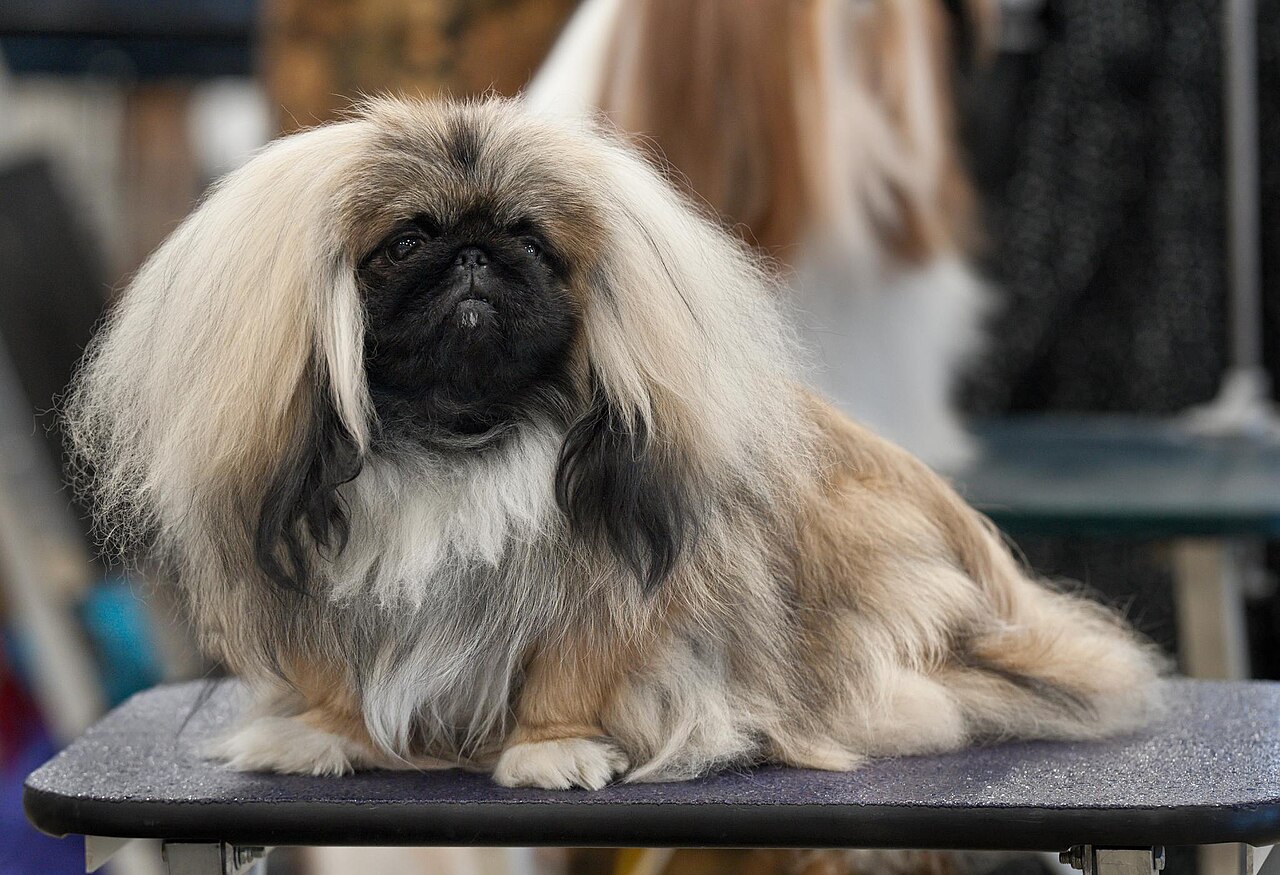
Pekingese
Bred inside the Chinese imperial palaces for a thousand years and unknown outside them until British soldiers took dogs from the Summer Palace in 1860, the Pekingese was created…
About the Pekingese
Bred inside the Chinese imperial palaces for a thousand years and unknown outside them until British soldiers took dogs from the Summer Palace in 1860, the Pekingese was created to resemble the lion of Buddhist symbolism and to live as a court companion. The rolling gait, the broad flat face and the mane of coat all come from that deliberate design, and none of them came from any practical job.
The standard sets a weight of up to 5 kg for dogs, on a low, heavy-fronted body with a profuse straight coat and thick feathering on the ears, legs and tail, in any colour. This is a breed on the Royal Kennel Club's Breed Watch list, and the visible points matter: nostrils that are genuinely open, a nose that is not sunk between the eyes, eyes that are not excessively prominent, a muzzle with some substance to it, and skin folds that are shallow and dry.
Breathing leads the health conversation. Ask whether the stud has had a respiratory assessment by a vet experienced in brachycephalic breeds, and watch him after exercise rather than at rest. Ask for a current eye certificate, since corneal ulceration and exposure damage are common. Spinal problems, heat intolerance, skin fold infection and whelping difficulty are all fair questions, and caesarean history in the line is one worth asking about plainly.
Health & breeding
We check every hip, elbow, eye and DNA result you give us against the Royal Kennel Club’s public records by hand, and we record who checked it and when. The Royal Kennel Club’s public records may not include all the screening a dog has had, so a dog with no Royal Kennel Club record showing is not necessarily untested.
Breed Right’s summary — under The Royal Kennel Club Health Standard
Health tests for the Pekingese
This panel is Breed Right’s summary of the testing that matters for the breed under The Royal Kennel Club Health Standard. The Health Standard is the Royal Kennel Club’s guidance for breeders, not a registration rule. It describes tests to ask about — it is not a report on any individual dog. The Royal Kennel Club’s public records may not include all the screening a dog has had, so a dog with no Royal Kennel Club record showing is not necessarily untested.
Best Practice — further tests it recommends
Completing these as well as the Good Practice tests is what the Royal Kennel Club calls Best Practice.
| Test | Type | Scheme | What’s involved |
|---|---|---|---|
| Eye testing (BVA/KC/ISDS) | Screening scheme | BVA/KC/ISDS | Result printed on the eye certificate. |
| Breathing grading — BOAS (RKC Respiratory Function Grading Scheme) | Screening scheme | RKC | Grade 0–3; 0 is clinically unaffected. |
At stud now
Pekingese stud dogs
No Pekingese studs are listed right now
When a Pekingese on the Royal Kennel Club Breed Register is listed at stud, it will appear here.
Also available
Pekingese litters
No Pekingese litters are listed right now
Litters appear here as breeders list them. Check back soon, or browse other breeds.