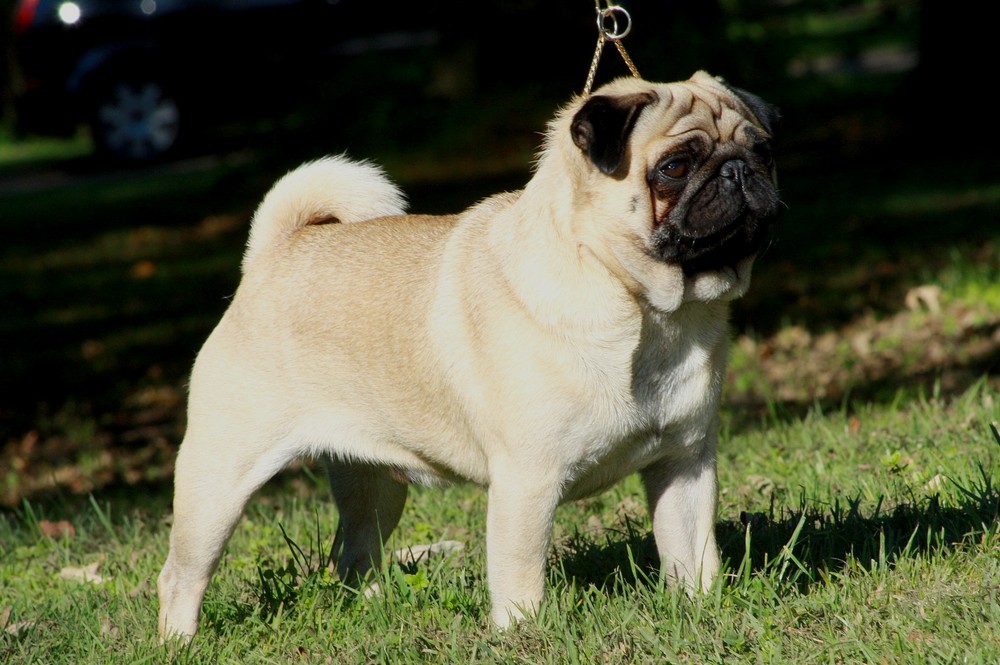
Pug
The Pug is one of the oldest companion breeds, kept in Chinese imperial households before it reached Europe with Dutch traders in the sixteenth century, and it has never had any…
About the Pug
The Pug is one of the oldest companion breeds, kept in Chinese imperial households before it reached Europe with Dutch traders in the sixteenth century, and it has never had any job but being with people. The breed motto, multum in parvo, a lot in a little, describes both the body and the personality.
Pugs weigh about 6.3 to 8.1 kg, square and cobby, in fawn, black, silver or apricot with a black mask. The breed's flat face has made it the centre of a welfare debate, and the Royal Kennel Club now runs a Respiratory Function Grading Scheme for Pugs; a stud with a grade 0 or 1 under the scheme is the single most useful thing a breeder can look for. A moderate muzzle and open nostrils are visible without any paperwork.
Beyond breathing, ask a Pug stud owner for a current eye certificate, since corneal ulcers and pigmentary keratitis are common, and for the DNA risk-marker test for necrotising meningoencephalitis, known as Pug dog encephalitis. Ask about spinal X-rays for hemivertebrae, about patella examination and hip scores, and about the stud's weight, because obesity worsens every problem the breed has.
Health & breeding
We check every hip, elbow, eye and DNA result you give us against the Royal Kennel Club’s public records by hand, and we record who checked it and when. The Royal Kennel Club’s public records may not include all the screening a dog has had, so a dog with no Royal Kennel Club record showing is not necessarily untested.
Breed Right’s summary — under The Royal Kennel Club Health Standard
Health tests for the Pug
This panel is Breed Right’s summary of the testing that matters for the breed under The Royal Kennel Club Health Standard. The Health Standard is the Royal Kennel Club’s guidance for breeders, not a registration rule. It describes tests to ask about — it is not a report on any individual dog. The Royal Kennel Club’s public records may not include all the screening a dog has had, so a dog with no Royal Kennel Club record showing is not necessarily untested.
Good Practice — the Royal Kennel Club’s minimum before breeding
The tests the Royal Kennel Club says breeders should, at a minimum, complete before breeding.
| Test | Type | Scheme | What’s involved |
|---|---|---|---|
| Eye testing (BVA/KC/ISDS) | Screening scheme | BVA/KC/ISDS | Result printed on the eye certificate. |
| Breathing grading — BOAS (RKC Respiratory Function Grading Scheme) | Screening scheme | RKC | Grade 0–3; 0 is clinically unaffected. |
Best Practice — further tests it recommends
Completing these as well as the Good Practice tests is what the Royal Kennel Club calls Best Practice.
| Test | Type | Scheme | What’s involved |
|---|---|---|---|
| DNA test — PDE (Pug Dog Encephalitis, risk test) | DNA test | Laboratory | Minimal risk (0 or 1) or increased risk (2). |
| Hip score (BVA/KC) | Screening scheme | BVA/KC | Total of both hips, 0–106. Lower is better. |
Breed club schemes listed in the Health Standard
Run by the breed club, not the Royal Kennel Club, which does not record their results. The Standard lists them as schemes to be aware of.
| Test | Type | Scheme | What’s involved |
|---|---|---|---|
| Breed club health scheme (named in the result) | Other | Breed club | Name the scheme and the outcome. |
Breed hip median
Too few dogs of this breed have been scored (BVA Hip Dysplasia Scheme breed statistics 2025 — 5 years: 4 dogs) to give a meaningful breed median. Source · How hip scores work
At stud now
Pug stud dogs
No Pug studs are listed right now
When a Pug on the Royal Kennel Club Breed Register is listed at stud, it will appear here.
Also available
Pug litters
No Pug litters are listed right now
Litters appear here as breeders list them. Check back soon, or browse other breeds.