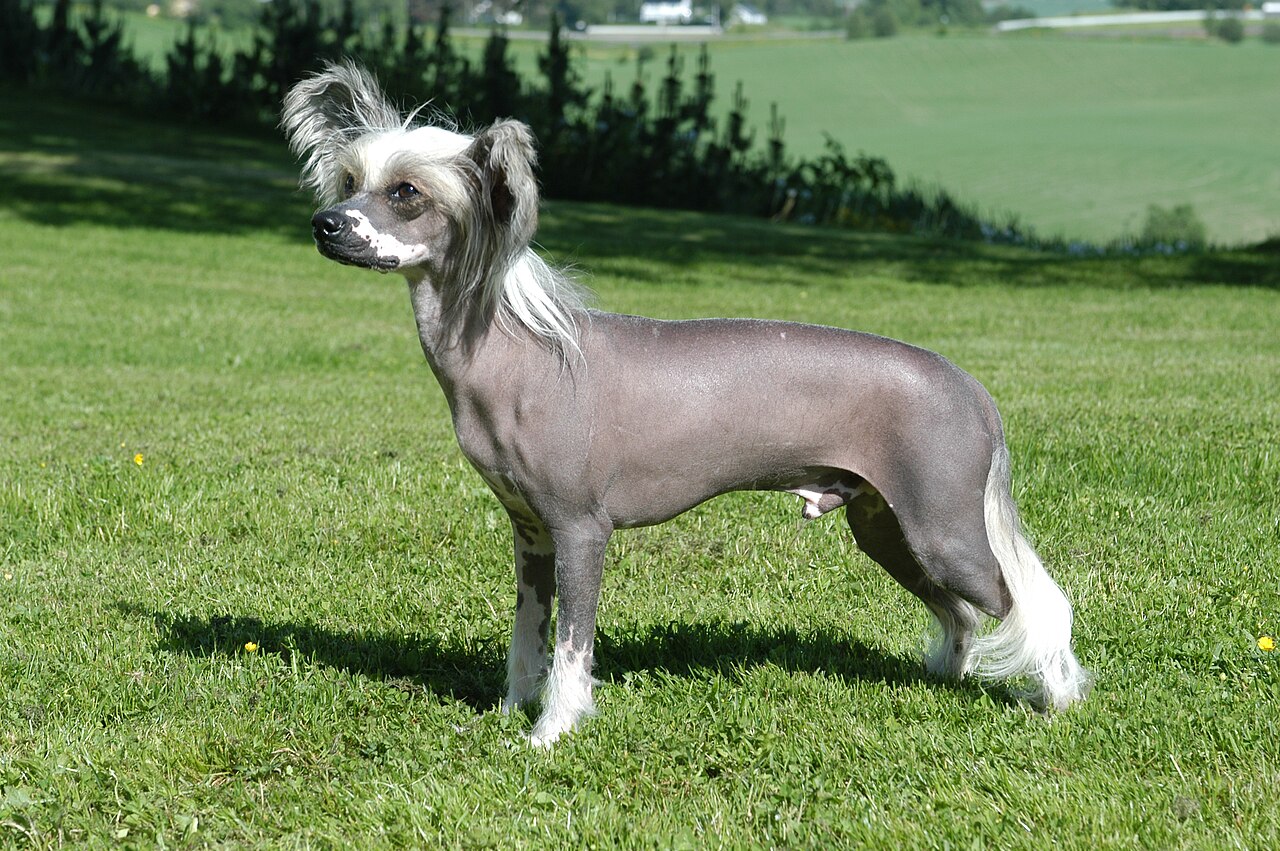
Chinese Crested
Nobody is certain how the Chinese Crested reached China, though hairless dogs of similar type were carried on trading ships for centuries and turn up in ports around the world…
About the Chinese Crested
Nobody is certain how the Chinese Crested reached China, though hairless dogs of similar type were carried on trading ships for centuries and turn up in ports around the world. The breed comes in two coats which appear in the same litter: the hairless, with hair on the head, feet and tail only, and the fully coated powderpuff, covered in a soft veil of hair.
Height runs to about 23 to 33 cm, with the fine-boned deer type and the heavier cobby type both permitted. The genetics behind the coat matter for breeding: the hairless gene is dominant, and the double dose is not viable, so hairless-to-hairless matings lose puppies before birth. Powderpuffs are therefore essential to the breed rather than a by-product, and a hairless to powderpuff mating is the sound choice. Hairless skin needs sun protection and washing, and the hairless dogs often have incomplete dentition, which is linked to the same gene and is not a fault to breed away from at the expense of health.
Ask for the DNA results for progressive retinal atrophy of the prcd form and for primary lens luxation, both established in the breed, and for a current eye certificate. A patella examination matters, as does a question about Legg-Calvé-Perthes disease and about skin problems and allergies in the line.
Health & breeding
We check every hip, elbow, eye and DNA result you give us against the Royal Kennel Club’s public records by hand, and we record who checked it and when. The Royal Kennel Club’s public records may not include all the screening a dog has had, so a dog with no Royal Kennel Club record showing is not necessarily untested.
Breed Right’s summary — under The Royal Kennel Club Health Standard
Health tests for the Chinese Crested
This panel is Breed Right’s summary of the testing that matters for the breed under The Royal Kennel Club Health Standard. The Health Standard is the Royal Kennel Club’s guidance for breeders, not a registration rule. It describes tests to ask about — it is not a report on any individual dog. The Royal Kennel Club’s public records may not include all the screening a dog has had, so a dog with no Royal Kennel Club record showing is not necessarily untested.
Best Practice — further tests it recommends
Completing these as well as the Good Practice tests is what the Royal Kennel Club calls Best Practice.
| Test | Type | Scheme | What’s involved |
|---|---|---|---|
| DNA test — prcd-PRA (Progressive Retinal Atrophy) | DNA test | Laboratory | The result printed on the laboratory certificate. |
| DNA test — PLL (Primary Lens Luxation) | DNA test | Laboratory | The result printed on the laboratory certificate. |
Breed hip median
Too few dogs of this breed have been scored (BVA Hip Dysplasia Scheme breed statistics 2025 — 15 years: 2 dogs) to give a meaningful breed median. Source · How hip scores work
At stud now
Chinese Crested stud dogs
No Chinese Crested studs are listed right now
When a Chinese Crested on the Royal Kennel Club Breed Register is listed at stud, it will appear here.
Also available
Chinese Crested litters
No Chinese Crested litters are listed right now
Litters appear here as breeders list them. Check back soon, or browse other breeds.