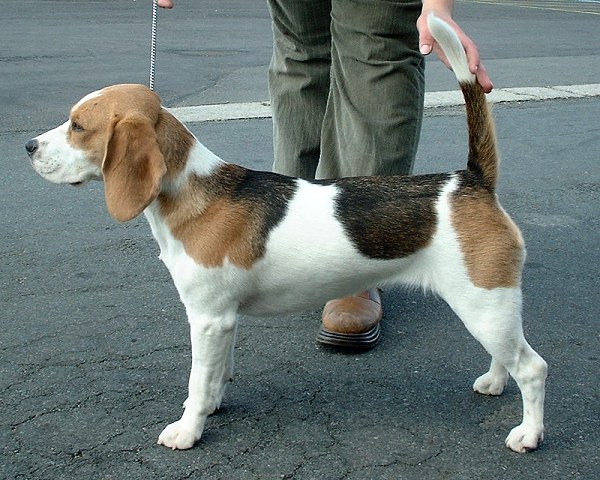
Beagle
The Beagle is Britain's scent hound in miniature, bred for centuries to hunt hare in a pack on foot, and the pack instinct has never left it. A Beagle wants company, will follow a…
About the Beagle
The Beagle is Britain's scent hound in miniature, bred for centuries to hunt hare in a pack on foot, and the pack instinct has never left it. A Beagle wants company, will follow a scent through any fence, and has a voice designed to be heard across a valley.
The breed stands about 33 to 40 cm, sturdy and compact, with a short weatherproof coat in any recognised hound colour, most often tricolour or lemon and white. Beagles are food-driven and put on weight easily, so a stud in fit, hard condition is a better advertisement than a heavy one. Temperament should be outgoing and even; a shy Beagle is not typical.
The Beagle has several DNA tests worth asking a stud owner about: Musladin-Lueke syndrome, neonatal cerebellar cortical degeneration, factor VII deficiency and Imerslund-Gräsbeck syndrome. None is common, which is exactly why the tests exist. Ask about hip scores and a current eye certificate, and about steroid-responsive meningitis and epilepsy in the dog's close family, which are the conditions no DNA test can find.
Health & breeding
We check every hip, elbow, eye and DNA result you give us against the Royal Kennel Club’s public records by hand, and we record who checked it and when. The Royal Kennel Club’s public records may not include all the screening a dog has had, so a dog with no Royal Kennel Club record showing is not necessarily untested.
Breed Right’s summary — under The Royal Kennel Club Health Standard
Health tests for the Beagle
This panel is Breed Right’s summary of the testing that matters for the breed under The Royal Kennel Club Health Standard. The Health Standard is the Royal Kennel Club’s guidance for breeders, not a registration rule. It describes tests to ask about — it is not a report on any individual dog. The Royal Kennel Club’s public records may not include all the screening a dog has had, so a dog with no Royal Kennel Club record showing is not necessarily untested.
Good Practice — the Royal Kennel Club’s minimum before breeding
The tests the Royal Kennel Club says breeders should, at a minimum, complete before breeding.
| Test | Type | Scheme | What’s involved |
|---|---|---|---|
| DNA test — Lafora (Lafora’s Disease) | DNA test | Laboratory | The result printed on the laboratory certificate. |
| DNA test — NCCD (Neonatal Cerebellar Cortical Degeneration) | DNA test | Laboratory | The result printed on the laboratory certificate. |
Best Practice — further tests it recommends
Completing these as well as the Good Practice tests is what the Royal Kennel Club calls Best Practice.
| Test | Type | Scheme | What’s involved |
|---|---|---|---|
| DNA test — FVIID (Factor VII Deficiency) | DNA test | Laboratory | The result printed on the laboratory certificate. |
| DNA test — IGS (Imerslund-Gräsbeck Syndrome) | DNA test | Laboratory | The result printed on the laboratory certificate. |
| DNA test — MLS (Musladin-Lueke Syndrome) | DNA test | Laboratory | The result printed on the laboratory certificate. |
Breed hip median
Breed median 10 (BVA Hip Dysplasia Scheme breed statistics 2025 — 5 years, 5 dogs scored — indicative only, from a small sample). Lower is better. Source · How hip scores work
At stud now
Beagle stud dogs
No Beagle studs are listed right now
When a Beagle on the Royal Kennel Club Breed Register is listed at stud, it will appear here.
Also available
Beagle litters
No Beagle litters are listed right now
Litters appear here as breeders list them. Check back soon, or browse other breeds.