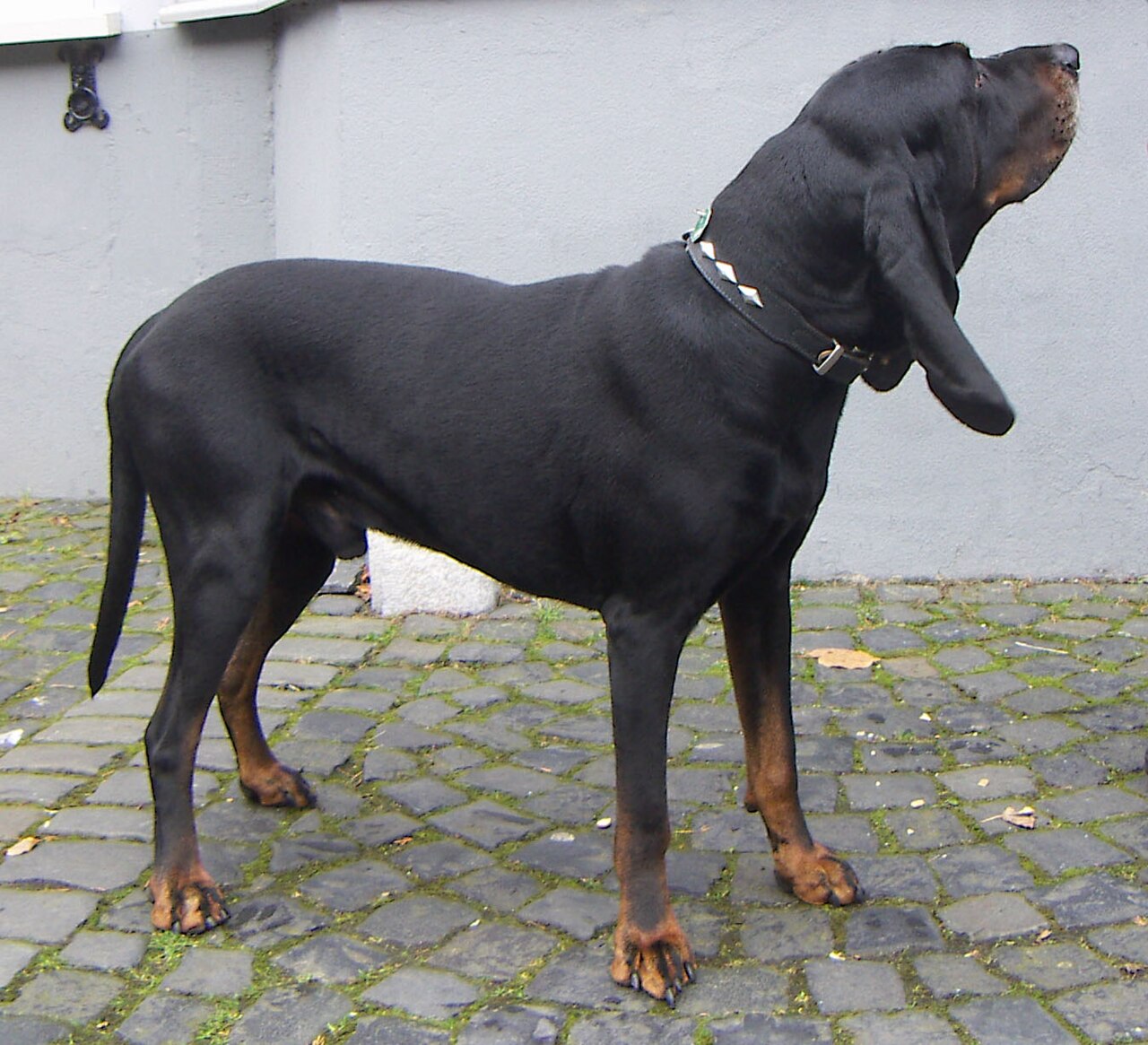
Black & Tan Coonhound
American hunters built the Black & Tan Coonhound from Bloodhound and Foxhound stock to work raccoon and opossum through the night, trailing by nose alone and then baying at the…
About the Black & Tan Coonhound
American hunters built the Black & Tan Coonhound from Bloodhound and Foxhound stock to work raccoon and opossum through the night, trailing by nose alone and then baying at the foot of the tree until the gun arrived. The voice is as much the point of the breed as the nose, and it carries a very long way.
This is a big, loose-skinned hound, dogs standing around 63 to 69 cm, coal black with clear tan markings over the eyes, on the muzzle, chest and legs. The ears are long and low-set, the expression soft, and the whole dog should look powerful without being cumbersome. Very few live in Britain, and those that do are usually in homes that understand a scent hound will follow its nose through a hedge and out of the county. A stud should be sound in movement, level in temperament and fit rather than heavy.
Ask for hip and elbow scores under the BVA/KC schemes, and for a current eye certificate, since drooping lower lids can cause trouble in a loose-skinned face. Chronic ear infection is worth a direct question, as is any history of bloat, which threatens deep-chested breeds of this build. In a small British population, ask as well how closely related the two dogs would be.
Health & breeding
We check every hip, elbow, eye and DNA result you give us against the Royal Kennel Club’s public records by hand, and we record who checked it and when. The Royal Kennel Club’s public records may not include all the screening a dog has had, so a dog with no Royal Kennel Club record showing is not necessarily untested.
Breed Right’s summary — under The Royal Kennel Club Health Standard
Health tests for the Black & Tan Coonhound
This panel is Breed Right’s summary of the testing that matters for the breed under The Royal Kennel Club Health Standard. The Health Standard is the Royal Kennel Club’s guidance for breeders, not a registration rule. It describes tests to ask about — it is not a report on any individual dog. The Royal Kennel Club’s public records may not include all the screening a dog has had, so a dog with no Royal Kennel Club record showing is not necessarily untested.
Good Practice — the Royal Kennel Club’s minimum before breeding
The tests the Royal Kennel Club says breeders should, at a minimum, complete before breeding.
| Test | Type | Scheme | What’s involved |
|---|---|---|---|
| Hip score (BVA/KC) | Screening scheme | BVA/KC | Total of both hips, 0–106. Lower is better. |
| Elbow grading (BVA/KC) | Screening scheme | BVA/KC | Grade 0–3. The dog is graded on the worse of the two elbows. |
Best Practice — further tests it recommends
Completing these as well as the Good Practice tests is what the Royal Kennel Club calls Best Practice.
| Test | Type | Scheme | What’s involved |
|---|---|---|---|
| Eye testing (BVA/KC/ISDS) | Screening scheme | BVA/KC/ISDS | Result printed on the eye certificate. |
Breed hip median
Breed median 11 (BVA Hip Dysplasia Scheme breed statistics 2025 — 5 years, 25 dogs scored — indicative only, from a small sample). Lower is better. Source · How hip scores work
At stud now
Black & Tan Coonhound stud dogs
No Black & Tan Coonhound studs are listed right now
When a Black & Tan Coonhound on the Royal Kennel Club Breed Register is listed at stud, it will appear here.
Also available
Black & Tan Coonhound litters
No Black & Tan Coonhound litters are listed right now
Litters appear here as breeders list them. Check back soon, or browse other breeds.