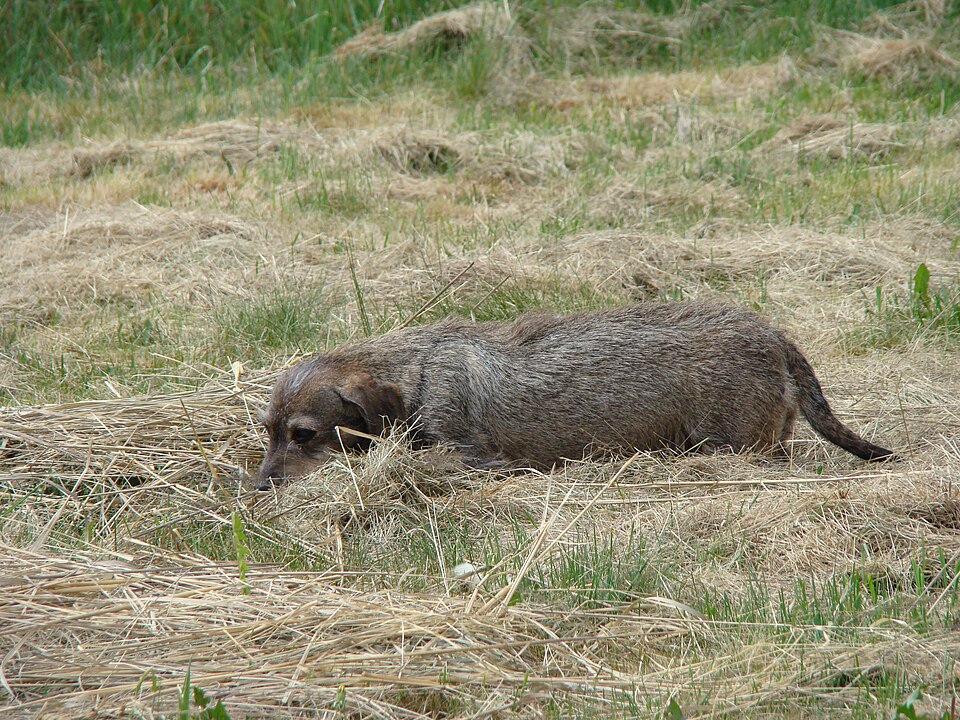
Dachshund (Wire Haired)
Terrier and schnauzer blood gave the Wire-haired Dachshund its harsh jacket and, along with it, a rather more forward attitude than the other coats carry. In continental Europe it…
About the Dachshund (Wire Haired)
Terrier and schnauzer blood gave the Wire-haired Dachshund its harsh jacket and, along with it, a rather more forward attitude than the other coats carry. In continental Europe it is still a genuine working dog, used underground and for tracking wounded game, and that background shows in the drive of a good one.
The coat is the defining feature: short, harsh and close over the body with a dense undercoat, a distinct beard and bushy eyebrows, and it should never be soft or shaggy. Standard dogs weigh in the region of 9 to 12 kg on the familiar long body and short legs. Wild boar is the classic colour, along with red, black and tan, and the various dapples and brindles. Here as in every variety, two dappled dogs must not be bred to one another.
Spinal screening comes before everything else. Ask which grade the dog was given on the breed council's IVDD radiograph and at what age the plate was taken, and treat an unscreened stud as an unknown quantity on the one problem this family of dogs is most likely to pass on. A current eye certificate should be part of the paperwork, and it is worth asking what DNA testing the owner considers appropriate for this particular coat.
Health & breeding
We check every hip, elbow, eye and DNA result you give us against the Royal Kennel Club’s public records by hand, and we record who checked it and when. The Royal Kennel Club’s public records may not include all the screening a dog has had, so a dog with no Royal Kennel Club record showing is not necessarily untested.
Breed Right’s summary — under The Royal Kennel Club Health Standard
Health tests for the Dachshund (Wire Haired)
This panel is Breed Right’s summary of the testing that matters for the breed under The Royal Kennel Club Health Standard. The Health Standard is the Royal Kennel Club’s guidance for breeders, not a registration rule. It describes tests to ask about — it is not a report on any individual dog. The Royal Kennel Club’s public records may not include all the screening a dog has had, so a dog with no Royal Kennel Club record showing is not necessarily untested.
Good Practice — the Royal Kennel Club’s minimum before breeding
The tests the Royal Kennel Club says breeders should, at a minimum, complete before breeding.
| Test | Type | Scheme | What’s involved |
|---|---|---|---|
| IVDD spine screening (RKC scheme, Dachshund Health UK) | Screening scheme | RKC | Grade 0–3 from one X-ray at 24–48 months. |
Best Practice — further tests it recommends
Completing these as well as the Good Practice tests is what the Royal Kennel Club calls Best Practice.
| Test | Type | Scheme | What’s involved |
|---|---|---|---|
| Eye testing (BVA/KC/ISDS) | Screening scheme | BVA/KC/ISDS | Result printed on the eye certificate. |
Breed hip median
Too few dogs of this breed have been scored (BVA Hip Dysplasia Scheme breed statistics 2025 — 5 years: 2 dogs) to give a meaningful breed median. Source · How hip scores work
At stud now
Dachshund (Wire Haired) stud dogs
No Dachshund (Wire Haired) studs are listed right now
When a Dachshund (Wire Haired) on the Royal Kennel Club Breed Register is listed at stud, it will appear here.
Also available
Dachshund (Wire Haired) litters
No Dachshund (Wire Haired) litters are listed right now
Litters appear here as breeders list them. Check back soon, or browse other breeds.