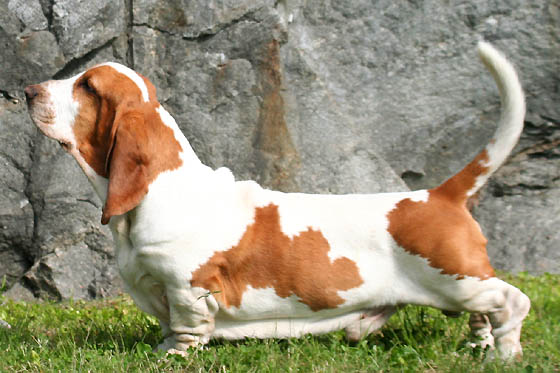
Basset Hound
The Basset Hound is a French scent hound built low to the ground so that a huntsman on foot could keep up with it, and it carries one of the finest noses of any breed. Its long…
About the Basset Hound
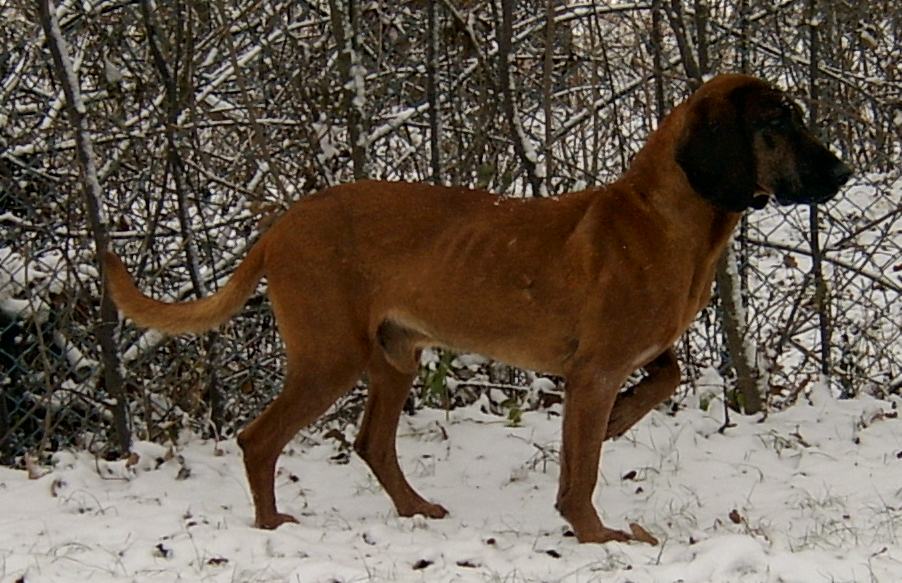
The Basset Hound is a French scent hound built low to the ground so that a huntsman on foot could keep up with it, and it carries one of the finest noses of any breed. Its long ears, loose skin and heavy bone are all part of the working design, and all need care in the way the breed is bred.
Bassets stand about 33 to 38 cm but weigh far more than their height suggests, and a fit dog with clean skin folds and a moderate outline is a better prospect than an exaggerated one. The Royal Kennel Club has asked the breed to move away from excessive skin, loose eyes and heavy bodies, and a responsible stud owner will show you a dog that reflects that. Colours are generally tricolour or lemon and white.
Eye health leads the list: ask for a current eye certificate with gonioscopy, because glaucoma is a serious concern in the breed, and whether the dog has been tested for the DNA marker associated with primary open-angle glaucoma. Ask about elbow scores, given the breed's front assembly, and about a history of back problems and ear infections in the line.
Health & breeding
We check every hip, elbow, eye and DNA result you give us against the Royal Kennel Club’s public records by hand, and we record who checked it and when. The Royal Kennel Club’s public records may not include all the screening a dog has had, so a dog with no Royal Kennel Club record showing is not necessarily untested.
Breed Right’s summary — under The Royal Kennel Club Health Standard
Health tests for the Basset Hound
This panel is Breed Right’s summary of the testing that matters for the breed under The Royal Kennel Club Health Standard. The Health Standard is the Royal Kennel Club’s guidance for breeders, not a registration rule. It describes tests to ask about — it is not a report on any individual dog. The Royal Kennel Club’s public records may not include all the screening a dog has had, so a dog with no Royal Kennel Club record showing is not necessarily untested.
Good Practice — the Royal Kennel Club’s minimum before breeding
The tests the Royal Kennel Club says breeders should, at a minimum, complete before breeding.
| Test | Type | Scheme | What’s involved |
|---|---|---|---|
| Eye testing (BVA/KC/ISDS) | Screening scheme | BVA/KC/ISDS | Result printed on the eye certificate. |
| Gonioscopy (BVA/KC/ISDS) | Screening scheme | BVA/KC/ISDS | Grade 1–3 on the certificate; 1 is normal or mild. |
Best Practice — further tests it recommends
Completing these as well as the Good Practice tests is what the Royal Kennel Club calls Best Practice.
| Test | Type | Scheme | What’s involved |
|---|---|---|---|
| DNA test — Lafora (Lafora’s Disease) | DNA test | Laboratory | The result printed on the laboratory certificate. |
| DNA test — POAG (Primary Open Angle Glaucoma, breed-specific variant) | DNA test | Laboratory | The result printed on the laboratory certificate. |
| Elbow grading (BVA/KC) | Screening scheme | BVA/KC | Grade 0–3. The dog is graded on the worse of the two elbows. |
Breed club schemes listed in the Health Standard
Run by the breed club, not the Royal Kennel Club, which does not record their results. The Standard lists them as schemes to be aware of.
| Test | Type | Scheme | What’s involved |
|---|---|---|---|
| Breed club health certificate | Other | Breed club | Which certificate, and its outcome. |
Breed hip median
Breed median 12 (BVA Hip Dysplasia Scheme breed statistics 2025 — 5 years, 14 dogs scored — indicative only, from a small sample). Lower is better. Source · How hip scores work
At stud now
Basset Hound stud dogs
No Basset Hound studs are listed right now
When a Basset Hound on the Royal Kennel Club Breed Register is listed at stud, it will appear here.
Also available
Basset Hound litters
No Basset Hound litters are listed right now
Litters appear here as breeders list them. Check back soon, or browse other breeds.