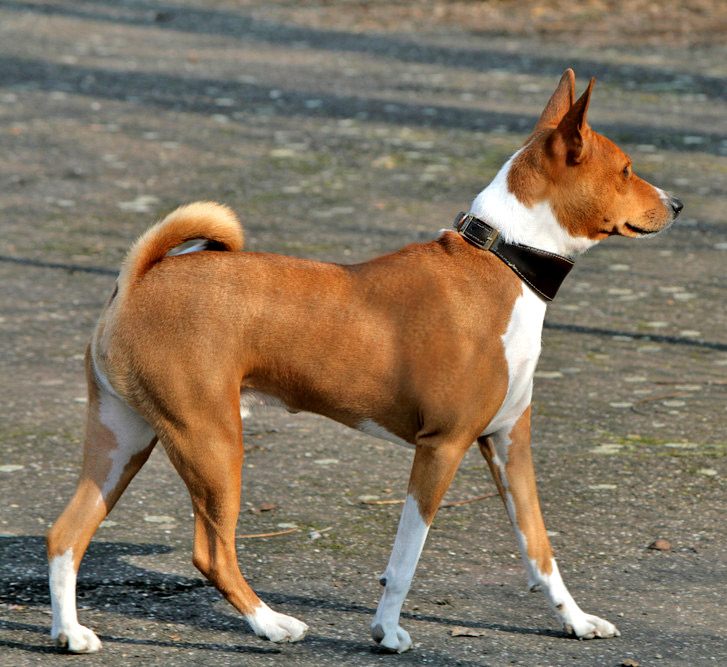
Basenji
Villagers in the Congo basin used the Basenji to drive game into nets, hunting by sight and scent together with a wooden bell at the neck so the hunter could keep track of it in…
About the Basenji
Villagers in the Congo basin used the Basenji to drive game into nets, hunting by sight and scent together with a wooden bell at the neck so the hunter could keep track of it in thick bush. The breed does not bark. The shape of its larynx produces a yodel instead, and it grooms itself much as a cat does.
A square, high-legged little dog of about 41 to 43 cm, smooth-coated in red, black, tricolour or brindle, always with white feet, chest and tail tip, a tightly curled tail and a wrinkled forehead over dark, almond eyes. Bitches in this breed usually come into season once a year rather than twice, a genuinely primitive trait that shapes any breeding plan around them. Nobody should expect biddability here; what to look for in a stud is soundness of mind and a dog that copes calmly with new people.
Three DNA tests carry real weight in this breed, and a serious owner will have used all three: Fanconi syndrome, a kidney disorder that was once the worst killer here, progressive retinal atrophy of the PRA-BJ1 form, and pyruvate kinase deficiency. Add hip scores and a current eye certificate. Immunoproliferative small intestinal disease has no test, so ask directly whether it has appeared in the line.
Health & breeding
We check every hip, elbow, eye and DNA result you give us against the Royal Kennel Club’s public records by hand, and we record who checked it and when. The Royal Kennel Club’s public records may not include all the screening a dog has had, so a dog with no Royal Kennel Club record showing is not necessarily untested.
Breed Right’s summary — under The Royal Kennel Club Health Standard
Health tests for the Basenji
This panel is Breed Right’s summary of the testing that matters for the breed under The Royal Kennel Club Health Standard. The Health Standard is the Royal Kennel Club’s guidance for breeders, not a registration rule. It describes tests to ask about — it is not a report on any individual dog. The Royal Kennel Club’s public records may not include all the screening a dog has had, so a dog with no Royal Kennel Club record showing is not necessarily untested.
Best Practice — further tests it recommends
Completing these as well as the Good Practice tests is what the Royal Kennel Club calls Best Practice.
| Test | Type | Scheme | What’s involved |
|---|---|---|---|
| Eye testing (BVA/KC/ISDS) | Screening scheme | BVA/KC/ISDS | Result printed on the eye certificate. |
Breed hip median
Breed median 7 (BVA Hip Dysplasia Scheme breed statistics 2025 — 5 years, 11 dogs scored — indicative only, from a small sample). Lower is better. Source · How hip scores work
At stud now
Basenji stud dogs
No Basenji studs are listed right now
When a Basenji on the Royal Kennel Club Breed Register is listed at stud, it will appear here.
Also available
Basenji litters
No Basenji litters are listed right now
Litters appear here as breeders list them. Check back soon, or browse other breeds.