Miniature Bull Terrier
The Miniature Bull Terrier is the same dog as its larger relative in every respect except height, which the standard caps at 35.5 cm, and it has been registered as a breed in its…
About the Miniature Bull Terrier
The Miniature Bull Terrier is the same dog as its larger relative in every respect except height, which the standard caps at 35.5 cm, and it has been registered as a breed in its own right since 1939. The two are not interbred, so a Miniature litter comes from Miniature parents on both sides.
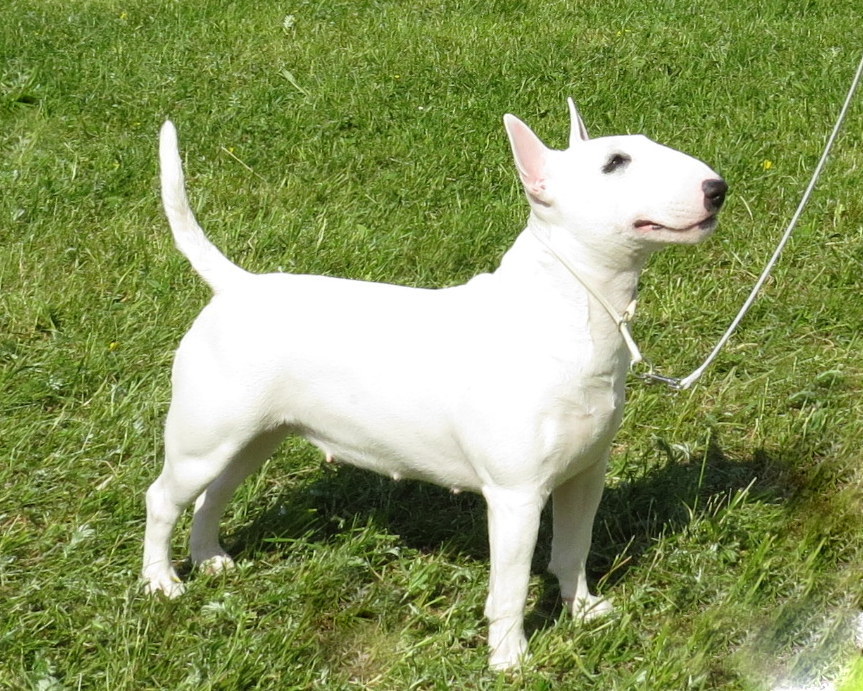
Everything about the type should read as a scaled version of the larger dog: the egg-shaped, down-faced head with no stop, the small triangular eye, the erect ear and the muscular, well-filled body. Colour may be white or coloured, brindle preferred among the coloureds. A stud should be balanced and free-moving rather than merely small, and an undersized dog with a poor head is not the same thing as a good miniature.
Primary lens luxation is the single most important test in this breed, it has a reliable DNA test, and no responsible owner will be surprised to be asked. Kidney disease matters here as well, so ask for a urine protein-to-creatinine ratio result and for a cardiac examination. Hearing should be checked by BAER, particularly in white dogs. A patella assessment and an annual eye examination round the list off.
Health & breeding
We check every hip, elbow, eye and DNA result you give us against the Royal Kennel Club’s public records by hand, and we record who checked it and when. The Royal Kennel Club’s public records may not include all the screening a dog has had, so a dog with no Royal Kennel Club record showing is not necessarily untested.
Breed Right’s summary — under The Royal Kennel Club Health Standard
Health tests for the Miniature Bull Terrier
This panel is Breed Right’s summary of the testing that matters for the breed under The Royal Kennel Club Health Standard. The Health Standard is the Royal Kennel Club’s guidance for breeders, not a registration rule. It describes tests to ask about — it is not a report on any individual dog. The Royal Kennel Club’s public records may not include all the screening a dog has had, so a dog with no Royal Kennel Club record showing is not necessarily untested.
Best Practice — further tests it recommends
Completing these as well as the Good Practice tests is what the Royal Kennel Club calls Best Practice.
| Test | Type | Scheme | What’s involved |
|---|---|---|---|
| DNA test — PLL (Primary Lens Luxation) | DNA test | Laboratory | The result printed on the laboratory certificate. |
| Eye testing (BVA/KC/ISDS) | Screening scheme | BVA/KC/ISDS | Result printed on the eye certificate. |
Breed club schemes listed in the Health Standard
Run by the breed club, not the Royal Kennel Club, which does not record their results. The Standard lists them as schemes to be aware of.
| Test | Type | Scheme | What’s involved |
|---|---|---|---|
| Heart testing (breed club scheme) | Other | Breed club | The club scheme’s own result, e.g. murmur grade. |
| Kidney testing (breed club scheme) | Other | Breed club | e.g. urine protein:creatinine ratio. |
Breed hip median
Too few dogs of this breed have been scored (BVA Hip Dysplasia Scheme breed statistics 2025 — 15 years: 3 dogs) to give a meaningful breed median. Source · How hip scores work
At stud now
Miniature Bull Terrier stud dogs
No Miniature Bull Terrier studs are listed right now
When a Miniature Bull Terrier on the Royal Kennel Club Breed Register is listed at stud, it will appear here.
Also available
Miniature Bull Terrier litters
No Miniature Bull Terrier litters are listed right now
Litters appear here as breeders list them. Check back soon, or browse other breeds.