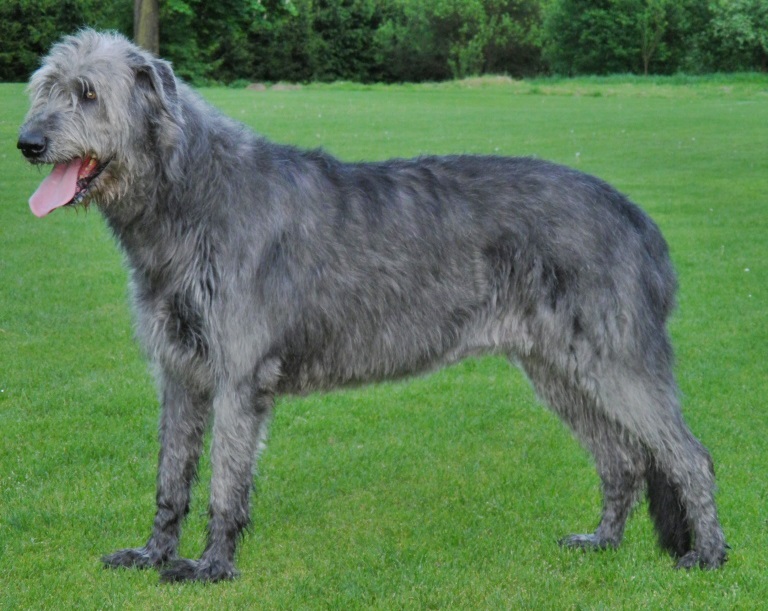
Irish Wolfhound
Ancient Ireland used the Irish Wolfhound to bring down wolf and elk, and the breed was so prized that it was given as a gift between kings. It faded almost to nothing once the…
About the Irish Wolfhound
Ancient Ireland used the Irish Wolfhound to bring down wolf and elk, and the breed was so prized that it was given as a gift between kings. It faded almost to nothing once the wolves were gone, and the modern dog was reconstructed in the nineteenth century by Captain George Augustus Graham, who used Deerhound, Great Dane and Borzoi to rebuild the type.
The standard sets a minimum of 79 cm for dogs, and many stand considerably taller, under a rough, harsh coat, wiry over the eyes and jaw, in grey, brindle, red, black, white or fawn. What a stud should show is not simply size but balance: sound feet, a strong back, easy movement and the famously placid, courteous temperament that makes such a large animal manageable at all.
Lifespan is the hard truth of the breed, and the health conversation follows from it. Ask for a recent cardiac examination, because dilated cardiomyopathy and atrial fibrillation are established problems here. Ask about bloat and gastric torsion in the line, about bone cancer, and about liver shunt, which occurs often enough that many breeders bile-acid test their puppies before they leave. Hip and elbow scores and an eye certificate belong in the file too, along with a frank answer about how long the dog's parents lived.
Health & breeding
We check every hip, elbow, eye and DNA result you give us against the Royal Kennel Club’s public records by hand, and we record who checked it and when. The Royal Kennel Club’s public records may not include all the screening a dog has had, so a dog with no Royal Kennel Club record showing is not necessarily untested.
Breed Right’s summary — under The Royal Kennel Club Health Standard
Health tests for the Irish Wolfhound
This panel is Breed Right’s summary of the testing that matters for the breed under The Royal Kennel Club Health Standard. The Health Standard is the Royal Kennel Club’s guidance for breeders, not a registration rule. It describes tests to ask about — it is not a report on any individual dog. The Royal Kennel Club’s public records may not include all the screening a dog has had, so a dog with no Royal Kennel Club record showing is not necessarily untested.
Best Practice — further tests it recommends
Completing these as well as the Good Practice tests is what the Royal Kennel Club calls Best Practice.
| Test | Type | Scheme | What’s involved |
|---|---|---|---|
| Eye testing (BVA/KC/ISDS) | Screening scheme | BVA/KC/ISDS | Result printed on the eye certificate. |
Breed club schemes listed in the Health Standard
Run by the breed club, not the Royal Kennel Club, which does not record their results. The Standard lists them as schemes to be aware of.
| Test | Type | Scheme | What’s involved |
|---|---|---|---|
| Heart testing (breed club scheme) | Other | Breed club | The club scheme’s own result, e.g. murmur grade. |
| Liver shunt testing (breed club scheme) | Other | Breed club | Bile acid result under the club scheme. |
Breed hip median
Breed median 7 (BVA Hip Dysplasia Scheme breed statistics 2025 — 5 years, 13 dogs scored — indicative only, from a small sample). Lower is better. Source · How hip scores work
At stud now
Irish Wolfhound stud dogs
No Irish Wolfhound studs are listed right now
When an Irish Wolfhound on the Royal Kennel Club Breed Register is listed at stud, it will appear here.
Also available
Irish Wolfhound litters
No Irish Wolfhound litters are listed right now
Litters appear here as breeders list them. Check back soon, or browse other breeds.