Otterhound
Hunting otter along English rivers called for a hound that could swim for hours, work a scent through water and force its way along a bank, and the Otterhound was bred for exactly…
About the Otterhound
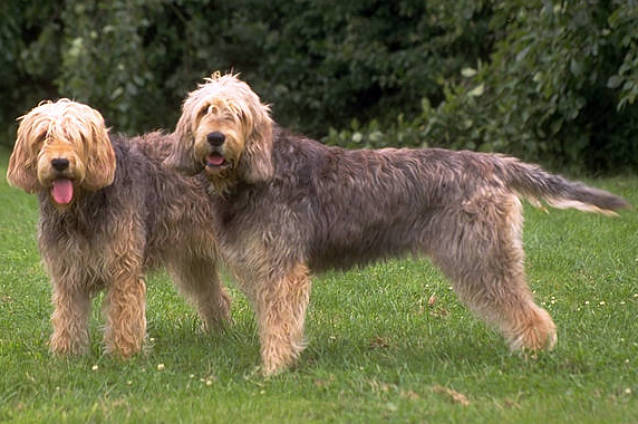
Hunting otter along English rivers called for a hound that could swim for hours, work a scent through water and force its way along a bank, and the Otterhound was bred for exactly that, with a dense oily double coat and webbed feet. When otter hunting ended the breed lost its purpose, and it is now among the most endangered of all native British breeds, with only a few hundred alive worldwide.
Dogs stand about 67 cm and are heavily built, with a rough, crisp outer coat over a woolly waterproof undercoat, in any hound colour. The head is large and long, the ears set low and hanging in folds, and the voice is deep and carrying. Otterhounds are boisterous and slow to mature, and a stud with a genuinely sound, friendly temperament and good hard feet is what the breed needs from its next generation.
The rarity is itself the central health issue: with so few breeding animals, the coefficient of inbreeding for any proposed mating deserves careful thought, and the breed clubs track this closely. Ask for hip and elbow scores under the BVA/KC schemes, since hip dysplasia is well recognised here. Ask too about the DNA test for the bleeding disorder Glanzmann's thrombasthenia, which has been identified in the breed, and about bloat and ear disease in close relatives.
Health & breeding
We check every hip, elbow, eye and DNA result you give us against the Royal Kennel Club’s public records by hand, and we record who checked it and when. The Royal Kennel Club’s public records may not include all the screening a dog has had, so a dog with no Royal Kennel Club record showing is not necessarily untested.
Breed Right’s summary — under The Royal Kennel Club Health Standard
Health tests for the Otterhound
This panel is Breed Right’s summary of the testing that matters for the breed under The Royal Kennel Club Health Standard. The Health Standard is the Royal Kennel Club’s guidance for breeders, not a registration rule. It describes tests to ask about — it is not a report on any individual dog. The Royal Kennel Club’s public records may not include all the screening a dog has had, so a dog with no Royal Kennel Club record showing is not necessarily untested.
Good Practice — the Royal Kennel Club’s minimum before breeding
The tests the Royal Kennel Club says breeders should, at a minimum, complete before breeding.
| Test | Type | Scheme | What’s involved |
|---|---|---|---|
| Hip score (BVA/KC) | Screening scheme | BVA/KC | Total of both hips, 0–106. Lower is better. |
| Elbow grading (BVA/KC) | Screening scheme | BVA/KC | Grade 0–3. The dog is graded on the worse of the two elbows. |
Best Practice — further tests it recommends
Completing these as well as the Good Practice tests is what the Royal Kennel Club calls Best Practice.
| Test | Type | Scheme | What’s involved |
|---|---|---|---|
| DNA test — GT (Glanzmann’s Thrombasthenia) | DNA test | Laboratory | The result printed on the laboratory certificate. |
Breed hip median
Breed median 20 (BVA Hip Dysplasia Scheme breed statistics 2025 — 5 years, 29 dogs scored — indicative only, from a small sample). Lower is better. Source · How hip scores work
At stud now
Otterhound stud dogs
No Otterhound studs are listed right now
When an Otterhound on the Royal Kennel Club Breed Register is listed at stud, it will appear here.
Also available
Otterhound litters
No Otterhound litters are listed right now
Litters appear here as breeders list them. Check back soon, or browse other breeds.