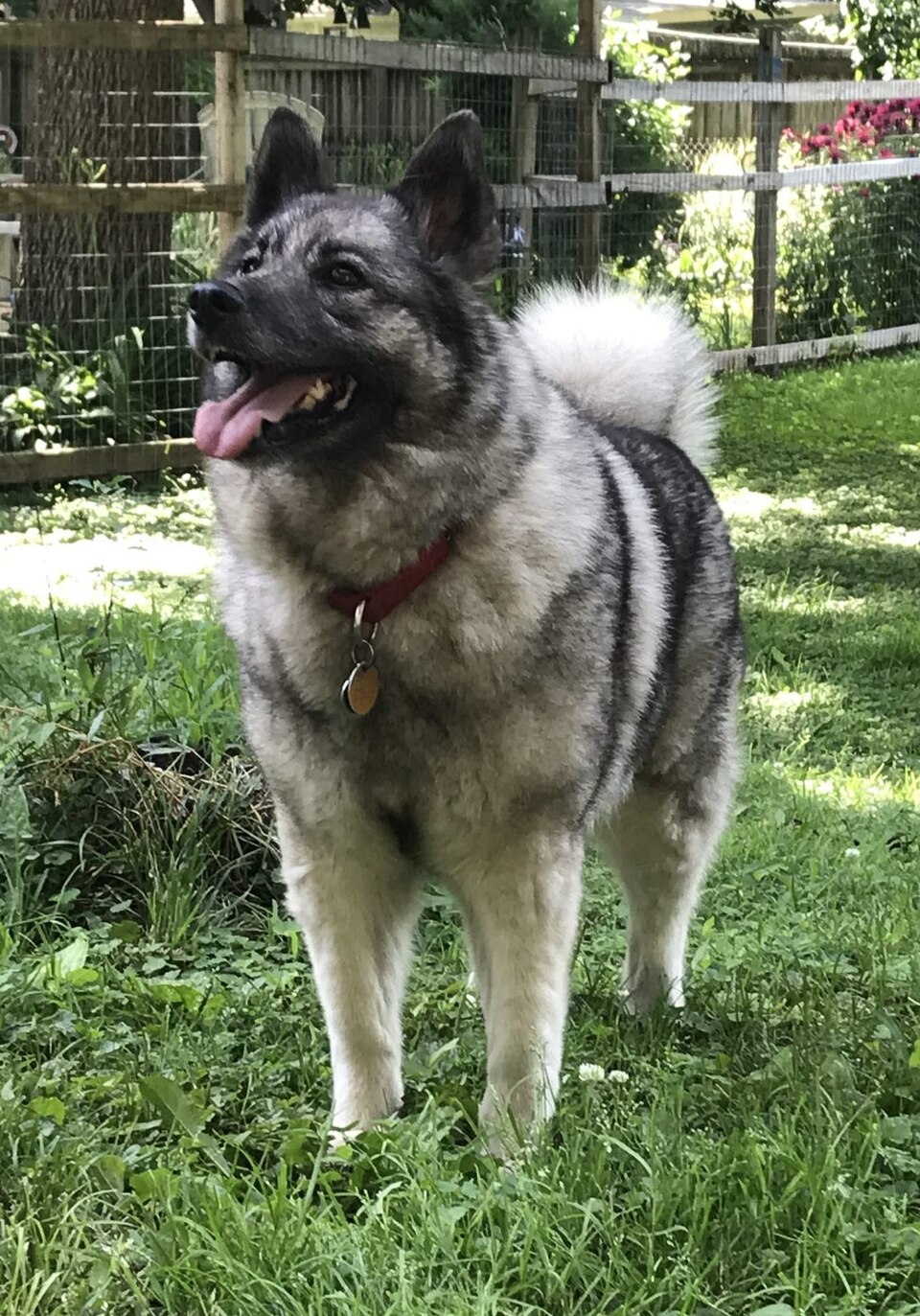
Norwegian Elkhound
For a thousand years and more, hunters in Norway have used the Norwegian Elkhound to find elk in forest, hold the animal at bay and bark steadily until the rifle comes up. That…
About the Norwegian Elkhound
For a thousand years and more, hunters in Norway have used the Norwegian Elkhound to find elk in forest, hold the animal at bay and bark steadily until the rifle comes up. That job explains everything about the breed: the stamina, the loud persistent voice, the weatherproof coat and a degree of independence that no amount of obedience training entirely removes.
It is a classic spitz, square and compact at about 49 to 52 cm, with pricked ears, a tightly curled tail and a thick grey double coat with black tips and lighter shading on the chest, legs and underside. The undercoat comes out twice a year in dramatic quantities. Elkhounds put on weight easily, so a stud in hard, fit condition says more than a heavy one, and the temperament should be confident and friendly rather than sharp.
Hip scores under the BVA/KC scheme are the first thing to ask for, as hip dysplasia has been a recognised issue in the breed. A current eye certificate with gonioscopy is worth having, since glaucoma and progressive retinal atrophy both occur here. Ask about kidney problems and thyroid function in the line, and about how the older relatives aged, since this is generally a long-lived breed and any short life in the pedigree is worth understanding.
Health & breeding
We check every hip, elbow, eye and DNA result you give us against the Royal Kennel Club’s public records by hand, and we record who checked it and when. The Royal Kennel Club’s public records may not include all the screening a dog has had, so a dog with no Royal Kennel Club record showing is not necessarily untested.
Breed Right’s summary — under The Royal Kennel Club Health Standard
Health tests for the Norwegian Elkhound
This panel is Breed Right’s summary of the testing that matters for the breed under The Royal Kennel Club Health Standard. The Health Standard is the Royal Kennel Club’s guidance for breeders, not a registration rule. It describes tests to ask about — it is not a report on any individual dog. The Royal Kennel Club’s public records may not include all the screening a dog has had, so a dog with no Royal Kennel Club record showing is not necessarily untested.
Good Practice — the Royal Kennel Club’s minimum before breeding
The tests the Royal Kennel Club says breeders should, at a minimum, complete before breeding.
| Test | Type | Scheme | What’s involved |
|---|---|---|---|
| DNA test — prcd-PRA (Progressive Retinal Atrophy) | DNA test | Laboratory | The result printed on the laboratory certificate. |
| DNA test — POAG (Primary Open Angle Glaucoma, breed-specific variant) | DNA test | Laboratory | The result printed on the laboratory certificate. |
Best Practice — further tests it recommends
Completing these as well as the Good Practice tests is what the Royal Kennel Club calls Best Practice.
| Test | Type | Scheme | What’s involved |
|---|---|---|---|
| DNA test — CDSL (Chondrodysplasia) | DNA test | Laboratory | The result printed on the laboratory certificate. |
| Hip score (BVA/KC) | Screening scheme | BVA/KC | Total of both hips, 0–106. Lower is better. |
| Eye testing (BVA/KC/ISDS) | Screening scheme | BVA/KC/ISDS | Result printed on the eye certificate. |
Breed hip median
Breed median 10 (BVA Hip Dysplasia Scheme breed statistics 2025 — 5 years, 58 dogs scored). Lower is better. Source · How hip scores work
At stud now
Norwegian Elkhound stud dogs
No Norwegian Elkhound studs are listed right now
When a Norwegian Elkhound on the Royal Kennel Club Breed Register is listed at stud, it will appear here.
Also available
Norwegian Elkhound litters
No Norwegian Elkhound litters are listed right now
Litters appear here as breeders list them. Check back soon, or browse other breeds.