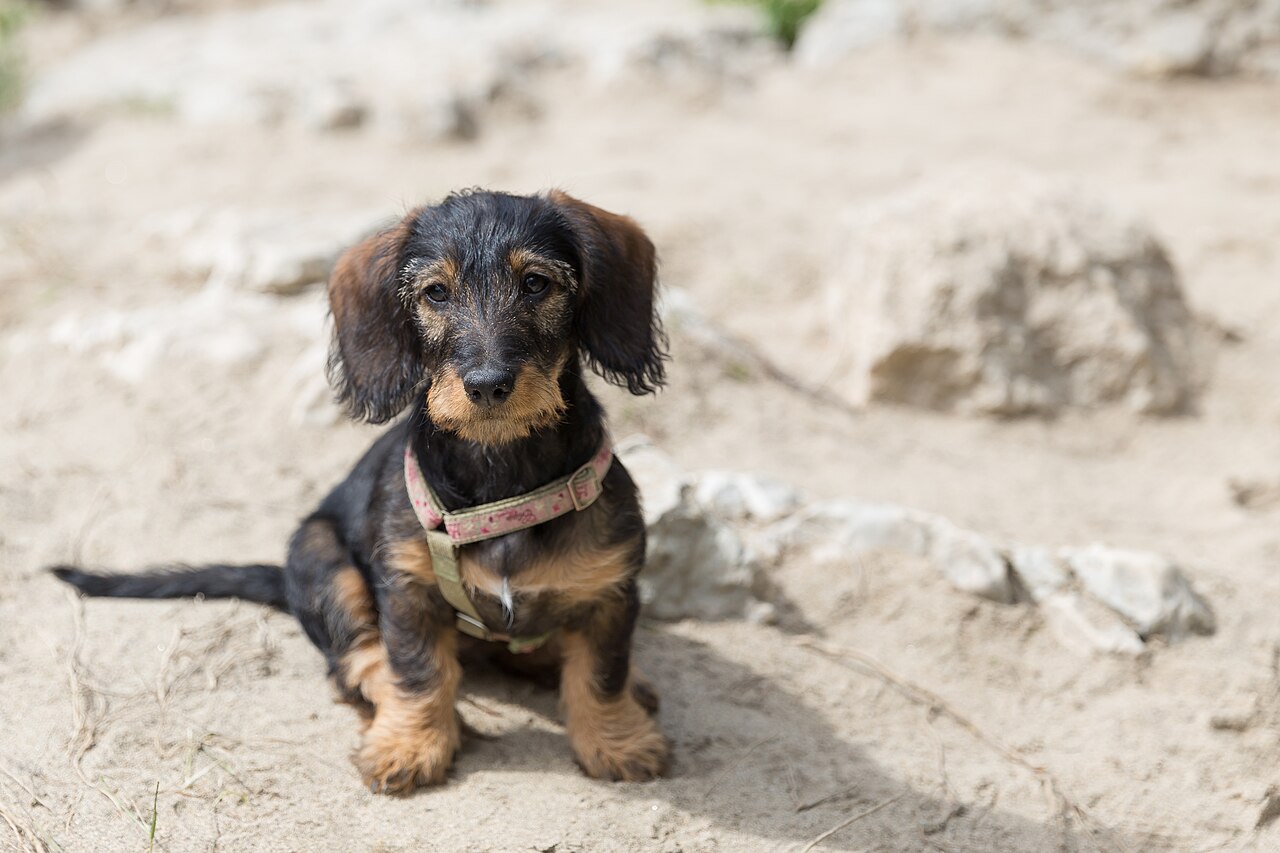
Miniature Wire Haired Dachshund
Wire hair and miniature size together make a tough, comic little hound, and the Miniature Wire-haired Dachshund is the variety most likely to still be working underground in…
About the Miniature Wire Haired Dachshund
Wire hair and miniature size together make a tough, comic little hound, and the Miniature Wire-haired Dachshund is the variety most likely to still be working underground in Europe. It is registered separately in Britain, with an ideal weight in the region of 4.5 to 5 kg and all the courage of the full-sized dog.
The jacket is short, harsh and dense with a good undercoat, finished with a beard and eyebrows that give the breed its cheerful, whiskery expression. Wild boar colouring is typical, along with red, black and tan and the various brindles and dapples. As in every Dachshund variety, two dapples must not be bred together. In a stud, look for a genuinely harsh coat, a level topline and free, ground-covering movement rather than an exaggeratedly low body.
This variety carries one test the others do not need to the same degree: the DNA test for Lafora disease, a late-onset inherited epilepsy, and no mating should be arranged without knowing both dogs' results. Add the breed council's IVDD spinal grade, taken after the dog is two, and a current eye certificate. Ask the owner which further DNA tests the breed clubs currently recommend, as the advice here is reviewed regularly.
Health & breeding
We check every hip, elbow, eye and DNA result you give us against the Royal Kennel Club’s public records by hand, and we record who checked it and when. The Royal Kennel Club’s public records may not include all the screening a dog has had, so a dog with no Royal Kennel Club record showing is not necessarily untested.
Breed Right’s summary — under The Royal Kennel Club Health Standard
Health tests for the Miniature Wire Haired Dachshund
This panel is Breed Right’s summary of the testing that matters for the breed under The Royal Kennel Club Health Standard. The Health Standard is the Royal Kennel Club’s guidance for breeders, not a registration rule. It describes tests to ask about — it is not a report on any individual dog. The Royal Kennel Club’s public records may not include all the screening a dog has had, so a dog with no Royal Kennel Club record showing is not necessarily untested.
Good Practice — the Royal Kennel Club’s minimum before breeding
The tests the Royal Kennel Club says breeders should, at a minimum, complete before breeding.
| Test | Type | Scheme | What’s involved |
|---|---|---|---|
| DNA test — Lafora (Lafora’s Disease) | DNA test | Laboratory | The result printed on the laboratory certificate. |
| IVDD spine screening (RKC scheme, Dachshund Health UK) | Screening scheme | RKC | Grade 0–3 from one X-ray at 24–48 months. |
Best Practice — further tests it recommends
Completing these as well as the Good Practice tests is what the Royal Kennel Club calls Best Practice.
| Test | Type | Scheme | What’s involved |
|---|---|---|---|
| DNA test — cord1-PRA (Progressive Retinal Atrophy, cone-rod dystrophy 1) | DNA test | Laboratory | The result printed on the laboratory certificate. |
| Eye testing (BVA/KC/ISDS) | Screening scheme | BVA/KC/ISDS | Result printed on the eye certificate. |
Breed hip median
Too few dogs of this breed have been scored (BVA Hip Dysplasia Scheme breed statistics 2025 — 5 years: 1 dog) to give a meaningful breed median. Source · How hip scores work
At stud now
Miniature Wire Haired Dachshund stud dogs
No Miniature Wire Haired Dachshund studs are listed right now
When a Miniature Wire Haired Dachshund on the Royal Kennel Club Breed Register is listed at stud, it will appear here.
Also available
Miniature Wire Haired Dachshund litters
No Miniature Wire Haired Dachshund litters are listed right now
Litters appear here as breeders list them. Check back soon, or browse other breeds.