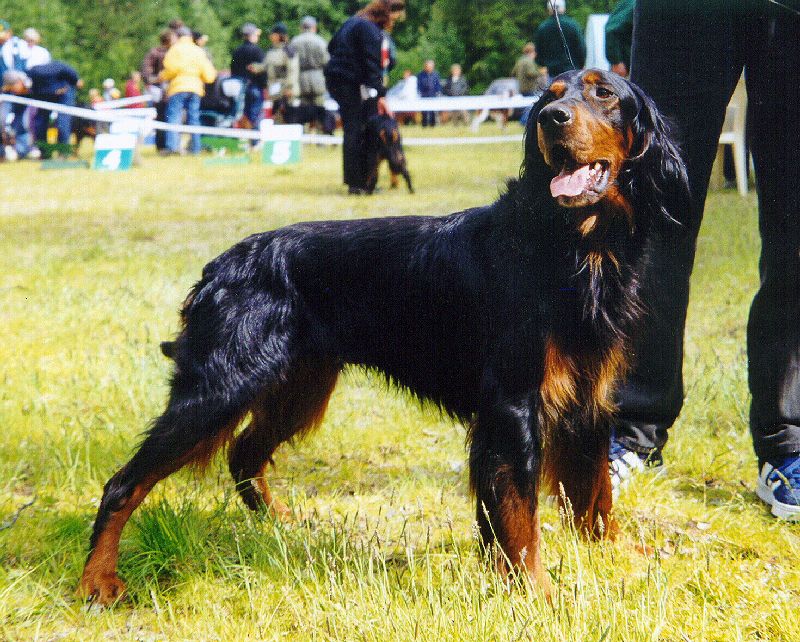
Gordon Setter
The Gordon Setter is Scotland's setter, built heavier than the English and the Irish, and named for the Duke of Gordon, whose Banffshire kennel fixed the black and tan colour…
About the Gordon Setter
The Gordon Setter is Scotland's setter, built heavier than the English and the Irish, and named for the Duke of Gordon, whose Banffshire kennel fixed the black and tan colour early in the nineteenth century. It hunts more deliberately than the other setters and has the stamina for a long day on high ground.
Colour is a shining coal black with rich chestnut markings in a precise pattern over the eyes, on the muzzle, chest and legs; dogs stand about 66 cm and weigh in the region of 29.5 kg, with long, straight feathering. Gordons mature slowly and can become one-person dogs, so a stud that is sociable and confident with strangers is worth going out of your way for.
This breed has a DNA test for rcd4 progressive retinal atrophy, a late-onset form that will not show on an eye examination in a young dog, and it is the single most useful result a Gordon stud owner can show. A DNA test for hereditary cerebellar degeneration is also used in the breed. Add hip scores and an annual eye certificate, and ask about bloat, a genuine risk in a deep-chested setter.
Health & breeding
We check every hip, elbow, eye and DNA result you give us against the Royal Kennel Club’s public records by hand, and we record who checked it and when. The Royal Kennel Club’s public records may not include all the screening a dog has had, so a dog with no Royal Kennel Club record showing is not necessarily untested.
Breed Right’s summary — under The Royal Kennel Club Health Standard
Health tests for the Gordon Setter
This panel is Breed Right’s summary of the testing that matters for the breed under The Royal Kennel Club Health Standard. The Health Standard is the Royal Kennel Club’s guidance for breeders, not a registration rule. It describes tests to ask about — it is not a report on any individual dog. The Royal Kennel Club’s public records may not include all the screening a dog has had, so a dog with no Royal Kennel Club record showing is not necessarily untested.
Good Practice — the Royal Kennel Club’s minimum before breeding
The tests the Royal Kennel Club says breeders should, at a minimum, complete before breeding.
| Test | Type | Scheme | What’s involved |
|---|---|---|---|
| DNA test — rcd4-PRA (Progressive Retinal Atrophy, rod-cone dysplasia 4) | DNA test | Laboratory | The result printed on the laboratory certificate. |
| Hip score (BVA/KC) | Screening scheme | BVA/KC | Total of both hips, 0–106. Lower is better. |
Best Practice — further tests it recommends
Completing these as well as the Good Practice tests is what the Royal Kennel Club calls Best Practice.
| Test | Type | Scheme | What’s involved |
|---|---|---|---|
| Elbow grading (BVA/KC) | Screening scheme | BVA/KC | Grade 0–3. The dog is graded on the worse of the two elbows. |
| Eye testing (BVA/KC/ISDS) | Screening scheme | BVA/KC/ISDS | Result printed on the eye certificate. |
Breed hip median
Breed median 10 (BVA Hip Dysplasia Scheme breed statistics 2025 — 5 years, 239 dogs scored). Lower is better. Source · How hip scores work
At stud now
Gordon Setter stud dogs
No Gordon Setter studs are listed right now
When a Gordon Setter on the Royal Kennel Club Breed Register is listed at stud, it will appear here.
Also available
Gordon Setter litters
No Gordon Setter litters are listed right now
Litters appear here as breeders list them. Check back soon, or browse other breeds.