
German Shepherd Dog
The German Shepherd Dog was created in 1899 by Max von Stephanitz from the herding dogs of Germany, with the deliberate aim of a versatile working dog, and it went on to become…
About the German Shepherd Dog
The German Shepherd Dog was created in 1899 by Max von Stephanitz from the herding dogs of Germany, with the deliberate aim of a versatile working dog, and it went on to become the police, military and guide dog of the twentieth century. The breed standard prizes a self-assured, even temperament, and that is the first thing to look for in a stud.
Two coat lengths are registered together in Britain, the short and the long, and two very different populations exist: show-line dogs bred to the ring, and working-line dogs bred for sport and service. The show line has attracted criticism for exaggerated hind angulation, and a stud that stands and moves soundly is worth more than one with a fashionable outline. Dogs stand about 60 to 65 cm.
Screening to ask about begins with hips and elbows, both under the BVA/KC schemes, and the breed's own DNA tests: degenerative myelopathy and, for a male, haemophilia A. Ask a stud owner about anal furunculosis and about epilepsy in the dog's close relatives. A dog that has been assessed for character under a breed survey or working test tells you more about temperament than any pedigree can.
Health & breeding
We check every hip, elbow, eye and DNA result you give us against the Royal Kennel Club’s public records by hand, and we record who checked it and when. The Royal Kennel Club’s public records may not include all the screening a dog has had, so a dog with no Royal Kennel Club record showing is not necessarily untested.
Breed Right’s summary — under The Royal Kennel Club Health Standard
Health tests for the German Shepherd Dog
This panel is Breed Right’s summary of the testing that matters for the breed under The Royal Kennel Club Health Standard. The Health Standard is the Royal Kennel Club’s guidance for breeders, not a registration rule. It describes tests to ask about — it is not a report on any individual dog. The Royal Kennel Club’s public records may not include all the screening a dog has had, so a dog with no Royal Kennel Club record showing is not necessarily untested.
Good Practice — the Royal Kennel Club’s minimum before breeding
The tests the Royal Kennel Club says breeders should, at a minimum, complete before breeding.
| Test | Type | Scheme | What’s involved |
|---|---|---|---|
| Hip score (BVA/KC) | Screening scheme | BVA/KC | Total of both hips, 0–106. Lower is better. |
| Elbow grading (BVA/KC) | Screening scheme | BVA/KC | Grade 0–3. The dog is graded on the worse of the two elbows. |
Best Practice — further tests it recommends
Completing these as well as the Good Practice tests is what the Royal Kennel Club calls Best Practice.
| Test | Type | Scheme | What’s involved |
|---|---|---|---|
| DNA test — DM (Degenerative Myelopathy, SOD1 risk test) | DNA test | Laboratory | SOD1 risk test: clear, carrier or at risk (affected). |
| Eye testing (BVA/KC/ISDS) | Screening scheme | BVA/KC/ISDS | Result printed on the eye certificate. |
Breed club schemes listed in the Health Standard
Run by the breed club, not the Royal Kennel Club, which does not record their results. The Standard lists them as schemes to be aware of.
| Test | Type | Scheme | What’s involved |
|---|---|---|---|
| Haemophilia testing (breed club scheme) | Other | Breed club | Club scheme result. |
Breed hip median
Breed median 11 (BVA Hip Dysplasia Scheme breed statistics 2025 — 5 years, 2,448 dogs scored). Lower is better. Source · How hip scores work
At stud now
German Shepherd Dog stud dogs
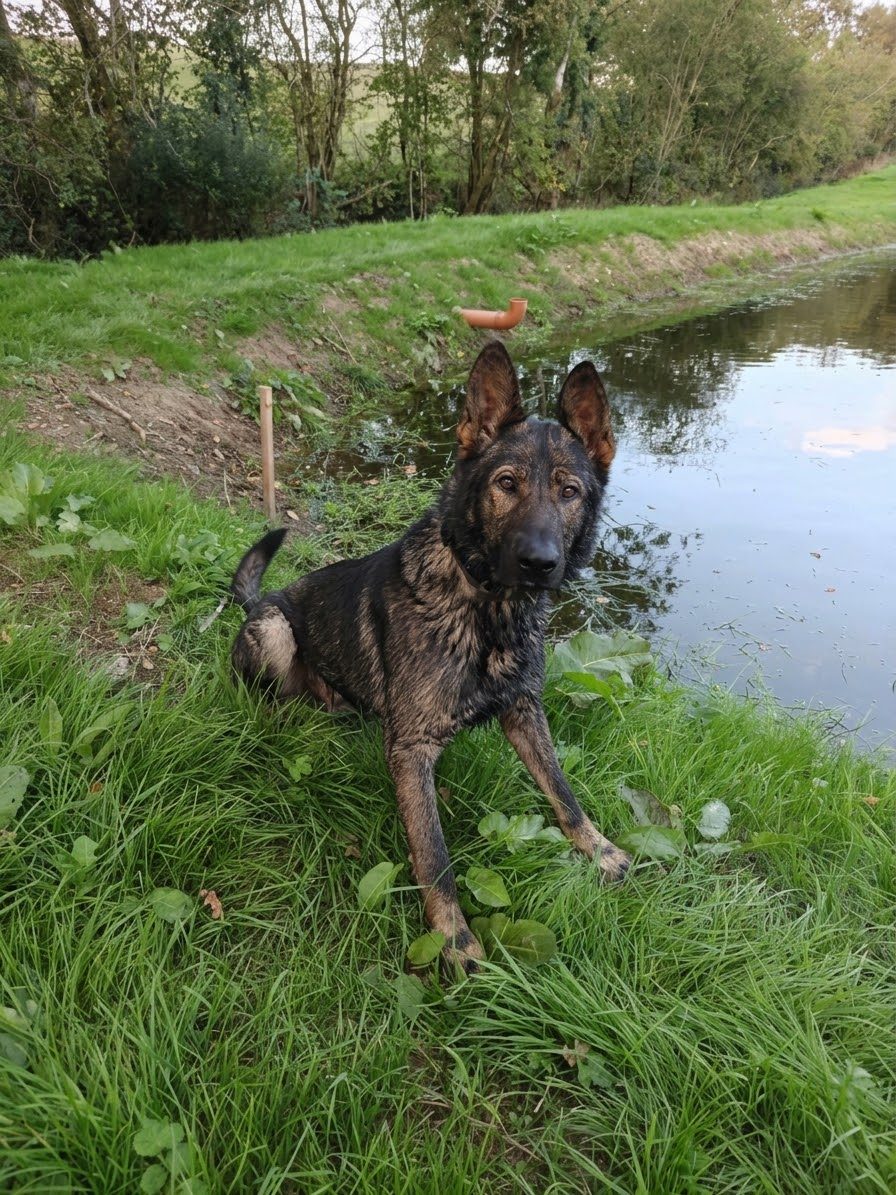
Every stud dog on Breed Right is on the Royal Kennel Club Breed Register. The Royal Kennel Club also runs an Activity Register, which is open to any dog including crossbreeds — those dogs cannot be listed at stud here. Results marked Verified were checked by us against the Royal Kennel Club’s public records; results we have not yet checked are not shown.
Also available
German Shepherd Dog litters
No German Shepherd Dog litters are listed right now
Litters appear here as breeders list them. Check back soon, or browse other breeds.


